
Reddit Reports A 75% Boost In Q1 Ad Revenue As It Reaches For 100 Million Daily US Users
Generative AI search has pushed traffic off a cliff across most of the internet, but not on social platforms. Reddit included.

Generative AI search has pushed traffic off a cliff across most of the internet, but not on social platforms. Reddit included.

Brave’s chief of ads Jean-Paul Schmetz on competition in the search and browser markets, the fallout from the Google Search antitrust ruling and whether AI search will help smaller upstarts compete with Big Tech.

Should businesses start advertising on AI media platforms? Yes. But it depends on how consumers in your category are already using AI and how quickly your organization can respond.

Freestar CEO Kurt Donnell explains why transparency in programmatic advertising is the open web’s best bet for survival in the AI search era.

For brands, this opens a new lever beyond impressions. For publishers, this is a business problem, as their first-party data and on-site inventory could become less valuable for targeting.

Reddit reported on Thursday $690 million in ad revenue for Q4 2025, a 75% YOY increase. But the company’s stock is down 38% over the past month.

People Inc. is offsetting a 50% decline in Google search traffic through off-platform growth and its highest digital revenue gains in five quarters.

Advertisers are still figuring out what value ChatGPT’s ads may offer. Are LLMs the next frontier for search, or a new channel entirely?

Big TV’s shift to programmatic brings in the performance brands; Meta rolls out premium subscriptions for Instagram, Facebook and WhatsApp; and Yahoo enters the crowded AI search market.

AirOps’ new Page360 platform helps brands update their content to better perform across traditional search, AI search and online forums.

Publishers have been losing 20%, 30% and in some cases even as much as 90% of their traffic and revenue over the past year due to the rise of zero-click AI search.

The era of “managed decline” is over; the era of existential clarity has begun. Publishers are no longer guessing what the post-platform world looks like. We are living in it.

From headline to punchline, AdExchanger’s weekly comics distill ad tech industry news into something our readers can laugh about. These are our faves of the year.
Enjoy this weekly comic strip from AdExchanger.com that highlights the digital advertising ecosystem …

AI shopping agents are breaking the traditional attribution loop. Marketers must ensure that AI is aware of their brand and track how that awareness influences ecommerce outcomes.

Publisher comment sections remain an untapped source of intent-based data, according to Kelly Andresen, who recently left USA Today to head up comment monetization platform OpenWeb’s direct sales efforts.

Newsweek launches an AI-powered homepage to offset traffic losses from AI search; OpenAI pulls an emergency pivot back to focusing on ChatGPT; and copycats dilute the impact of Spotify Wrapped.

You can’t buy your way to the top of a large-language model. At least not yet. But there are things that brands can do to influence how – and if – they get mentioned, says Tracy Morrissey, SVP of media and performance at full-service agency Innocean USA.
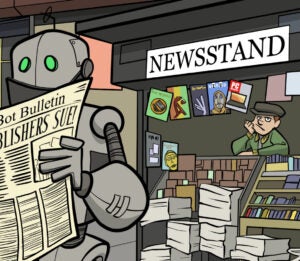
Adobe acquires SEO tech business Semrush; brands want to know what AI search engines think of them; and the LGBTQ community is an under-targeted audience.
There’s no magic bullet for AI search optimization; how kids’ media monetizes outside of YouTube; and hey, whatever happened to the TikTok ban?

Traffic-starved publishers are hopeful that their long-undervalued audience data will fuel advertising’s automated future – if only they can finally wrest control of the industry narrative away from ad tech middlemen.

While Reddit had plenty to crow about on the advertising front, it was less sanguine about the rise of generative AI search, which CEO Steve Huffman said is “not a traffic driver today.”

Walmart’s AI shopping deal with ChatGPT might ding its retail media biz; the MRC shares updates on which platforms won and lost accreditation; and kids’ sports streaming is becoming a real media channel.

The fate of the open web will be decided on who controls the data that drives monetization and the AI that determines distribution. Google controls both, and proposed remedies to its ad tech monopoly do not address this imbalance.

The layoffs reflect a strategic decision on People Inc.’s part to free up money to invest in growth areas, according to CEO Neil Vogel’s memo to employees.
Publishers must coalesce to gain a credible bargaining position and stop the bleeding caused by AI search. From there, we must put the processes in place to actually operate a licensing mechanism.

ChatGPT and others continued the fragmentation of the search journey, which today hops between platforms and intents. The funnel no longer exists. Here’s how to pivot your brand’s SEO/GEO strategy.

The fundamental shift from traditional search to AI chatbots has major implications for the entire marketing organization, says Bluefish CEO Alex Sherman. If brands want control over how they appear in AI search results, they must think about the content they feed to large language models.
Spotlight recently partnered with Cheil UK to help the agency give its clients better insights that they can use to stand out in AI search.

Human-made content will remain the most important source of information for consumers online. And our appreciation for human expression will only grow as we experience derivative outputs created by AI models.