
I hate to be the bearer of bad news, but you’re not getting your clicks back.
Today, your customers can discover, decide and often convert without visiting your website. Google, TikTok, Instagram, YouTube, Amazon, Reddit and even voice assistants can frequently meet searchers’ needs, leaving all your hard work and effort for naught.
But “zero-click” is not a bug; it’s a feature. It also isn’t a new fad; it’s a two-decade trend that AI accelerated.

A short history of zero-click
Zero-click behavior, first coined by SparkToro, began long before ChatGPT or AI Overviews.
Just think back to the introduction of Google’s Featured Snippets, which extracted answers and pulled passages from relevant content, placing them at the very top of the search engine results page (SERP). And, more recently, Google AI Overviews (AIO) began synthesizing AI-generated answers above organic links.
As search was evolving, social media and ad platforms also prioritized keeping users engaged on their own platforms.
Facebook lowered the visibility of organic posts, and TikTok became a go-to search platform for younger audiences. Google’s dominance as a search engine hasn’t waned, but users have more options to discover content than ever before.
When ChatGPT and many others threw their hat in the ring, it continued the fragmentation of the search journey. Now, AI models can synthesize the world’s knowledge into a single, fast answer. This has led to a change in search behavior where people ask longer questions and expect a complete response, not a blue link.
Search journeys today
Today, search journeys hop between platforms and intents. The funnel no longer exists.
Consider the diagram below:
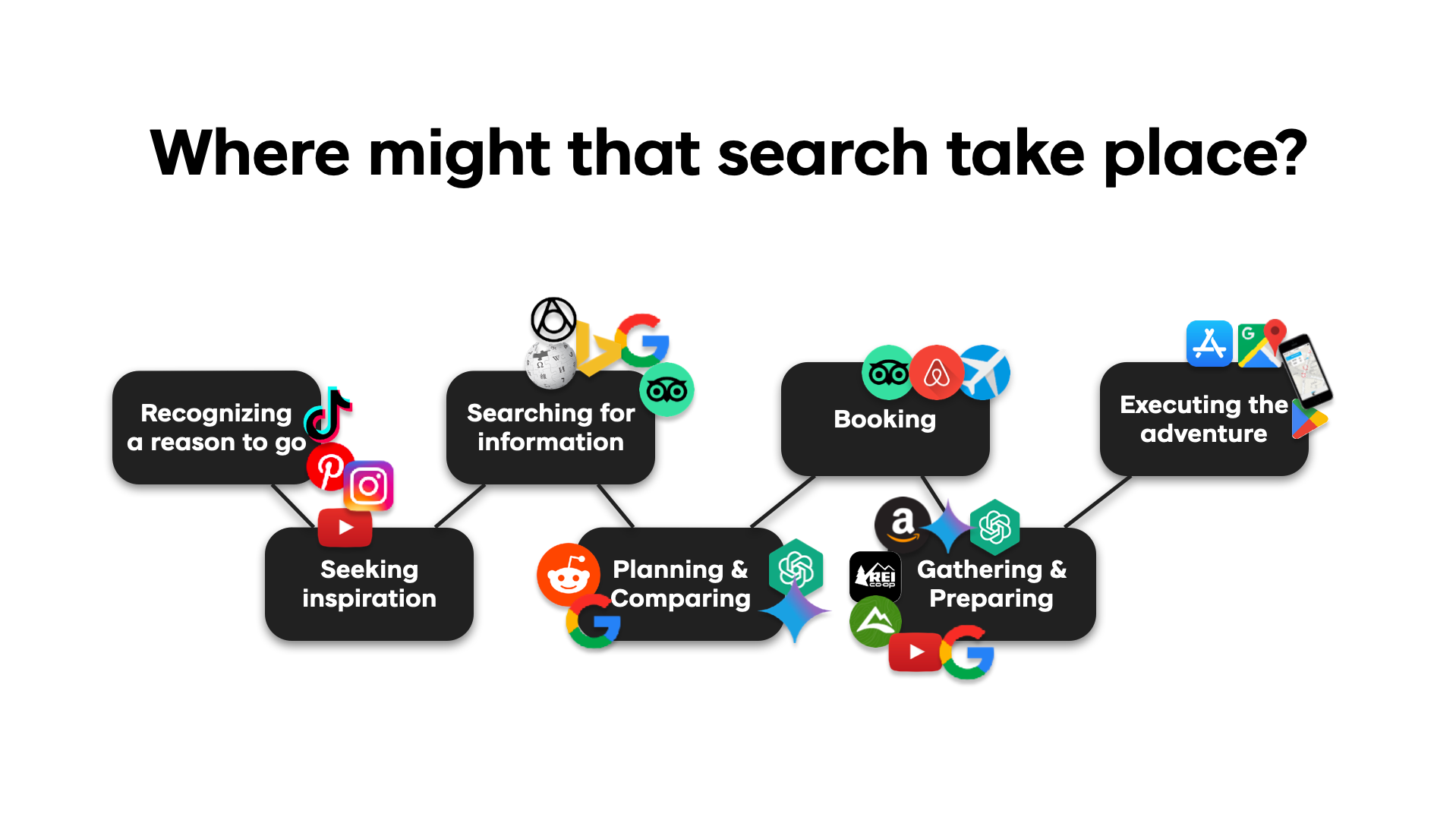
Each phase of a user’s search journey can happen in Google or Maps, social feeds, vertical engines, retail, app stores, communities, voice assistants and AI search. Successful content engagement comes down to understanding the target audiences and their preferences.
People turn to social and entertainment platforms like TikTok, YouTube, Pinterest and Instagram for trend discovery, creator-led reviews and visual inspiration. They browse retail search engines, such as Amazon, Walmart or Home Depot, when they’re closer to purchase and ready to compare prices, features and reviews.
In niche spaces, vertical engines like Yelp, Angi and Zillow offer experiences tailored to specific search intents. People trust communities like Reddit and Nextdoor for authentic, candid peer recommendations.
Meanwhile, AI tools like ChatGPT and Gemini are answering more questions each day.
But this fragmentation of the search journey has muddied how brands could measure performance.
A modern SEO value framework
To help capture ROI on your SEO/GEO investment, estimate a time to value or the length of time it takes for your SEO investment to begin delivering measurable business outcomes. Tracking this metric helps set organizational expectations and places the focus on quick wins or long-term gains. Be sure to tailor time to value to your own product pipeline.
Use these three pillars to help you thrive in a zero-click world.
1. Impression (visibility and presence)
Visibility metrics tell you how authoritative your brand is in the market. Does your site get mentioned in ChatGPT or AI Overview responses? Are you receiving citations? How frequently are you appearing in search experiences?
For older metrics, this would have been limited to keyword rankings and organic traffic. Today’s KPIs shift toward share of voice, SERP feature ownership, impression growth (especially non-branded), LLM mentions and NLP/AI readiness content scores.
Expected time to value: First lift in 30 to 60 days, with competitive presence solidifying in about 90 days.
2. Impact (outcomes and revenue)
Impact metrics show how your organic search strategy contributes to business growth, conversions and revenue, not just clicks. This is where marketers prove the commercial value of SEO by connecting audience reach to outcomes.
KPIs include organic key events (direct and assisted), branded search growth and transactions or revenue attributed to organic.
Expected time to value: Early signals in about 30 days, faster in shorter decision cycles.
3. Intelligence (marketing and content insight)
Search intelligence helps you discover new keyword clusters, audience intents and market trends. These insights strengthen content strategies by providing a feedback loop on messaging, positioning and unmet demand.
KPIs include keyword intent clustering, topic trend discovery and persona-aligned content opportunities.
Expected time to value: Continuously feeding strategy, content and product.
Build your practical playbook
Here’s some practical advice for updating your SEO/GEO strategy:
- Measure your organic search goals beyond clicks and sessions: track engagement and tie performance to outcomes.
- Optimize for “share of answer.” Structure content for FAQs, comparisons and local intent. Add schema markup. Aim for snippet inclusion: panels, map packs and AIOs.
- Find where your customers search. Treat YouTube, TikTok, Instagram and Pinterest as discoverable platforms, not just social shares.
- Adopt native conversion paths. Test lead-form extensions, bookings from ads, shops/checkout inside social and call-only where it fits, then reconcile those outcomes in reporting.
- Cluster by intent, not just keywords. Group topics around the phases of your journey and build connected content hubs.
- Tag everything. UTM rigor, custom events and CRM alignment make it so organic assists and cross-platform touches aren’t invisible.
Modern SEO/GEO is about earning visibility by being the most authoritative answer, providing impact toward real business goals and compounding intelligence across every discoverable search platform.
Zero-click search doesn’t mean zero value; it just means value is shifting beyond outdated KPIs.
“Data-Driven Thinking” is written by members of the media community and contains fresh ideas on the digital revolution in media.
Follow VML and AdExchanger on LinkedIn.