
Ahhh, “Diversity”
Google has often had to defend its generative AI search product, called AI Overviews (AIOs), to investors, long-tail publishers, large pubs, advertisers and regulators.
Two of Google’s most common refrains are that AIOs are simply superior answers (as in, fewer people click a link and immediately bail back to the Search page) and are also especially popular with younger consumers.
Fair enough.

But Google also maintains that AIOs link out to a “greater diversity of webpages.” That line is from a recent Financial Times interview with Elizabeth Reid, head of Google Search, though the same phrase has been used by other Google execs and in Reid’s own blog post announcing AIOs last year.
Most people would imagine a “greater diversity of webpages” to mean that more niche and/or sites overall are getting traffic. But Google must be using “greater diversity” as some internal term of art – because the reality is a far different story.
AIOs generate fewer clicks and index higher to its platform data partners, such as Reddit. But at least it’s popular with younger consumers.
The All-Ad Feed
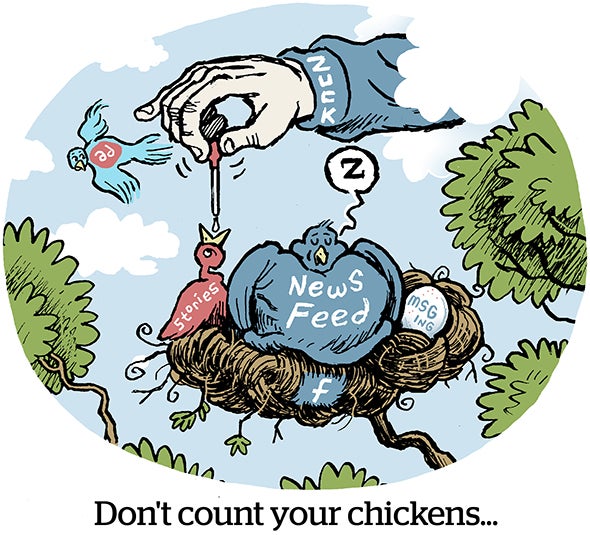
Mark Zuckerberg took the stand this week during the FTC’s antitrust trial over Meta’s acquisitions of Instagram and WhatsApp, Reuters reports. Zuck’s testimony offers revealing insights into how Meta – and the FTC – think about heavy ad loads.
For the FTC, the profusion of ads on Instagram after Meta (then Facebook) acquired the platform in 2012 proves that Meta has acted as a monopoly.
The FTC contends that the acquisition of Instagram reduced social media competition, thereby allowing Meta to change Instagram to benefit Meta rather than users. Namely, Meta jammed Instagram with ads.
The FTC argues that had Meta not acquired Instagram, then competition between the two platforms would have likely led to reduced ad loads over time in an attempt to win users.
Zuckerberg challenged the premise that users don’t like ads. He also emphasized that Instagram’s algorithm is designed to “show more ad content to people who like seeing ad content.”
Meta is so sure that some Instagram users enjoy seeing ads that the company even toyed with the idea of releasing an all-ad Instagram feed, according to Zuckerberg.
However, he added, although “we have discussed it at different points […] I don’t think we have done it.” (A little odd that a CEO doesn’t know whether his company ever released a product or not, but okay.)
Tariffs, Ands Or Buts
After a week of tariff flip-flops, are advertisers any more optimistic about potential ad spend growth this year?
Ehh, not exactly. Advertisers continue to spend conservatively, because it’s incredibly difficult to plan campaigns amid so much uncertainty, The New York Times reports.
Advertisers feel “paralyzed” and are locked in “wait and see” mode, says Forrester’s Jay Pattisall.
And even though most of President Trump’s tariffs are being temporarily held at the base 10% level, prognosticators are wavering on whether the US could be headed for a recession. That bodes ill for both consumer spending and ad budgets. Tariff talk will likely hang over next month’s upfronts like a storm cloud, dampening commitments to TV broadcasters.
For now, a few agency holding companies, including Omnicom and Publicis, have reported cautiously positive results. Although it’s worth noting that Q1 ended just before the true macroeconomic craziness began – so we may be witnessing the calm before the storm.
“We were planning for a glass that could be half empty,” said Omnicom CEO John Wren during the agency’s earnings report earlier this week. “But we’re personally striving for what we really believe and have believed for a long time, that we’re optimistic and that it will wind up half full.”
But Wait! There’s More
The Australian communications minister gave YouTube a personal guarantee that it would be exempt from the country’s new social media ban for people under 16. [Bloomberg]
The Dutch data protection authority sent a warning to 50 companies regarding what the agency sees as misleading cookie banners for data collection. [blog]
Apple rebrands its search ads business to “Apple Ads.” [9to5Mac]
CTV advertising will face a transparency reckoning, says David Nyurenberg, Rain the Growth Agency’s director of video product development and innovation. [Beet.TV]
You’re Hired!
Snap promotes Grace Kao to CMO. [Ad Age]
Strategic advisory firm Madison and Wall hires Greg McLelland as GM for Canada and CRO advisory practice lead. [release]
Madhive appoints Michael Kim as chief product officer and Laura Colona as chief of staff. [release]
Thanks for reading AdExchanger’s daily news round-up… Want it by email? Sign up here.









