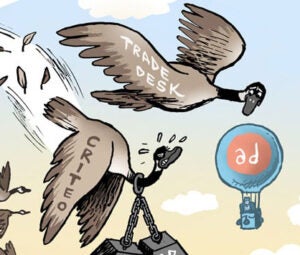
The Trade Desk Faces Headwinds As Investors Reconsider The Thesis Of Objective Indie Ad Tech
The Trade Desk, once a Wall Street darling, now faces the challenge of rebuilding goodwill across the investor community and the ad tech industry.
Last year was a massive success for Warner Bros. Discovery’s content – but maybe not so much for its financials.
LLMs now rely on YouTube as a top source for citations – and that includes sponsored creator content. Plus: Generative AI makes it easy for made-for-advertising publishers to expand their playbook.
Display advertising is old and busted. Streaming CTV is the new hotness. Obviously, those aren’t the exact words Magnite CEO Michael Barrett used, but it’s pretty much what the numbers say.
While the outcome of Paramount Skydance’s bid for Warner Bros. Discovery hangs in the balance, Paramount is laser-focused on driving streaming growth.
On Wednesday, and in time for the upfronts, Nielsen added more than 200 advanced audience segments in Nielsen ONE, its cross-platform analytics dashboard.
Ad verification used to be mostly about keeping brands away from the bad stuff. Now, verification providers have to prove that quality actually moves the needle, says Integral Ad Science CEO Lisa Utzschneider.
The future of publishing won’t be defined by where content lives, but by how it’s created, licensed, distributed and valued, writes David Kohl.
Buyers dig Netflix’s ad platform changes; OpenTable puts the “restaurant” in “RMN”; and Google and Amazon blame human error even when it’s AI’s fault.
Traffic didn’t drip. It dropped. In 2026, publishers are prioritizing stability over scale as AI, automation and curation reshape the sell side.
In pursuit of ad revenue, Dow Jones is betting on a tried-and-true strategy: direct relationships, first‑party audiences and a disciplined approach to using data to enrich ad campaigns.
59A develops brand algorithms by looking at both online and offline data points to determine who to reach and where to target them.
The future of retail media depends on a shift away from siloed in-store and online metrics to a full-funnel approach that reflects how customers actually shop.
WPP airs some dirty laundry; HubSpot buys itself a media brand; and data centers are more politically unpopular than ever.
Infillion, an ad tech business built on M&A, is back with another acquisition. This time it’s Catalina, a century-old market research and shopper marketing company with roots in physical cash register machines.
OpenX and Givsly’s new curation solution lets political campaigns reach voters based on data sourced from nonprofits, rather than traditional party affiliation.
As companies rush to roll out “helpful” AI bots, they’re inadvertently giving those agents broad access to sensitive data and opening the door to leaks.
What’s the deal with viral apps?; Dentsu and WPP are off of OpenPath; and AI coding has its downsides.
The Winter Olympics show us how far streaming live sports has come – and how much linear viewership remains. Plus: CPGs are pulling back on ad spend, as they steer through economic challenges and the ripple effects of policy decisions.
Luzia wanted ads that were specifically designed for an AI chat interface. It found a solution in generative AI ad network Koah.
Enjoy this weekly comic strip from AdExchanger.com that highlights the digital advertising ecosystem …
Agentic commerce can’t stop, won’t stop; Perplexity is officially done with its ads business; and AppLovin may launch its own social media platform.
“Fully a third of our profit in the most recent quarter was related to advertising and membership income,” Walmart CFO John David Rainey told investors on Thursday.
During his time as a New York financier, Jeffrey Epstein met and did business with dozens of other investors, entrepreneurs, tech founders and members of the elite. Which means it was inevitable that he would intersect with Ad Land at some point.
ICE wants to know how ad tech and location data could aid investigations. The question is: Will ad tech finally draw a line – or cross one?
Upstream, a supply-side company that until today was called TheViewPoint, introduced a platform that automates direct TV and streaming ad sales. The platform launch and company rebrand strive to highlight the role of TV and streaming as an upper-funnel awareness channel.
For most of the last decade, performance marketing was rewarded for momentum. Spend efficiently. Scale quickly. Optimize continuously. If the line went up and to the right, few questions followed. But that era is ending, because performance without accountability is no longer credible.
A 2004 statute prevents owning enough TV stations to reach 39% of households. But without the scale afforded to other digital content companies, local TV is at a competitive disadvantage.
Analog Intelligence The AI marketing boom is here. And not just for auto-generated creative or campaign optimization. San Francisco is one of the few places (besides airports) filled with B2B advertising on billboards. Good luck relaxing during a stroll with your iced coffee and Tartine pastry on a weekend, because you’ll walk or drive by […]
Omnicom just reported its first earnings since closing the IPG deal and, shocker, it’s saying AI is main growth driver for combined holdco.