This week, I’m ruminating on the word mirage.
It is a useful term for the ongoing debate over if and when agentic shopping – as in, people assigning agents the latitude and payment info to make purchases on their behalf – will actually happen. Unlike “illusion,” say, or a term like “potential” or “promise,” the “mirage” of agentic commerce denotes the truer and far greater anxiety that drives this trend for large software companies.
A potential mirage might save your life, if it proves true, or it might drag you deeper into the desert.
For companies like Shopify, Criteo and Instacart, and even for giants like Amazon and Walmart, all of which are all in on agentic commerce investments, figuring out if the agentic oasis is real and has a place for them is priority No. 1.

Reasons to believe
For every company that has a stake in the agentic commerce market, even in a third-party-vendor-type way, there are compelling reasons for the optimism behind agentic commerce.
Almost 20% of Amazon shoppers that engage with a brand via Rufus, its AI shopping agent, ask for more information about the brand, CEO Andy Jassy told investors during a quarterly earnings report last week.
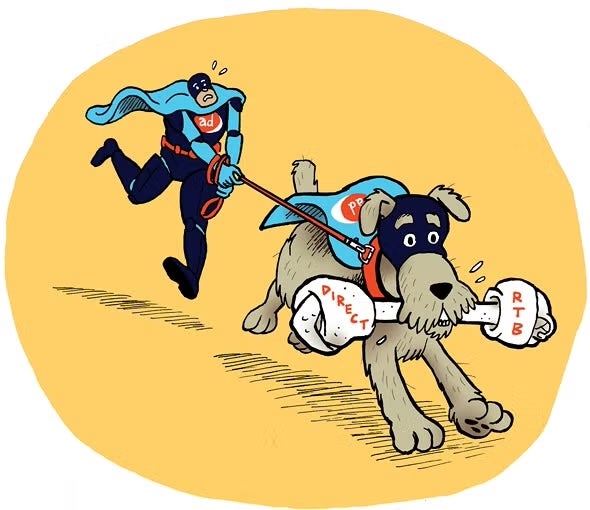
Walmart shoppers who engage in some way with its Sparky AI agent spend on average 35% more per order. (As an aside, I’m convinced the dog names for AI agents are to make all the AI ad products named “Max” look silly.)
During his quarterly earnings report this week, Shopify President Harley Finkelstein said, “What we’re seeing already in terms of the proof points is that orders from AI searches are up nearly 13x, AI-driven traffic to Shopify stores has grown 8x year over year and new buyer orders from AI searches are actually occurring at nearly twice the rate of traditional organic search.”
Shaky agents
The agentic shopping experience is poor right now. But that’s not necessarily bad for all commerce tech companies with agentic shopping ambitions.
“The experience just hasn’t gotten great with these third-party horizontal agents yet,” Jassy told investors regarding other agentic shopping services, while discussing the major LLMs. “They’re not often able to get the pricing right or the product information right. They don’t have any personalization data or any shopping history.”
And he’s right. As someone who also evaluates many agentic shopper bots, take it from me that there is a real function gap. AI-recommended products are often unavailable, or product info that’s confidently declared by the AI is incorrect.
For the likes of Criteo, Shopify and Instacart, which have vast product catalogues and up-to-date pricing and product info feeds, there’s a chance to offer their services.
Instacart CEO Chris Rogers, also speaking to investors this week, mentioned that one potential feature of its AI assistant is to flag to a shopper whether something in the cart has gluten in it. Instacart might know more about that shopper, and can do “a little bit more behind the scenes to help them” with those types of prompts.
Shopify’s Finkelstein said, “Traffic from catalogue-powered AI searches [as in, Shopify’s catalogue] converts 2x more than traffic from general AI searches where the agent is working from scraped or often outdated information from across the web.”
Who knows where that data comes from. But his point is that the big LLMs and other agentic services work by crawling and scraping, not through direct feeds set up by a merchant within a vendor’s system (à la Shopify, Criteo, et al).
Background AI
The word “mirage” may be a keen metaphor for agentic commerce, but “agentic commerce” itself is poorly termed.
People who engage with or purchase via Rufus or Sparky, or buy through a Shopify storefront on ChatGPT or Claude, might not self-describe the process as “agentic shopping.” They haven’t empowered a bot to do their research or use their credit card.
Rather than displace the incumbent players in ecommerce, this perspective makes AI more of a background force.
Perhaps the best example of that comes from Amazon itself. Users have begun spotting in the wild that Rufus is being tested for direct search bar queries.
Walmart’s Sparky is, likewise, sort of a notification feature that suggests new potential products in more effective ways than the standard sponsored product ad.
Daniel Danker, Walmart’s EVP of AI acceleration, product and design, said on stage at the Morgan Stanley Technology, Media & Telecom conference in March that one of Sparky’s benefits is, for instance, that it “pops up and says, ‘I notice you tend to buy the same items every week.’” Sparky might recommend laundry detergent seemingly out of the blue, except Walmart might know that customer tends to buy laundry detergent every 8 weeks, and it’s been 53 days.
Even for customers who have the Sparky in-app assistant built into ChatGPT, which Walmart announced this year, the conversions tend to happen when the shopper agent can step in and make a back-and-forth between the user and the AI into a shoppable moment.
Danker said the top two selling product types via the ChatGPT Sparky integration are protein supplements and vitamin supplements. What’s likely happening, he added, is that people are starting with prompts along the lines of, “I just started taking GLP-1s. What do I need to know?”
Eventually, that led to an opportunity for Sparky to interject. Good boy.
Real or not
The question of whether agentic commerce is a mirage probably comes down to whether your company can gain leverage to make a buck in this new media channel, if it usurps most general online searches.
Walmart, for instance, doesn’t have that much to sweat about.
For one thing, Walmart doesn’t mind a missed bet. It went all in on metaverse virtual reality shopping trends, back when Facebook was name-changing.
Since Walmart has the most money at the table, it’s always calling someone else’s all in and never putting itself truly at risk.
“Will there be some channel shift where maybe we’re disintermediated in some way and don’t control the customer experience?” Walmart CFO John Rainey said at the J.P. Morgan Retail Round Up Forum 2026 last month, when asked about the potential displacement of ad revenue and user control to AI companies.
“Yes, I would expect that,” he responded to his own hypothetical.
But even while some ad budgets may shift, he said, Walmart has better contextual information via AI searches that improve its ability to convert at a high ROAS. He gave the example of a sleeping bag purchase being as a result of a more involved prompt-based conversation about a hiking trip
“There are both puts and takes, I think, in this space,” he said.
For Criteo, which also boasts a first-of-its-kind integration with ChatGPT, the benefits are less real and tangible right now.
Last December, Criteo pre-release agentic advertising tests with an unnamed LLM were presented to press, and CEO Michael Komasinski acknowledged that Criteo and the LLM in question hadn’t even gotten close to what a potential payment model might look like. Would Criteo get paid on a performance model if it suggested a product that led to a conversion? Or a CPM model? Or perhaps a data-licensing arrangement, where its data contributes to the LLM’s decision like a publisher?
Criteo integrates with ChatGPT Ads on a CPM model, but its benchmark for success right now is how many clients it can onboard. Pointedly, the benchmarks are not revenue-related.
“Our guidance does not assume any material revenue contribution from agentic AI initiatives,” said Criteo CFO Sarah Glickman during a quarterly earnings this week.
Criteo wants to be one of the first on the wave. But it has to hope for a monetization framework to materialize soon to placate its investors.
One Instacart investor also asked about the risk-reward calculus with agentic partners, given that organic users of its app might be siphoned away and disintermediated.
“It’s still very early in engagement,” Rogers said. “But we are viewing this as an incremental demand channel in a very large and under-penetrated category.”
If online grocery adoption increases, whether by app, website or an AI chatbot, the trend should benefit Instacart, said the CEO.
The greater risk, perhaps, is in not rushing forward and being left behind when the monetization clicks into place.
“Our strategy here is pretty simple. We want to be wherever customers are,” he said.
Those customers, at least, are not a mirage.