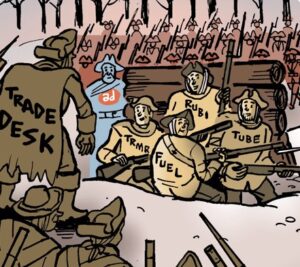
The Trade Desk made $689 million in Q1 2026, up 12% from the period last year, while its net income and profit margin dipped slightly to $40 million and 6%, respectively, according to its quarterly earnings report on Thursday.
The Trade Desk CEO Jeff Green warned of difficult macroeconomic headwinds that make for cautious marketers. And investors are taking the same cautious stance, with shares of TTD down by 15% in after-hours trading following the company’s earnings.
Green touched on some of the main growth channels that TTD mentions every quarter: namely, streaming TV and retail media. And, of course, AI received its fair share of attention.
But Green also laid the DSP’s plan for winning in a new world of advertising that, AI aside, would necessitate major changes in how marketers behave in the market today.
Green has made some successful contrarian bets in the past. He placed an early chip on the bet that Google would abandon its Privacy Sandbox and plans to remove third-party cookies from Chrome. Which, perhaps you’ve heard.
But in Thursday’s earnings call, he laid out perhaps his boldest forecast.

“We are convinced that the evolution and changes being made in the open internet today will make it soon become a place where, consistently, an advertiser’s first dollar is spent,” Green told investors.
If this became a reality, it would be a radical turnaround for marketers. The vast majority of online ad dollars go to walled gardens like Amazon, Google and Meta, which have been steadily increasing their share of spend in recent years.
“Once the open internet consistently gets the first dollar, most of the walled gardens will open up their inventory and join the open internet,” Green hypothesized. “I view this as inevitable.”
Right now, there is a deficit in ad budgets for publishers and media companies from the open internet – including the likes of Spotify and Disney, not just sites with banner ads. These sites, apps and TV networks have vast audiences and time, but do not monetize anywhere close to as effectively as walled gardens. Likewise, Green noted that Amazon’s 15% of US retail shopping represents far less purchase data than is combined from first-party retailers on TTD’s marketplace.
Despite his confidence, investors, especially bankers consolidating to seemingly safe equities during a period of public company instability, are not betting right now on the open internet to win back share from walled gardens.
If The Trade Desk is going to convince marketers to place their first dollars with the open internet, marketers themselves are going to have to change in a big way.
“Objectivity matters more than ever,” Green said. “In the best buyer’s market in history, it is important that your DSP does not own media.”
And beyond walled garden campaigns, he alluded to “fixed price deals that essentially allow sellers and publishers to offload the leftovers that don’t earn their keep,” an apparent reference to principal-based media buys. And the implication is that marketers, upon closer examination, will pull back hard on these types of campaigns. Although the major holdco agencies seem intent on growing their principal media revenue.
Green is banking on marketers to up their own game, in terms of programmatic knowledge, as well as enforcing changes at their agencies and pressing for transparency from data-driven ad platforms in ways that have never been the case before.
For one example, he said that “the best CMOs in the world are focused on the question, ‘How do I grow?’ not ‘How do I cut costs?’”
Although, the general CMO mantra right now seems to be “cut, cut, cut.”
In multiple conversations with Fortune 100-type CMOs, Green said the message has been of a sea change in terms of no longer chasing cheap reach or inventory.
One top-20 brand CMO told Green that “chasing cheap reach is one of the biggest landmines a CMO or digital marketer can pursue,” he said. “That mindset is what is driving the shift toward more data-driven decisions.”
Great CMOs can convey the complexity of programmatic to CFOs and CEOs without the industry jargon and acronym soup, he said.
And those types of CMOs could take the next step in making open programmatic tech their preferred online advertising vehicles rather than walled garden platforms.
“These are the leaders helping to shape the future of advertising,” he said.
If such CMOs exist, perhaps, in meaningful numbers, then Green might win his most contrarian bet yet.