Happy Q4 earnings season!
This is the time of year when the biggest brands disclose their full-year results and report on their make-or-break holiday seasons.
And it’s not been an easy few weeks for some of America’s biggest CPG brands.
Companies like Procter & Gamble, Pepsi and Colgate-Palmolive are contending with cautious consumers and shrinking margins. Cutting marketing spend has become the easiest and quickest way to protect profitability.
Here’s how Big CPG is coping with a challenging year in the North American market.

Out-of-control macros
Marketing budgets tend to face the greatest scrutiny because they’re one of the few line items executives can fully control.
The challenge for big US brands in 2026 is how much is totally outside of their control.
In Q4 2025, brands were hit by a perfect storm: a month-long government shutdown in October, significant cuts to SNAP (the federal food assistance program) that reduced grocery spending and, on top of it all, political turmoil tied to large-scale ICE deportation campaigns.
“What’s behind the slowdown in the category?” one investor asked Colgate-Palmolive CEO Noel Wallace.
The main culprit is “uncertainty,” Wallace responded. “We’ve seen, obviously, some softness in Hispanic cluster markets,” he added.
That “obviously” is pulling a lot of weight. Wallace and other CEOs and investors tip-toed around the issue of a major drop-off in spending by Spanish-speaking Americans.
In a follow-up question, another investor asked about how Colgate-Palmolive is rethinking its portfolio “in this kind of K-shape world we’re living in?”
“You’ve heard me consistently talk about where we under-indexed the most globally … on the super-premium side,” Wallace answered. A major focus moving forward will be to “get more of our fair share” in the upper part of the K shape.
But even good news can feel like a headwind. For instance, cocoa prices, which had soared for several years due to disastrous harvests in northwest Africa, which is where most of the world’s cocoa is from, have plunged precipitously in recent months.
Mondelez, one of the world’s largest cocoa buyers, had to somewhat bashfully admit to investors that, out of an abundance of caution due to years of price and supply volatility, it had already acquired its full 2026 cocoa supply. The problem is that it did so at last year’s prices. Mondelez won’t benefit from the price drop until 2027.
“I believe what the market is recognizing now is maybe a little bit overdue,” said Mondelez CFO and COO Luca Zaramella. “Obviously, we would have liked a little bit more of a balanced approach to the way down of cocoa.”
Learning from ecommerce
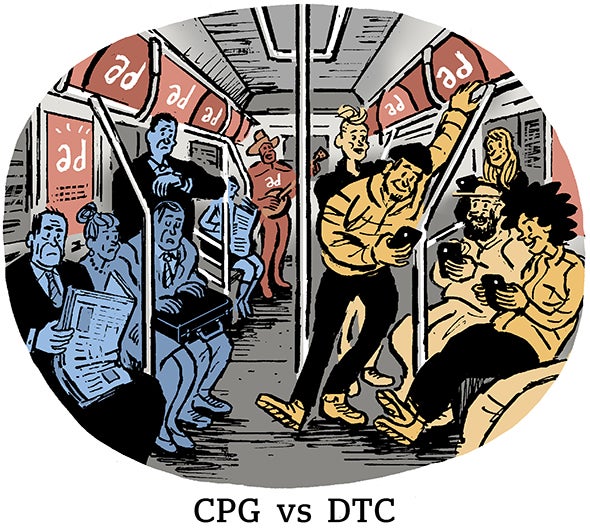
But there are a few bright spots to call out from recent earnings calls, including a shift in how big CPG brands view competition from DTC and ecommerce startups.
New digital-first brands in beauty and personal care, for example, often operate at premium price points, said P&G CFO Andre Schulten.
“That’s an opportunity for us to innovate,” Schulten said. By which he means by releasing higher-margin products that still undercut startups on price.
While startups generate compelling ideas at the “creative stage,” Schulten said – some of which P&G could replicate in its own product lines – they lack the scale, technology and marketing and supply-chain distribution to compete with P&G.
Coca-Cola CEO James Quincey echoed that sentiment at the Morgan Stanley Global Consumer & Retail Conference in December, noting that it’s easier than ever to launch a beverage or grocery brand and find third-party contracting for ecommerce fulfillment.
But “the barriers to scale are actually quite large,” he said. Very few succeed, and there is major churn among newcomers. “Add up the sum of all the small players,” he said, and the category hasn’t grown its share in the past decade.
Occasionally, Coca-Cola does what Quincey called “bolt-on M&A” – Fairlife and Topo Chico are standout examples – but he emphasized that the startup ecosystem primarily helps “drive up our success rate on innovation” by generating interesting new ideas. Startups simply can’t scale enough to compete with Coke.
The advertising angle
But for all the talk of innovation, the most visible form of “efficiency” many brands are embracing right now is cutting their ad budgets.
“It was prudent for us to scale back a little bit of the advertising given some of the headwinds that we saw in the categories,” said Colgate-Palmolive’s Wallace.
Not that there aren’t “areas of the world and brands” that will merit ad budget increases, he said. Moving forward, however, the focus will be “on driving efficiency through spend.”
Which is MBA speak for spending less.
Lauren Lieberman of Barclay’s Bank pressed PepsiCo’s leadership on a $500 million decrease in ad spend in 2025. “I would think advertising would go up,” she said, “and I’d love to hear more about it.”
“We did get some efficiency from both the working and nonworking advertising line,” acknowledged PepsiCo CFO Stephen Schmitt. (Meaning PepsiCo spent less on media and on data and media-related costs, such as tech and vendor fees.)
On the flip side, TD Cowen bank analyst Robert Moskow asked P&G about its higher rate of discounts and promotional sales, which went up considerably in Q4.
“The promotion read you’re getting is not wrong,” Schulten admitted. But many of the promos, he added, involved relatively small price discounts.
Those sales “show up in the promotion line,” he said, but don’t cost as much from a marketing perspective as the data might indicate.
And no wonder P&G feels the need to justify what looks like an increase in marketing spend as a percent of overall sales.
At Mondelez, advertising has been framed to investors as a tailwind because, well, it’s shrinking.
During the first half of 2025, “we were quite aggressive on promotions and on deals,” Mondelez CEO Dirk Van de Put told one investor who’d asked about challenges in North America. “I have to say it didn’t give us a return on our investment.”
Marketing investment may rise again in the coming year, Van de Put said. “But, overall, I would say [pulling back on advertising costs] probably was better for us.”