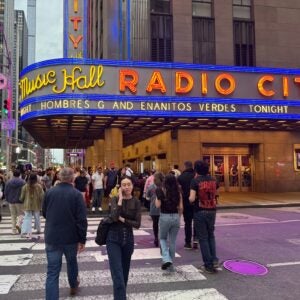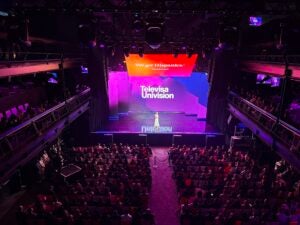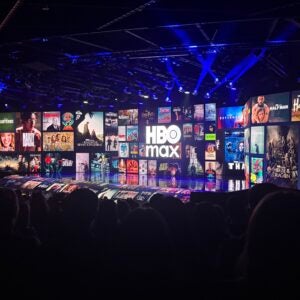
And that’s a wrap on Day One of upfronts 2026!
AdExchanger Senior Editor Alyssa Boyle and Associate Editor Victoria McNally traversed the island of Manhattan on Monday to scope out upfront presentations by NBCUniversal, Fox and Amazon.
So, what was their message to marketers? Performance, performance, performance.
NBCU, Fox and Amazon spent their stage time pitching themselves to media buyers as the most uniquely positioned to help drive the outcomes marketers want.
Here are the highlights.
NBCUniversal: Leading with its scripted content, NBCU’s upfront event focused heavily on its breadth of IP as a legacy media company, aligning nicely with NBCU’s celebration of its 100th birthday.
NBCU positioned the pairing of its media portfolio with ad tech as a way to drive ad performance, including a newish NBCU capability that allows marketers to retarget viewers on linear TV. It also highlighted new contextual advertising and outcomes-based measurement capabilities.
Fox: Aside from touting its sports and news portfolio, Fox spent much of its upfront event bragging about Tubi, the free ad-supported TV platform it acquired six years ago. Fox amplified Tubi’s broad reach with Gen Z audiences and its plans to increase viewer engagement on Tubi with short-form video, AI-driven personalization and an integration with ChatGPT.
Fox was also careful to position Tubi as more than just a FAST service, claiming that 95% of Tubi viewership is on-demand, whereas FAST content typically runs on a linear-like program guide.
It’s not a unique argument; Paramount makes a similar assertion about Pluto TV, for example. But why are broadcasters making this distinction? We’ll say the quiet part out loud: Many buyers consider on-demand more desirable than FAST because viewers are actively choosing specific shows and episodes that they can start from the beginning (or at any desired point in a stream), making the viewing experience feel more premium.
Amazon: Amazon’s upfront was the most overtly advertising-focused, in part because it structured its presentation like a TV show complete with “commercial breaks” (or prerecorded videos designed to look like ad breaks) of Amazon highlighting the benefits of its ad tech for marketers.
A major highlight was a new ad product called Dynamic TV Creative that customizes an ad’s interactive capabilities, including a call to action, depending on where consumers are in their purchase journey.
Amazon’s event was so ad-focused, in fact, that roughly an hour passed before the company even mentioned a TV title other than Thursday Night Football, which is one of its most highly coveted advertising opportunities.