More Ads! More!
“Late Night” host Seth Meyers roasted Netflix during NBCU’s upfront presentation earlier this week, telling the audience that the streamer was hosting its own event at a pier on the Hudson River “because once a Netflix show hits two seasons, that’s where they dump its body.”
Jokes aside, despite the new location at Sunset Pier 94 Studios, Netflix’s presentation on Wednesday – its fourth ever – felt more like a continuation than a cancellation.
“If the last couple of years were about proving we’re a durable player, this year is about establishing ourselves as a formidable one,” President of Advertising Amy Reinhard said onstage.
Netflix’s ad-supported tier now reaches more than 250 million global monthly active viewers, up from 190 million last November when the streamer first launched its new MAV metric.
The streamer will soon introduce programmatic pause ads and dynamic ad insertion, along with programmatic audience targeting via Amazon and Yahoo DSPs in ad-supported markets, with 15 more countries set to follow in 2027.
Most surprisingly, Netflix also announced plans to expand brand partnership opportunities on Tudum, the official fan site that no one seems to know or talk about. (Aside, of course, from that time in 2022 when Netflix laid off its first batch of Tudum writers just months after hiring them.)
CAPI Kingdom
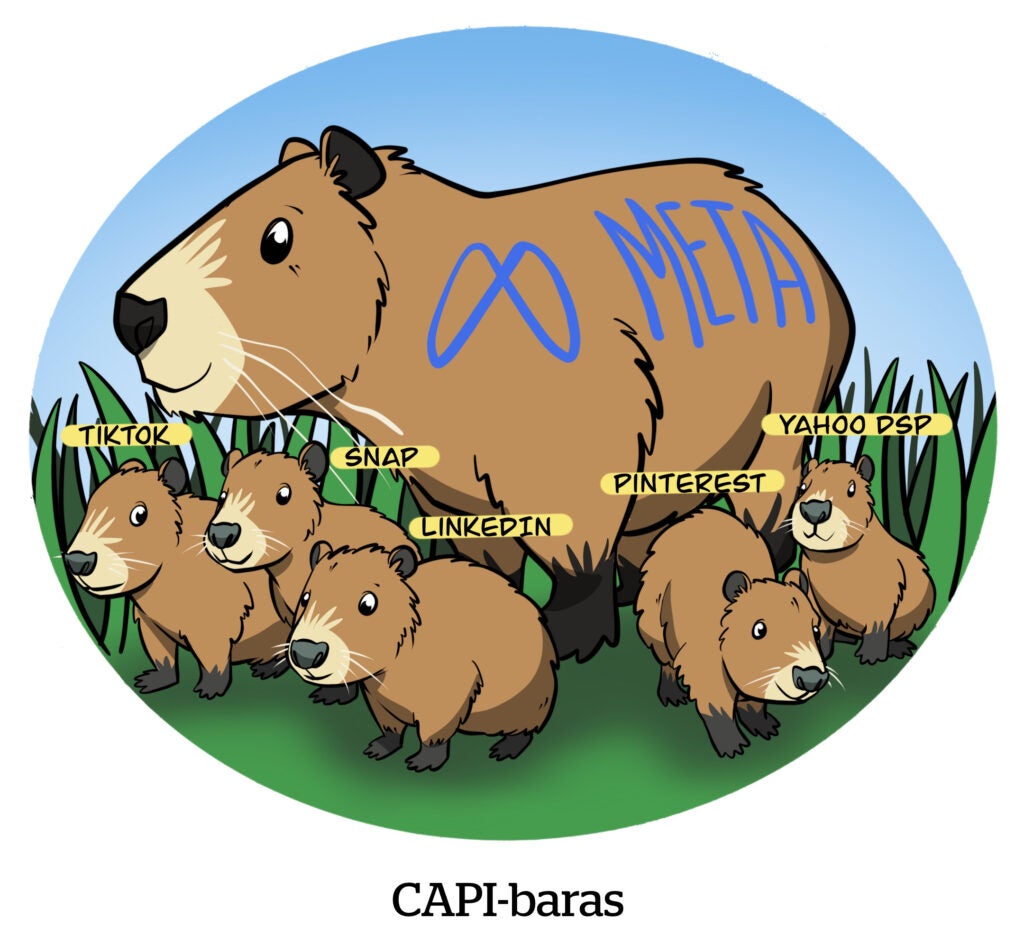
Sticking with the upfronts, the clear theme this year is performance. Which means yet another conversion API for TV and streaming is making its debut.
On Wednesday, Warner Bros. Discovery announced from its upfront stage that it’s participating in a new initiative led by data and identity company OpenAP. The effort aims to help advertisers connect their first-party data with outcomes data through a CAPI integrated with some TV heavy hitters, including NBCUniversal, Paramount, A+E and AMC, to name just a few.
But unlike most CTV CAPIs, which are built for a single publisher – think Netflix or Roku, both of which recently launched their own CAPIs – this one is designed to work across multiple media companies.
“This initiative is designed to reduce the number of integrations advertisers need to connect conversion data across major TV publishers,” OpenAP CEO David Levy told AdExchanger ahead of WBD’s event.
Centralizing outcomes data within a single CAPI should “create more consistent identity resolution and protocols for matching outcome data to ad exposure data,” he added, which should eventually allow for more automated, cross-publisher campaigns across channels.
From Hardware To Adware
In the past, government intelligence agencies would track targets by tapping physical satellite communication lines. This tactic has since been rendered largely obsolete in the age of low-Earth orbit networks like Starlink.
But two Israeli firms – and they’re likely not alone – have started collecting ad bidstream data as a workaround, Haaretz reports.
Location data and consumer profiles can be reverse engineered by blanketing satellite-delivered Wi-Fi networks with ads, from which a steady stream of location and identity data can be extracted.
“The ship can hide, but the crew still needs porn and TikTok.” That’s a real quote from a sales pitch made by one of the two Israeli startups, called TargetTeam, which was seen by Haaretz. In other words, even if people on ships turn off tracking and cell service to avoid detection while, say, navigating the Strait of Hormuz, Starlink users are still trackable.
Kind of makes you wonder about the real motivation of folks buying ads on porn sites, but that’s a different story.
This type of bidstream data use breaks the IAB’s standard terms and conditions and doesn’t fly under Google’s or Apple’s respective ad policies. Not much can be done, though. All of those are self-regulatory rules.
But Wait! There’s More!
MrBeast is building an AI-powered creator platform that points to a more programmatic future for the creator economy. [Digiday]
Will Anthropic surpass OpenAI as the LLM frontrunner? [WSJ]
Here’s a nice break from all of the layoff news: Google plans to hire hundreds of engineers to help customers adopt its AI tools. [The Information]