
Disney Scores With Sports; Video Currencies Compete For Market Share At CES
Broadcasters, streamers and video currencies are making a lot of noise at the Consumer Electronics Show in Las Vegas this week.

Broadcasters, streamers and video currencies are making a lot of noise at the Consumer Electronics Show in Las Vegas this week.

Contextual intelligence platform Precise TV announced a $26 million investment from UK-based private equity investor LDC, which is part of Lloyds Banking Group.

At CES on Tuesday, media and ad tech veteran Kris Johns unveiled AdGood, a nonprofit with a connected TV ad platform and a mission to help other nonprofits access streaming media.

During CES, Comcast debuted a plan to expand its reach among small business and regional advertisers with a new offering called Universal Ads.

This week, Experian launched its own marketplace for third-party data vendors at the Consumer Electronics Show in Las Vegas.

Three years after launching its own data clean room, Roku is trying to bring something new to the table. On Monday, the company announced the launch of a new offering, the Roku Data Cloud, which allows marketers access to more granular streaming TV data via ad tech and agency API partners.

On Monday, Disney released a new ad product called Disney Compass designed to give buyers quicker and more direct access to Disney data in addition to data from Disney’s identity and measurement partners.

Good news for the skeptics: 2025 will hopefully be a year of more practical AI use cases for advertising, especially as agencies get more hands-on with the tech.
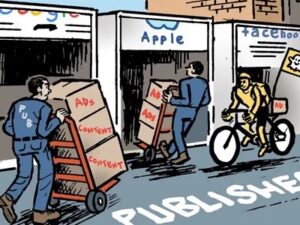
Meta recently revisited its goal to create AI-generated “characters” — which backfired. Plus, Apple’s trying to avoid a class-action lawsuit.

The Consumer Electronics Show may be “the event that folks love to hate,” as IAB CEO David Cohen put it to AdExchanger – but it’s still the place to be at the start of every new year.

As the new year begins, expect CTV growth to continue blasting along with a vengeance. Experts are “bullish” on the channel and believe that many of 2024’s biggest CTV trends will continue well into 2025.

Enjoy this weekly comic strip from AdExchanger.com that highlights the digital advertising ecosystem …

Dealmaking and AI (and blackjack) are top of mind for those heading to CES. Plus, don’t expect brands to reengage with hard news in 2025.

Back in 1966, McKinsey astutely observed, “Change gets costlier every day, yet not changing can be costlier still.” This statement rings truer than ever in today’s rapidly evolving advertising landscape.

Read on for an inexhaustive list of the most notable ad tech, agency and digital content deals of 2024, with a few fun wild cards tossed in. (Looking at you, “Hot Ones.”)

As seemingly every industry embraces retail media, grocery chains stand out with unique shopper data and insight into the real purchase behaviors of consumers.
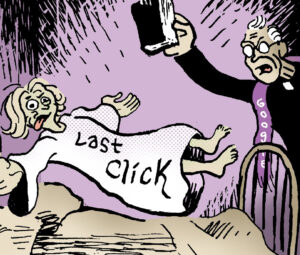
Trap More Flies With Honey Honey, a free browser extension that automatically finds and applies discount codes, is being accused of defrauding its users and the online content creators who championed it. That’s according to a YouTube tech investigator who goes by MegaLag. He alleges that the PayPal-owned Honey effectively steals the credit for online […]

Generative AI is quickly becoming the bedrock of the digital advertising landscape.
That might sound like a bold statement—after all, generative AI only hit the mainstream two years ago. But while many industries are just beginning to explore the potential of generative AI, advertisers have been leveraging AI and machine learning for years.

Every week, we publish an original comic creation inspired by trends in the online advertising industry. These are the stories – and the highly specific double entendres – behind AdExchanger’s top 10 comics of 2024.

Scott McKinley shares his journey from professional cyclist and captain of the 1988 US Olympic Road Cycling Team to CEO and founder of data validation provider Truthset. The road was more linear than one might think.

What captured our readers’ attention this year was both a continuation of and a departure from years past. Our top 10 stories in the past year coalesce around two themes: kookies and kwality. Ahem, cookies and quality.

2024 was a year of hectic change for ad measurement. These are a few of the new ad attribution trends and techniques programmatic advertiser should know going into 2025.
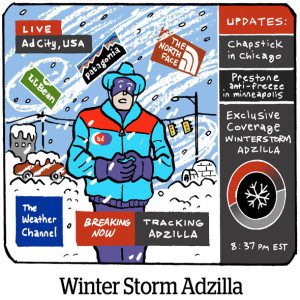
Happy holidays! Bundle up, get cozy and please enjoy this classic winter-themed comic, which first ran in February 2014.

2024’s most popular guest columns offer a snapshot of an industry in flux – and one that’s grown cynical due to repeated promises of unrealized change.

Feels like we’ve been waiting for the convergence of ad tech and mar tech forever. But it’s finally starting to happen, and the time couldn’t be more ripe, says Heather Macaulay, president of product-focused consultancy MadTech.

As the ad industry awaits Judge Leonie Brinkema’s decision in US v. Google (ad tech edition), get up to speed quick with AdExchanger’s in-depth coverage.

But cookies aside – and don’t forget to leave a few real ones out for Santa – there were lots of other big privacy developments in 2024. Here are some of the highlights.

Google plans to create an “AI Mode” for its web search engine users. Plus, the social media vultures now circling the air above TikTok.
For all intents and purposes, 2024 is already over. Which means now is a fine time to see how far CTV advertising has come by looking back at some of this year’s most-read stories on AdExchanger.

The IAB gave us new retail media standards for Christmas. But will the industry actually adopt them? Plus: how AI will be used in advertising in 2025.