

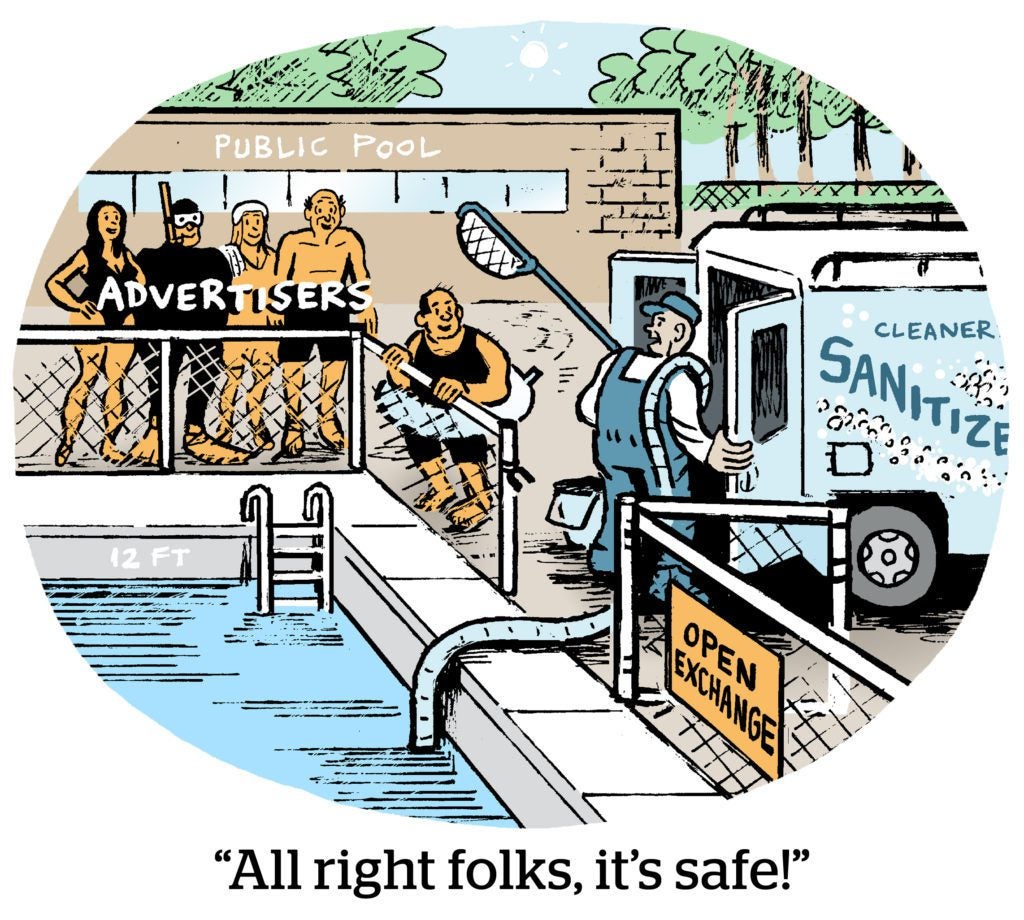
News publishers have found a way around brand safety barriers blocking them from ad budgets – if advertisers are willing to use their content taxonomy to buy ads.
The Local Media Consortium (LMC) and its NewsPassID ad network on Tuesday launched a new content taxonomy for programmatic deals. Via a private marketplace (PMP), buyers can buy inventory contextually targeted to focus on brand-safe content from trusted news outlets.
The idea is that, by allowing brands to target only what they want – like stories about the NFL or women’s sports – advertisers can overcome any qualms they might have buying news inventory programmatically, said Scott Cunningham, initiative lead at NewsPassID and chair of the Brand Safety Institute’s publisher council.
And with an approved list of sites and contextually segmented content, publishers don’t risk getting caught up in automated keyword blocklists, which consistently demonetize the news.

Here are the guardrails: The PMPs brands create will only feature news publishers who have been vetted by the LMC to become part of the NewsPassID network, which should convince brands they can trust the inventory without filtering it through pre-bid brand safety solutions, Cunningham said.
At launch, advertisers will be able to buy inventory across 5,000 of these vetted news publishers, including TEGNA, Tribune, LA Times, Cox Media Group, Gray, E.W. Scripps, Graham Media, Nexstar, Media News Group and Lee Enterprises. Deals can span display inventory, online video, native formats and CTV.
The new taxonomy is launching with 10 of the most in-demand content categories. Those 10 categories are high school sports, women’s sports, college sports, NFL sports, local politics and elections, national politics and presidential elections, weather and climate, health and wellness, back to school and travel and tourism.
The categories were based on a survey of ad agencies on their Q3 and Q4 buying plans, said Chris Fehrmann, VP of digital products at TEGNA and an LMC board member.
Just the news
The taxonomy offers an alternative to the widely used IAB Tech Lab content taxonomy, which is typically applied across different types of publishers. In those cases, brand safety and suitability are less assured, Cunningham said.
“When you have a global taxonomy like that, it’s interoperable between journalism, entertainment, social media platforms, you name it,” he said. “Journalism, especially local news, gets buried.”
In contrast, the NewsPassID network’s taxonomy has categories that are specialized for local news, including granular segments not featured in the IAB Tech Lab’s taxonomy – such as women’s sports and high school sports.
By giving advertisers the ability to target only the kinds of content they’re interested in, it effectively makes pre-bid brand safety blocking obsolete, Cunningham said. If advertisers take LMC publishers up on their offer, news orgs could recover much of the revenue they lose to pre-bid brand safety blocks.
Who’s in the middle
Because the LMC wants to bypass brand safety blockers, it discourages the use of pre-bid brand safety decisioning tools in its PMPs.
However, advertisers can still use tools like IAS or DoubleVerify to perform post-campaign verification to ensure their viewability thresholds and other metrics are being hit and to review adjacencies after ads are purchased.
The solution is platform-agnostic, allowing buyers to purchase ads through the DSPs and SSPs of their choice. But it is launching with a few tech partnerships to enable more optimized supply paths.
Hashtag Labs will enable open market programmatic auctions across the entire NewsPassID network. Media.net and Microsoft Advertising’s Curate platform will facilitate the building of PMPs. And contextual targeting is further enabled through NewsPassID’s partnerships with Media.net and Comscore.
The Media.net and Comscore partnerships also enabled the solution to include targetable categories for political news, Cunningham said, since Microsoft Advertising started prohibiting political ad spend on its platform a year ago.
As a nonprofit, the LMC takes a small cut to cover its costs, and there are fees associated with building the PMPs. The solution minimizes ad tech intermediaries since advertisers don’t need to carry brand safety vendors, which ensures that cash-strapped news publishers collect the lion’s share of the revenue, Cunningham said. NewsPassID was able to keep the total programmatic tech tax to less than a 30% take rate in most cases.
The goal is to create a new stream of demand from advertisers that were previously averse to buying news content through established programmatic methods – with the publisher collecting the bulk of the revenue.
“This is unique demand we’re not getting elsewhere, and it creates more competition in the waterfall,” TEGNA’s Fehrmann said. “And we’re able to get more of the dollars towards the media versus middlemen taking their take rate.”







