Marketing Agency Myosin Lets Consumers Give Your Media Budget To Charity
Growth agency Myosin Marketing is hoping your desire to do some good in the world will supersede your annoyance at getting a random text.
“Can you tell me which hour of the day is most profitable for us?”
It’s a familiar scenario: You’re meeting with your client to review their latest campaign dashboard, and your client asks for a custom metric that goes just beyond the dashboard you’re sharing with them. You say you’ll check with the team and get right back to them.
AI-powered systems should make the humans that use them smarter, says WPP CTO Stephan Pretorius. “It has to be people first, not technology first.” Plus: why “technology doesn’t destroy jobs, it destroys tasks.”
Investor, industry veteran and former SpotX CEO Mike Shehan returns from the ad tech sidelines to join the C-suite at Telly, a startup that gives away free TVs in exchange for viewer data.
For some, Chrome’s news that it’s keeping third-party cookies was a moment of vindication. But was it a cruel blow to partners that tested the Privacy Sandbox in good faith?
MiQ is acquiring PathLabs, a platform for independent agencies. Plus, Pinterest and LinkedIn are trying to get included in more media plans.
Google is still figuring out what a cookie opt-in or opt-out model would look like — and how it would affect development and adoption for the Chrome Privacy Sandbox.
Google is keeping third-party cookies in Chrome, and here’s what ad tech Twitter (X, whatever), has to say about it.
By reversing its position on third-party cookie deprecation, Google’s is acknowledging its inability to effectively execute its plans for the Privacy Sandbox. It’s time Google commits to competing with the rest of the industry rather than dictating terms.
In today’s newsletter: To boost its ads biz, Walmart will show in-store ads for non-endemic brands; Hyve Group buys Possible; and the Senate advances KOSA and COPPA 2.0, but the bills face obstacles in the House.
During Q1 this year, Viant reported that streaming audio and CTV combined represented more than half of the total ad spend on its platform.
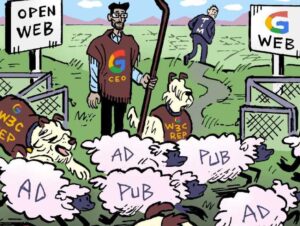
Enjoy this weekly comic strip from AdExchanger.com that highlights the digital advertising ecosystem …
With attribution-based platforms taking over, there aren’t many ways for an advertiser to bet (and win) big. Plus, what about the Google advertising ID?
If Chrome imitates Apple, there may be a de facto deprecation of the third-party cookies, since potentially only a slim percentage of users would consent to tracking. In that case, advertisers would still have to primarily rely on cookie alternatives, including the Privacy Sandbox.
Keep the cookies; hold for consent. We unpack Google’s reversal on third-party cookies and what it means for the ad industry, which was preparing for a cookieless future.
The FTC is ordering data from eight companies, which Commissioner Lina Khan describes as part of a “shadowy ecosystem of pricing middlemen,” in pursuit of visibility into “surveillance pricing.”
Despite setbacks, the mobile advertising industry has not only recovered but thrived post-ATT. What can overcoming the impact of ATT teach us about overcoming the latest uncertainty around the future of the cookie?
Media buyers and ad tech companies are accusing Pluto TV of bid duplication. Plus, Reddit is now only accessible via Google Search.
Alphabet is so big that, even when it’s growing slowly – YouTube, for example, disappointed with a lower-than-expected growth rate – it’s still outpacing competitors.
Sure, it’s July. But as the 2024 holiday shopping season nears, using location intelligence allows businesses to integrate physical and digital experiences, creating a cohesive customer journey across both realms.
What does programmatic media have in common with toilet paper? A lot more than you might think, says Sherine Ebadi, managing director of forensic investigations at Kroll. It’s a question of quality (or the lack thereof).
The industry shouldn’t let Google’s repeated delays slow down the progress we’ve made toward a more privacy-friendly advertising ecosystem. The need for innovation and collaboration is greater than ever.
In today’s newsletter: Spotify surges on strong Q2; how Gen Z media preferences are transforming the Olympics; and QSR companies ditch subscription services after first-party data gains fail to materialize.
Google appears to have thrown regulators for a loop with its surprise announcement on Monday that it no longer plans to deprecate third-party cookies in Chrome.
Unlock New Perspectives with the “Addressability & Performance Best Practices Study” Third-party cookies are here to stay on Chrome — but identifiers for iOS, Safari, and potentially Android are not. While this is a temporary relief for some, consumer behavior and privacy expectations have already shifted permanently. Our comprehensive “Addressability & Performance Best Practices Study” […]
Bacardi doesn’t have a digital marketing strategy, per se – because it’s all digital, says Laila Mignoni, the brand’s global VP of marketing and creative excellence.
The concept of ID bridging has long been the foundation of programmatic advertising, writes LiveIntent CEO Matt Keiser. What is cookie matching but an early iteration of ID bridging?
Some brands are turning away from larger media agencies in favor of smaller, independently run shops. Plus, licensing sports content is Reddit’s next revenue diversification play.
You read that headline right: Google is seriously considering scrapping its plans to deprecate third-party cookies in Chrome. Instead, it’s proposing some kind of TBD opt-out tool for third-party cookies.
In January, the Chrome browser removed third-party cookies for 1% of users, to facilitate testing of the Privacy Sandbox – and a new controversy was born.