Here’s today’s AdExchanger.com news round-up… Want it by email? Sign up here.
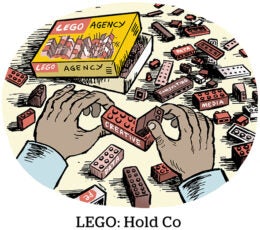
A HoldingCo Pattern
Shares of WPP, already down roughly 10% in the past year, took another thumping yesterday after a tepid earnings report and a lowered revenue forecast.
Some categories are growing strongly, CFO Joanne Wilson told investors. But this growth was offset in large part by losses in the health care and retail verticals.
WPP is not alone. Other agency holding companies have also suffered from a dropoff in retail accounts.

Publicis, by contrast, has seen its share price grow by 20% in the past year.
It’s a tricky situation for Publicis to navigate. Some of its fastest-growing and most strategic businesses – including Profitero, CitrusAd and Epsilon – are winning retail category share in part because they have large incoming revenue from other agencies. These other agencies, meanwhile, are moving away from agency-owned tech and SaaS vendors to seek growth of their own.
“Publicis has been banging on about Epsilon for ages,” Julien Roch, a managing director at Barclays, said on the WPP earnings call. “Omnicom is now talking about Omni a lot. Interpublic mentioned Acxiom yesterday. What about your data offer?”
“We’re not going to get drawn on this,” WPP CEO Mark Read responded a little obliquely.
Never Text Your X
Everybody knows the best way to stop someone from breaking up with you is to threaten them, right?
Elon Musk seems to think so, as evidenced by X’s recent decision to sue GARM for “evidence of an illegal boycott.” Or, as we referred to it in yesterday’s newsletter, “suing advertisers for not spending on its platform.”
And surprise! Adweek reports that those same advertisers, who were apparently just starting to warm back up to this new version of Twitter, are getting cold feet all over again, again.
Add to that Musk’s ramped-up political proselytizing in recent weeks – which might’ve had something to do with why GARM recommended against buying ads on the website to begin with, by the way – and it’s not a shock that buyers aren’t super interested in spending money there.
As one of Adweek’s anonymous source notes, this sets a weird precedent. What if, for example, a brand decides to reduce an ad budget on X for one quarter? As the source puts it: “Is Elon going to just tell Linda Yaccarino to sue?”
Death To Spam
Aggregated advertising funnels based on local obituaries (what this newsletter referred to as “programmatic death mills” back in 2022) are unfortunately still alive and kicking. And what’s worse, now they’re folding AI spam into the equation.
The Verge originally shed light on this phenomenon back in February, and now has an update in the form of a report from watchdog group Check My Ads, which seeks to call out “bad faith publishers” and other forms of advertising fraud.
Unlike previous versions, these obituaries aren’t just scraped from existing sources – they’re now attaching real names of the recently deceased to inaccurate, AI-generated details about the person’s life, including even made up causes of death.
Check My Ads blames the ad tech industry’s lack of oversight, arguing that this content violates the spirit (although maybe not the letter) of most publisher policies. At least one platform, TripleLift, has opened an internal investigation.
Check back in another two years for the latest.
But Wait, There’s More!
Publishers see short-term opportunity from Outbrain’s acquisition of Teads. [Digiday]
The ALS Ice Bucket Challenge celebrates its 10th anniversary. [Ad Age]
Is the new Harris-Walz logo “boring,” or is it an example of smart under-branding? [Fast Company]
Sens. Elizabeth Warren and Bernie Sanders and Rep. Joaquin Castro asked the DOJ to investigate Venu, the joint sports streaming service from Disney, Fox and Warner Bros. Discovery. [The Athletic]
You’re Hired!
BBDO taps Jiah Choi as the agency’s first CEO leading its Chicago and New York offices. [Ad Age]