
PODCAST: The Big Story
Rest In Privacy, Sandbox
Last week, after nearly six years of development and delays, Google officially retired its Privacy Sandbox.
Which means it’s time for a memorial service.

Last week, after nearly six years of development and delays, Google officially retired its Privacy Sandbox.
Which means it’s time for a memorial service.

Chrome kept cookies and killed the Privacy Sandbox, but at least we got some great comics out of it.

Amazon acquires AI-equipped wearable manufacturer Bee; the UK’s CMA shares competition guidelines for Google and Apple; and AI models may be learning from each other in unexpected, potentially harmful, ways.

A UK-based early-stage startup called Paapi, which just closed its pre-seed funding round last month, is building a platform to help advertisers with privacy-safe ad measurement.

Despite all the cookie drama, companies haven’t completely abandoned the Chrome Privacy Sandbox, and BU marketing professor Garrett Johnson has the receipts to prove it.

Michael Komasinski, Criteo’s newly-minted CEO, shares his vision for the company – and swears that Criteo doesn’t regret its huge investment in testing the Chrome Privacy Sandbox.
Enjoy this weekly comic from AdExchanger.com that highlights the digital advertising ecosystem …

Shopify is growing its advertising and data business; the privacy train is slowing down; Roku is striking deals to make its data more accessible.
While some Privacy Sandbox testers lamented their seemingly wasted effort, they remain committed to post-cookie targeting and measurement – even if Google eventually abandons the Sandbox entirely.

Despite a 3% uptick in Q1 revenue to $451 million, Criteo’s stock fell by roughly 15% on Friday after news of a pullback by a major retail media client and tepid guidance.

Erez Levin, a former Googler and current outspoken consultant, on why the digital ad industry should transact on media quality signals like attention instead of optimizing to outcomes and other flawed attribution models.

If the court ultimately orders Google to spin off AdX or DFP, the result would be a fundamental rebalancing of power across the digital advertising supply chain. For marketers, the implications are just as significant.

Many in the industry see Google’s fingerprinting reversal as an irresponsible move due to privacy concerns, particularly in regions with strict data regulations.
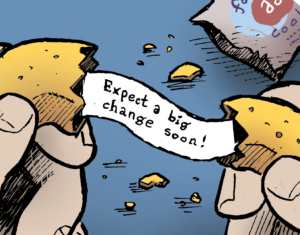
Google just shared a teeny tiny bit more info about its planned consent mechanism for Chrome, which will be “a one-time global prompt.” Pause for amazed silence (lol).

What do toasters have in common with transparency and online advertising standards? Quite a lot, actually, says Ben Hovaness, chief media officer at OMD Worldwide. No, really.

Google asserts its position in the CTV ad ecosystem. Also: a change to its search ads biz may be inflating advertising costs for charities.

2024’s most popular guest columns offer a snapshot of an industry in flux – and one that’s grown cynical due to repeated promises of unrealized change.

But cookies aside – and don’t forget to leave a few real ones out for Santa – there were lots of other big privacy developments in 2024. Here are some of the highlights.

Forrester released its first SSP wave since 2014 last week, and there’s a surprise. The research firm ranked Google – whose sell-side ad tech platform is facing federal antitrust charges – as a mere challenger.

Google and the UK’s Competition and Markets Authority continue their seemingly never-ending colloquy on Chrome, competition and cookies.

Even when third-party cookie deprecation was ostensibly still in the offing last year, there was only modest publisher adoption of the Protected Audiences and Topics APIs, according to data from Sincera.
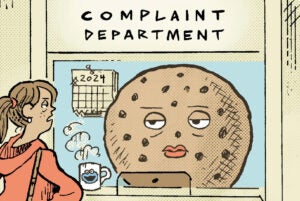
There’s been plenty of mudslinging in and around the Chrome Privacy Sandbox. But the Protected Audiences API (PAAPI) maybe ain’t so bad, according to researchers at Boston University.
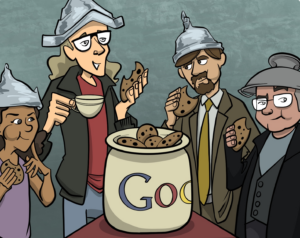
It’s been more than two months since Google said it would forego third-party cookie deprecation in favor of a user choice mechanism. But it hasn’t shared any details yet.

Chrome Privacy Sandbox adds support for deal IDs and extends Protected Audiences’ lifespan to 90 days; Google’s ad tech antitrust trial could open YouTube to DSPs other than DV360; and former Kubient CEO charged in accounting fraud scheme.

Confidential matching – which uses a TEE built on Google Cloud infrastructure – will now be the default setting for all uses of advertiser first-party data in Customer Match.

The publication still makes most of its on-site digital revenue from programmatic. But it’s doubling down on direct-sold custom content, especially when it comes to video and social media.

An ex-Googler asks: Has the commitment to perfection over progress led to the current state of play for the Privacy Sandbox and harmed the industry’s opportunity to provide better consumer privacy?
Although the full revenue impact of Magnite’s exclusive SSP partnership with Netflix hasn’t hit yet, simply announcing the deal “created significant momentum for our business,” Magnite President and CEO Michael Barrett told investors.

By reversing its position on third-party cookie deprecation, Google’s is acknowledging its inability to effectively execute its plans for the Privacy Sandbox. It’s time Google commits to competing with the rest of the industry rather than dictating terms.

If Chrome imitates Apple, there may be a de facto deprecation of the third-party cookies, since potentially only a slim percentage of users would consent to tracking. In that case, advertisers would still have to primarily rely on cookie alternatives, including the Privacy Sandbox.