Sparring Partners
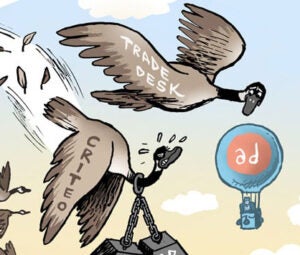
Agentic advertising is forging a wave of unexpected programmatic alliances.
Last week, The Trade Desk announced a partnership to embed its DSP in another platform – a first for the company – giving joint customers access via Pacvue and Skai. Likewise, affiliate rivals Rakuten and Impact announced a major strategic partnership last week.
An even more recent example comes courtesy of Yahoo and Kochava. The Yahoo DSP now has a dedicated workspace within Kochava’s StationOne product, which is its MCP and integration hub for AI tech services.
“We’re going to see a deduplication of tooling by teams,” Kochava CEO Charles Manning tells Digiday, “where things are coming together, as opposed to [being] so splintered and separated.”
Even within a single company, teams often operate in silos. But through the Yahoo/Kochava integration, it’s possible for ad ops, media buyers and creative folks to produce code and develop apps using generative AI without duplicating efforts.

At the macro level, the same dynamic plays out between companies crossing into each other’s lanes, like SSPs vying to own data marketplace sales or cloud-based programmatic bidding, jobs traditionally done by DSPs.
The takeaway? Expect more unexpected partnerships among frenemies.
Social Video And Beyond
US digital ad spend is projected to exceed $80 billion this year – an 11% increase from 2025, according to the IAB’s latest report. And guess what? The main growth driver isn’t connected TV.
Here’s why: Social video ad spend is set to jump 13% YOY, surpassing the 11% growth expected for CTV, partly thanks to AI-driven ad personalization. Another reason for social video’s dominance is the industry’s other favorite buzzword: performance.
Unlike TV, social video ads are targeted on a one-to-one basis, and attribution is more straightforward. Streaming platforms can launch CAPIs and shoppable ads all they want, but viewers still don’t typically buy things directly from their TVs. Oh, and streaming ad targeting also isn’t that great, due party to IP degradation, according to the report.
Another highlight is the categorization of YouTube as social video, alongside Instagram and Reddit.
YouTube pitches itself as television to media buyers, especially during upfront season, because it wants to attract premium ad budgets. But a media buyer told AdExchanger during POSSIBLE that YouTube is more than fine being classified as social video.
Talk about wanting to have your cake and eat it, too.
If You Build It, Will They Come?
There are now more than 1,200 consumer-facing apps that connect either ChatGPT or Claude to major brands. ChatGPT, for example, has integrations with Target, Walmart and Expedia, to name just a few, while Claude integrates with Uber, TripAdvisor and Instacart, among many others.
But is anybody actually using these apps? According to Modern Retail, no. Or not yet, at least.
Adoption and conversion are low thus far, because there’s very little natural discoverability. First, you need to have both the retailer’s app and the AI chatbot installed already. Then you need to learn that there’s even a way to conjoin the two, a fact often only announced via press releases that the average consumer does not see. Finally, in some cases you also need them both running at the same time.
That’s a lot of factors.
But even still, more of these apps will be released. FOMO aside, they’re relatively cheap to produce and allow companies to experiment with agentic development.
Jason Goldberg, Publicis Groupe’s chief commerce strategy officer, even suggests that they’re a bit like focus groups in that the data they collect can inform how brands think about the customer journey.
Compared with past hype cycles around tech like NFTs, though, ChatGPT apps at least offer somewhat better use cases for brands.
But Wait! There’s More!
The FTC settled with Media Matters and has agreed to forgo future investigations of the nonprofit watchdog organization. [Media Matters]
The AI drive shortage is making it harder and more expensive to archive the internet. [404 Media]
Europe’s age verification push raises privacy issues beyond data confidentiality. [Tech Policy Press]
Meanwhile, Meta is now using “AI bone structure analysis” (which is not facial recognition, the company stresses) to identify photos of children. [The Verge]
Kendall Roy is in talks to buy Vaulter. [Variety]
Viant has officially closed its acquisition of TVision. [TVNewsCheck]
You’re Hired!
NextRoll, the company that owns AdRoll, names Jay Webster as CTO. [release]
Go-to-market firm Marketbridge hires Geoffrey Sidari as chief innovation officer and head of AI. [release]
TripleLift appoints Timothy Jasionowski as chief product and technology officer, and Benjamin Felix as CMO. [release]
Thanks for reading AdExchanger’s Daily News Roundup. Want it by email? Sign up here.