
Privacy Compliance Is At The Top Of The Tech Lab’s 2024 To-Do List
The days of online ad industry self-regulation are well and truly over, say IAB Tech Lab CEO Tony Katsur.

The days of online ad industry self-regulation are well and truly over, say IAB Tech Lab CEO Tony Katsur.

Cookie loss is happening, even if it doesn’t feel imminent, and there’s no point in procrastinating, according to Sisi Zhang, chief data and analytics officer at Publicis-owned Razorfish.

Commissioner Rebecca Slaughter had some free advice for anyone tuning in to the Federal Trade Commission’s virtual PrivacyCon event on Wednesday: “Pay close attention to Kochava.”

Google claims that more than 90% of the 44 use cases analyzed by the IAB Tech Lab’s Privacy Sandbox Task Force are actually still doable using the Privacy Sandbox APIs.

Lawmakers are busy playing politics, and it’s getting in the way of creating safety guardrails for children’s privacy online.
In a blog post on Wednesday, Google’s senior director of product management, Victor Wong, defended the Privacy Sandbox APIs and laid out in very direct terms the flaws Google sees in common criticisms of its sandbox proposals.

We’ve spent enough time and spilled more than enough ink this year talking and writing about Big Tech privacy fines, enforcement actions and the unutterably slow phaseout of third-party cookies in Chrome. So rather than rounding up the obvious online privacy trends of 2023, let’s dive into the weeds.

How would you describe the state of privacy in the ad tech industry? “In one word: fragmented,” says Tony Katsur, CEO of the IAB Tech Lab.

Mark your calendars for Jan. 4, 2024 all you deprecation skeptics. On Jan. 4, Google will begin cutting off third-party cookie access for 1% of a randomly selected group of Chrome users globally.

AppsFlyer announced its second-ever “real” acquisition on Wednesday (its first was an acqui-hire in 2018) with the purchase of devtodev, an analytics provider for app and game developers.

Consent is becoming one of the most important requirements in online advertising – and InMobi wants to help publishers collect it.

The IAB Tech Lab released its first data clean room guidance and also shared the first version of the Open Private Join and Activation (OPJA) specifications, which sets use cases to match encrypted audiences.
AppsFlyer’s solution allows advertisers and DSPs to create custom first-party segments for reengagement campaigns without needing an SDK integration of their own.

Legal drama alert: The Federal Trade Commission refiled its privacy complaint against Kochava earlier this week. The case is under a temporary seal, so details are thin on the ground (for now).

Apple has a knack for making privacy-related product announcements that cast aspersions on the data practices of any company whose name isn’t “Apple,” and there were a handful of those.
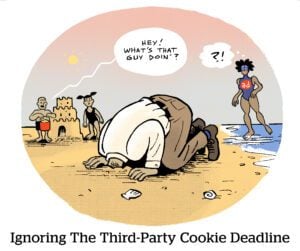
In Q1 2024, Chrome will deprecate cookies for 1% of a randomly selected group of Chrome users and slowly expand deprecation to more users throughout the year.

The US now has nine state privacy laws on the books – and the list is only going to get longer over the next couple of years.

“Esto perpetua” – let it be perpetual, in Latin – is the state motto of Idaho, but it doesn’t apply to the Federal Trade Commission’s lawsuit against Kochava.

A new integration between SafeGuard Privacy and the Institute for Advertising Ethics will allow companies to automatically check whether they and their partners are adhering to a standard set of ethical standards covering privacy, data ethics and misinformation.

There’s been talk about raising the age of consent from 13 to 16 under the Children’s Online Privacy Protection Act. Dona Fraser, SVP of privacy initiatives at BBB National Programs, weighs in.

Whenever the butterflies at Apple WebKit flap their wings, “Ad Tech Island” feels the aftershocks. Last week, a small change to Apple’s on-device tech to patrol third-party data collectors sent some mobile and online advertising practitioners into a tizzy over the loss of another sliver of data transparency. They also fret because Apple continues to […]

Most consumers think the Health Insurance Portability and Accountability Act (HIPAA) is a lot broader than it is. But in a post-Dobbs world, it bears repeating: HIPAA doesn’t cover all health data, including reproductive health information collected through phones, tablets and other devices.

The Federal Trade Commission helped normalize and popularize the term “commercial surveillance.” But is the current FTC “anti-advertising”?

Prebid has decided not to serve as public operator for Unified ID 2.0, a decision it made quietly last year. Meanwhile, The Trade Desk is prioritizing private operators as the way forward for UID2.
If programmatic ad tech was a canary in the coal mine for how data privacy would affect the online advertising industry, then some of the canaries have escaped and are creating businesses to help coal mine operators do better.

Privya, which came out of stealth mode in August, has an AI-powered scanner that analyzes a company’s software source code before it goes into production to check for data protection issues.

The idea of a digital twin is to create personas that function as amalgamations of how different people with similar preferences and online patterns think – or how they shop, to be specific. “None of your customers is unique,” Rayn co-founder and CEO Geenen said.

There’s no such thing as “compliance by obscurity,” says Sheila Colclasure, who serves as global chief digital responsibility and public policy officer at Kinesso, the mar tech unit within IPG.

California’s privacy protections are considered by most privacy pros to be the toughest and most comprehensive in the nation. But the California Privacy Protection Agency has a budget of just $10 million to regulate against the largest technology companies in the world.

Notice and choice just got dragged at a House subcommittee hearing on privacy. Rep. Frank Pallone called it “coercive.”