Ad Agency Holdcos, But Minus The Ads; Creators In Brief
Holdcos get creative with M&A; striking a balance with influencer marketing; and social influencers are given marketing titles at brands.
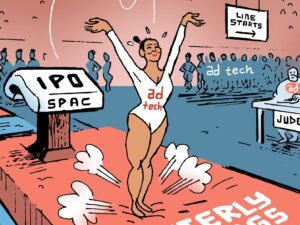
Somewhere between what the ad industry says and what the market rewards is often where the truth lives. Here are the three industry storylines most in need of debunking.
Advertising in AI-native destinations and experiences is already starting to look less like a series of experiments and more like an emerging market.
Instead of relying on rigid audience segments, modern systems can interpret a real-world moment in real time, combining layers of information to better predict what someone might actually care about right now.
Creator marketing is taking over the B2B space; Reddit develops AI tools to fight spam; and Comcast-owned Sky will acquire ITV’s Media & Entertainment unit.
Some DOJ staffers wanted to challenge the Paramount/WBD merger on antitrust grounds; ad tech M&A is poised to pick up; and social media marketers want to normalize controversial clipping.
Recorded live in Las Vegas at Prog AI, the AdExchanger team tackles a tricky question: As AI floods the feed with chaotic, addictive content and people engage with it, what does “premium” even mean anymore?
Hundreds of exasperated and unexpected ad industry phone calls were made on Sunday, as agencies and ad tech vendors discussed the fallout of Publicis Groupe’s $2.2 billion acquisition of LiveRamp over the weekend.
OpenAI has its own tracking pixel; Amazon sellers are boycotting the platform; and DirecTV hops on the CAPI bandwagon.
The Trade Desk overhauls ID partner payments; investors downplay their software holdings; and Kalshi’s “we don’t do death markets” campaign may be backfiring.
It can be hard to measure the effect of advertising on in-person sales. Men’s Wearhouse partnered with measurement agency Ovative to see what was working.
Wall Street is falling out of love with SaaS; OpenAI has an “ads integrity” unit; and the Super Bowl is getting more personalized.
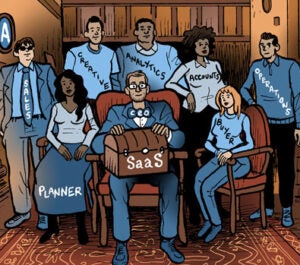
An emerging consensus among Wall Street investors, based on the earnings reports of companies like Meta and Alphabet, is that subscription software is on the way out. LiveRamp, which reported its Q4 earnings on Thursday, is staring straight down the barrel of this conventional wisdom.
Q4 earnings reports are heating up; Private equity firms get squeamish; and AI data centers are harder to build than ever.
AI is reshaping how we shop, but agents won’t take over our carts just yet. LiveRamp CEO Scott Howe explains why the change will be gradual – and how chatbot ads (not just on ChatGPT) will change the online shopping experience.
A few years ago, “data clean rooms” were all the ad tech trades could talk about. Fast-forward to 2026, and maybe advertisers don’t need to know what a data clean room is after all.
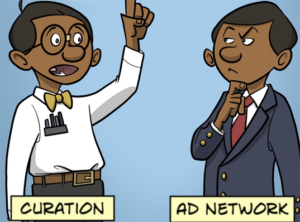
AudienceMix, a new curation startup, aims to make it more cost effective to mix and match different audience segments using only the data brands need to execute their campaigns.
LiveRamp’s gift could make IAB Tech Lab’s AI consent model workable; Spotify hypes video podcast growth and nabs a bigger ad margin; and Coke launches another AI holiday ad campaign.
Through Index Exchange’s data vendor marketplace, curators gain access to third-party data sets without needing their own integrations.
Google’s penalties were pretty lenient; brand crossovers may have gone too far; and why so many ad tech leaders are founding startups.
Roqad is buying Zeotap’s third-party data biz to boost its identity resolution capabilities, but also for access to key integrations with major ad platforms.
According to Adam Paul, executive director of media alliances at LiveRamp, the old-school programmatic ads – the ones bought across multiple platforms without regard to context or audience – are underperforming on CTV these days.
The pivot to AI has led to a gap in many SaaS and ad tech companies’ payment models; AppLovin bounces back in Q2; and Grok might be your newest media planner.
Newton Research announced its $9 million Series A raise on Tuesday. The funds will go toward hiring as demand for Newton’s specialized AI agents grows.
AI Overviews makes dodgy product recommendations because it scrapes marketing copy; discrepancies in TV ratings hamper upfronts negotiations; and why mar tech companies are building software fortresses.
Alliant will integrate AnalyticsIQ’s audience modeling platform, which is based on user surveys and studies of health, wellness and cognitive psychology.
OMD’s Emily Proctor outlined the criteria the ad agency uses to evaluate alt IDs. She also shared which five IDs OMD uses most often and why.
CTV advertising has made great strides, but it still lags behind social platforms in one critical area: optimizing campaigns based on outcome data. Here’s how standardized conversion API integrations for CTV can help.
The need for addressability has been a rallying cry among advertisers for the past five years. But clinging to outdated notions of addressability means overlooking the broader needs of today’s modern media landscape.
Forget ramping up. Maybe it’s time for the online advertising industry to ramp down. That’s the idea behind a guerrilla marketing campaign by InfoSum, timed to coincide with LiveRamp’s RampUp event in San Francisco this week.