

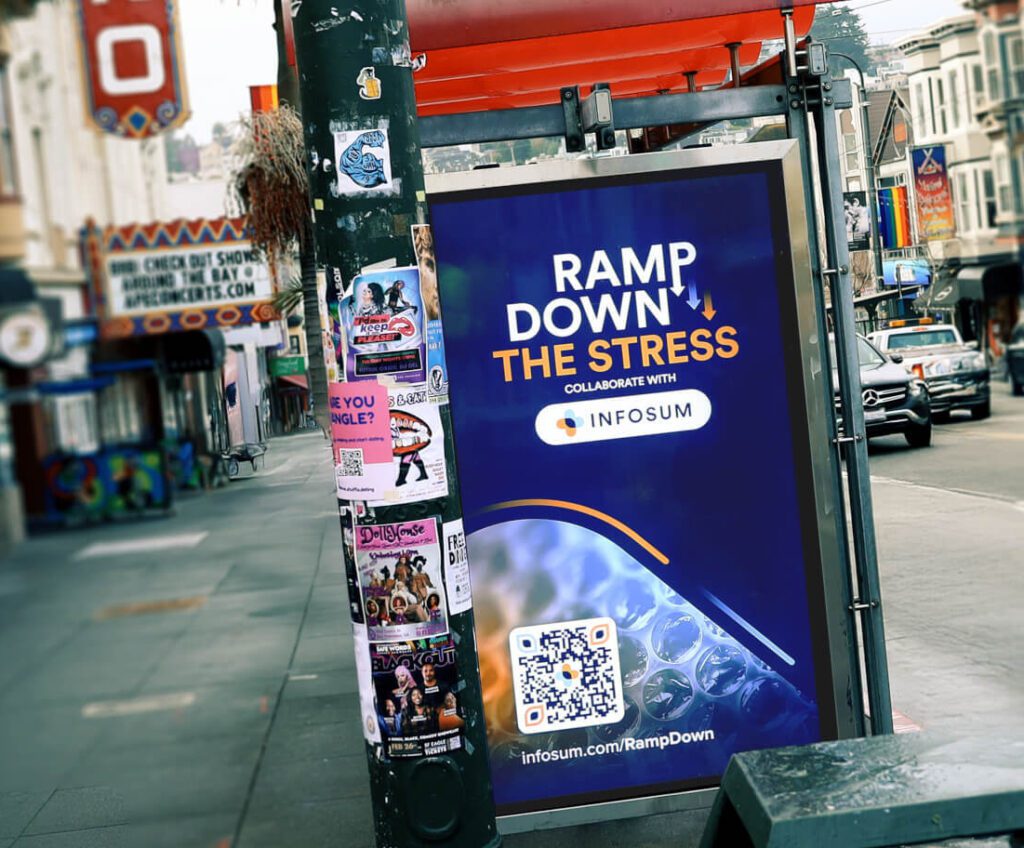
Forget ramping up. Maybe it’s time for the online advertising industry to ramp down.
That’s the idea behind InfoSum’s guerrilla marketing campaign, which launched this week to coincide with LiveRamp’s annual RampUp conference, held this year at the Marriott Marquis in San Francisco.
The campaign, which includes out-of-home activations, is targeted at the more than 2,000 marketing and ad tech business leaders in attendance.
The OOH signage running on Clear Channel bus shelter inventory outside of the hotel urges those who see it to “ramp down the risk” of CMOs having to hand over their data to third parties and “ramp down the time” it takes to start using data collaboration technology.

InfoSum claims it can set up clients on its platform 156 days faster, on average, than other data clean room providers.
But the campaign is also a call to action for the broader advertising ecosystem, said InfoSum CEO Lauren Wetzel.
“It’s time to acknowledge the warts and flaws of our industry and take a moment to be very real with ourselves about some of the challenges,” she said.
Down with the status quo
The online advertising industry has a tendency to pay lip service to privacy while at the same time maintaining the status quo. Privacy washing is real.
“There’s a lot of talking the talk, but not walking the walk,” Wetzel said.
InfoSum’s “ramp down” campaign is an appeal to the industry to stop collecting and sharing data with data brokers like it’s going out of style – not just because it is (regulators are paying closer attention), but because the technology already exists for secure and privacy-safe data collaboration.
Which is, of course, a self-serving statement. InfoSum sells data collaboration tech and so does LiveRamp, its competitor. LiveRamp acquired data clean room startup Habu early last year for $200 million.
Is it a concern for InfoSum that it might look like it’s running down one of its rivals in a relatively small category of players?
Wetzel said she recognizes InfoSum’s campaign could come off that way, but that’s not the intention.
RampUp is simply an opportunity to get in front of data-driven decision-makers with a sobering message that’s also a little tongue in cheek, she said.
“When this industry gathers, it often talks about the same things year after year, but I think the conversation has amplified a desire to move away from the old way of working,” Wetzel said. “Privacy and performance aren’t trade-offs, and we can embrace higher standards.”
A new (new) order
Although Wetzel isn’t attending RampUp this year – she’ll be on a business trip in London – a handful of InfoSum employees are registered.
They’ll be taking meetings as usual and handing out branded swag, including more than 400 “Ramp Down” stress balls and stickers.
“We probably have more stress balls than my team is thrilled with in terms of having to manage that,” Wetzel joked.
In addition to the OOH placements around the San Francisco Marriott Marquis this week, InfoSum is also posting content on LinkedIn and X, including a brief video of Wetzel explaining the campaign’s raison d’être as well as the link to a landing page asking people to share what they would do if they got 156 days back in their life.
The person with the most creative answer, as determined by InfoSum, will win a LEGO Star Wars X-Wing set so they can, as InfoSum put it, “join the rebellion against the Empire.”
Not that ad tech is an evil empire. But there are “entities resisting that there is privacy-enhancing technology out there that allows all partners to collaborate and maintain control,” Wetzel said.
“The evil empire are the companies that still mandate to a CMO that they have to hand over control of their data,” she said. “And then consumers are none the wiser that these intermediary companies they’ve never heard of have access to that data.”
But seriously, folks
This is InfoSum’s first-ever brand campaign. It devised the strategy itself and used its own in-house creative team to produce the assets.
To measure the campaign’s impact, InfoSum will track the effect on its pipeline, which is the same measurement approach it uses for any event the company attends.
“We don’t send everyone to every single conference,” Wetzel said. “We chose RampUp because it happens to perform very well for us. We’ve landed a lot of deals coming out of RampUp conversations.”
Although InfoSum doesn’t have a direct partnership with LiveRamp, the two companies have worked together to support a handful of mutual clients, which Wetzel expects will continue.
Meanwhile, InfoSum is hoping its campaign comes off in the spirit it was intended.
“I think the timing is right, and the underlying message is really important,” Wetzel said. “If you’re handing your data over to a data broker, that’s very 2000, not very 2025.”







