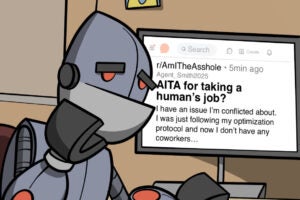

If AI agents can plan and buy media, who needs a holding company?
Good question.
Toward the end of Omnicom’s third-quarter earnings call on Thursday, Tim Nollen, an equity analyst at independent financial research firm SSR, asked Omnicom’s leadership how the role of a large holdco will have to change in the agentic AI era.
Omnicom is building its own AI-driven marketing intelligence platform, called Omni, but it’s got major competition. Walled gardens and even some independent ad tech companies are building their own end-to-end platforms, too.

Historically, an agency’s job is to help clients make sense of a fragmented, confusing media market. But that market has never been more complex, and agents are increasingly poised to do the work agencies used to do.
Conducting the chaos
Omnicom, unsurprisingly, would not concede the point. Complexity in the market only makes Omnicom’s offering “more central,” said CFO Phil Angelastro.
“[That’s] in terms of the platform we’re building out,” he said, “and in terms of the ease in which both Omnicom employees and client employees can come together on a platform and execute certain statements of work.”
Omnicom’s CTO, Paolo Yuvienco, got into the specifics of what that means.
“We orchestrate that complexity on behalf of our clients,” he said, pointing to Omni as the tool that makes that happen. “[It] helps facilitate the work that our people are actually delivering for our clients every day.”
Agentic AI gets the work done faster, more efficiently and more effectively, Yuvienco said, and simplifies “the entire marketing life cycle.”
He did not, however, address how Omni stacks up against the growing crop of end-to-end solutions Nollen described.
Growth in media, a bet on AWS
Integrated media, which includes media, commerce, data, CRM, consulting and content automation, made up 53% of Omnicom’s $6 billion in core revenue in Q3 and grew more than 10% organically. But much of that work, from buying media to producing content, is exactly what AI agents are being built to take on.
Omnicom is gaining share, though, said CEO John Wren, and has the resources and cash to keep investing in its platform and agentic AI capabilities.
Meanwhile, earlier this week, Credera, Omnicom’s tech consultancy, signed a 5-year collaboration agreement with AWS. Yuvienco told investors the partnership is “meant to drive joint growth,” and that Omnicom is setting up a more dedicated unit to sell AWS-centric cloud AI solutions to clients.
Omnicom already does this type of work for many clients, he said, but the deal establishes “a more dedicated unit” focused on it.
IPG done, more M&A to come
But Omnicom’s biggest bet, of course, remains IPG, which it closed just shy of one year ago in late November, making this the duo’s first Q3 as a combined company.
Overall, core revenue – which excludes the businesses Omnicom has sold or plans to sell, including specialist firms and agencies that overlap with its own – rose 7.2% organically. The US market, which makes up 60% of core revenue, grew 10%.
The World Cup and, to a lesser degree, the midterm elections, boosted growth in the quarter, Wren said, although he warned investors that neither will repeat in 2027. But hey, he said, “next year, we’ll be looking forward to the ’28 Olympics.”
Next year’s numbers should also be easier to read.
Omnicom has been reporting the businesses it’s selling separately from the rest of its revenue, but Wren said Omnicom is “substantially through” those sales, with only “a handful” still in the talking-with-buyers stage.
Angelastro said the goal is to wrap up by Dec. 31, although some closings could slip into early 2027. After that, Omnicom can stop splitting out those numbers and get “back into acquisition mode,” he said, which is already starting to happen.
“We’ve been entertaining some discussions with potential targets,” Angelastro teased.