Omnicom’s advertising revenue suffered in the second quarter.
But that didn’t stop the holding company’s stock from jumping to a one-year high on Wednesday morning, as investors digested its plan to sell off parts of IPG and absorb IPG.
Total revenue in Q2 was $6.6 billion, roughly flat compared to Omnicom and IPG’s combined revenue from a year ago. Omnicom’s net income, or total profit, however, was up from $258 million in Q2 2025 to $585 million.
There were bright spots. Integrated media, Omnicom’s health vertical, the PR business and its experiential category (boosted by the World Cup) all saw low to moderate growth. But advertising fell by low single digits, Omnicom CFO Phil Angelastro told investors on Tuesday evening.
So why are investors pleased despite tepid results and flagging advertising spend?
One reason is because Omnicom is halfway through a major sell-off of IPG agencies. Its future looks healthier as it prunes lower-growth firms, including eliminating certain specialist firms and overlapping agencies in certain countries.
That portfolio clean-up brings the usual “synergy” benefits attendant with reductions in headcount, shutting down offices and other overhead costs that free up profit margin. But the biggest takeaway from Omnicom’s Q2 report is the status of its “dispositions,” meaning the revenue-generating sales of its low-growth businesses.

Steven Cahill of Wells Fargo asked whether Omnicom expects to maintain its run rate of overall organic growth and profit margin expansion, or if that’s just a 2026 cash injection from the IPG asset sales. “Is there any way to sort of push back on that street skepticism that you’ve kind of just solved into it financially this year?” Cahill said euphemistically.
“It’s hard to predict the future,” Omnicom CEO John Wren responded, “and if I was better at it, I’d probably have done something else as a career.”
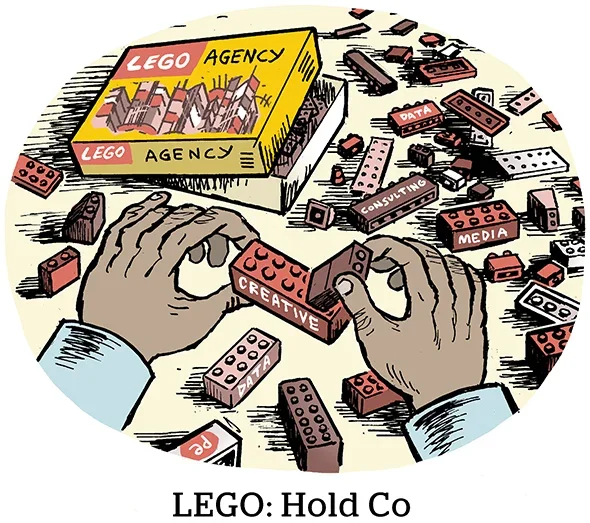
Zinger aside, Wren noted that Omnicom is “now more of an operating company than a holding company,” which is how it’s winning new business and growing services with existing clients. Rather than a vast number of agencies acting independently to bring revenue back to the hive like a colony of bees, Omnicom is more like an octopus, with a single central brain coordinating its different business segments.
But the question of how Omnicom makes money also came up in another way.
Executives briefly addressed the rise of principal media, a controversial practice whereby an agency buys inventory directly from media sellers, which it then resells to clients at a markup. (Big ups to Michael Nathanson of MoffettNathanson who forced a discussion of principal media with the very last question of a long Q&A session.)
Nathanson pointed out that IPG Mediabrands “wasn’t very modern when it came to principal media,” meaning that it generated relatively little in the way of earnings from principal media.
In Q2 2025, Omnicom reported that third-party service costs, the obscure revenue line item where it buries principal media earnings, were up $107 million to $918 million overall. In Q2 of this year, third-party service costs grew by $604 million to a total of $1.5 billion.
Because Omnicom doesn’t break out principal media revenue, the best reads can only be indirect.
But for the sake of comparison, Publicis’ CFO said last year that principal media represents roughly half of its third-party pass-through costs, which is how Publicis terms its murky principal media revenue. It’s an inexact way to measure principal media earnings, but the agency holdcos don’t disclose that revenue.
What we can say for certain is that principal media is growing and here to stay.
“Principal media … is part of the value equation,” Florian Adamski, CEO of Omnicom Media, told Nathanson. “This is what the modern marketplace looks like.”