Doug Lauretano began his advertising career in the early noughts on the publisher side at titles such as Fortune, The Wall Street Journal and CNN Money. He spent a decade at supply-side programmatic players OpenX and Media.net before joining data and advertising company CivicScience in 2021.
It was at CivicScience while developing a deal ID and curation product where Lauretano got his first real look into the mechanics of how DSPs work.
“And what I saw was pretty ugly,” he said.
That firsthand experience led Lauretano to launch a new DSP called Tuple, which went live in March. The company has only eight customers, including one enterprise mobile brand that spoke to AdExchanger on condition of anonymity about their rationale for choosing a startup DSP over an incumbent.

The programmatic trust gap
Tuple is entering the DSP market at a strange and tense moment for third-party ad tech.
“There’s just so much animosity” between the programmatic buy and sell sides, Lauretano said.
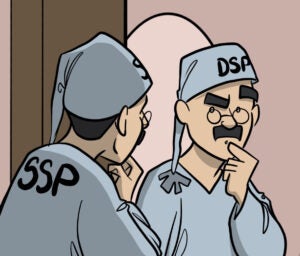
For example, The Trade Desk changed its nomenclature to refer to SSPs as “resellers,” while SSPs duplicitously illicit higher bids and evade frequency capping rules with ID bridging.
“It’s almost like one is constantly trying to trick the other,” Lauretano said.
Into this mess steps Tuple.
Adding to the discord between DSPs and SSPs is the technical upheaval of AI and cloud-based ad tech infrastructure, or “containerization.” Increasingly, there are DSPs, custom algorithm providers and media buyers themselves that embed their algorithm within SSPs rather than bidding from the traditional DSP account seat.
These two trends are closely related, according to Lauretano.
There is such distrust between DSPs and SSPs in part because the buy side is beholden to obscure forces of throttling and curation. An SSP might have millions of impressions that a particular advertiser would want to bid on, but the DSP sees only part of that total because SSPs ration the impressions they offer to each DSP. This is a basic cost management feature when dealing with live impressions at global internet scale.
But containerized bidding models allow the buyer to see every impression as it comes to the SSP without the throttled query-per-second model that typically exists between a buy-side platform and a sell-side platform.
Being able to establish trust between a buyer and an SSP is “almost as important” as the technical advancements themselves, Lauretano said.
How it works
You may be wondering how Tuple is different and where it fits into this landscape. Tuple is a DSP, plain and simple. But it has a very different model than legacy DSPs.
The standard practice in ad tech has been for DSPs and SSPs to integrate in an almost willy-nilly manner. An advertiser that uses The Trade Desk, Beeswax or Viant, for instance, can bid on ads via any number of SSPs – literally hundreds.
Tuple is integrated with only one SSP right now, and it’s Media.net, where Lauretano knows the team well and has a high degree of trust in their deal ID setups.
In the short term, Tuple may work with as many as five SSPs, Lauretano said. But the sweet spot will be to eventually work with just three SSPs, which will allow it to have visibility into every programmatically available impression.
But is it really the case that just a small handful of SSPs can cover the universe of programmatic inventory? Well, yes, Lauretano responded. “There are so few with exclusive supply.”
Also, Tuple wants to make sure it sees each impression – but only once. Adding more SSPs wouldn’t necessarily add worthwhile incremental supply. And who needs additional seats for an advertiser to bid on duplicated inventory?
On top of that, DSPs often boast of their walled-garden-esque AI features, Lauretano said. Mostly, those are black-box-style products where advertisers input their desired outcomes and the price they’re willing to pay per conversion. The platform takes it from there.
But that misses one of the great advantages of walled gardens, he said, which is that advertisers don’t need sophisticated systems to parse dozens of duplicate impressions and optimize campaigns based on how the tangle of SSPs are responding to their bids.
“A platform with as little noise as possible has the best chance of being the best performer,” he said.
A DSP’s AI-based optimization products often sacrifice transparency, too, he said, and that’s true even among third-party programmatic DSPs, not just biggies like Google’s Performance Max.
For instance, even using an AI model within a traditional DSP, an advertiser might not know that, say, conversions are mostly coming from California when the buyer’s goal for the campaign is to grow in other markets. The DSP may also be targeting cheaper display ads when the advertiser expects higher-quality inventory.
AI products will follow what they view as performance, Lauretano said, even when the buyer can’t see that the system is disregarding their preferences.
When a DSP takes that access and visibility away from its buyers, he said, it commits “the original sin” of legacy tech – and creates the need for startups like Tuple.