The San Francisco 49ers won their fifth in-season game Sunday facing off against the Seattle Seahawks. Toyota is also hoping for a win this season with a campaign featuring Brock Purdy, one of the winning team’s quarterbacks.
On Wednesday, sell-side ad platform Magnite and LG Ad Solutions announced LG smart TV home screen inventory will be available to agencies through agentic AI media buying. Northern California Toyota Dealers Association is part of the first campaign accessing this inventory through agentic pipes with the help of indie agency H/L.
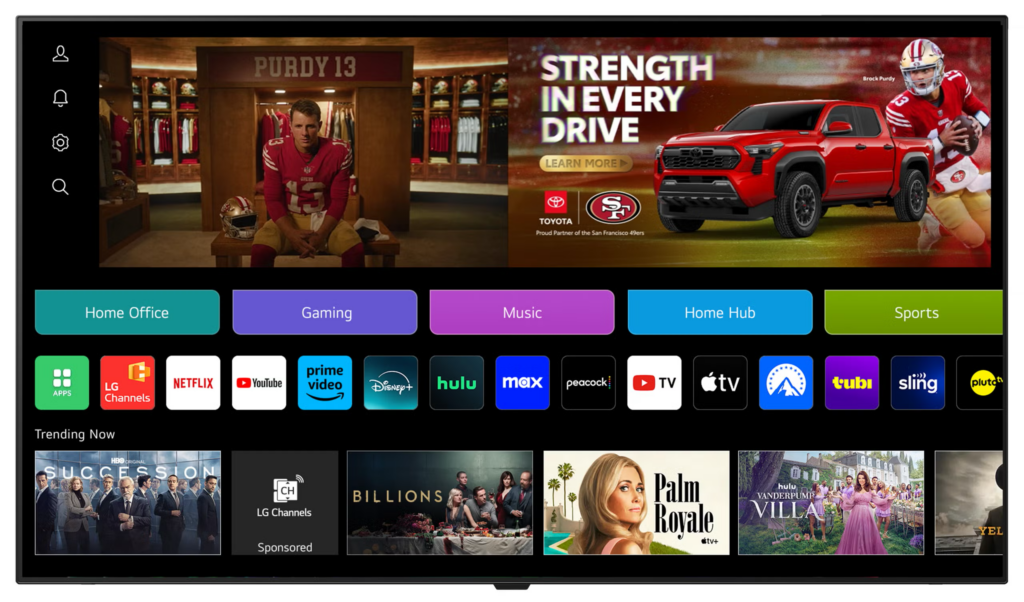
The ad displays in the hero placement on LG home screens in a split-screen format. The ad’s video component plays on the left side of the hero takeover while a static ad picturing Purdy alongside a red Toyota Tacoma is on the right side. The video’s audio component plays when a viewer is hovering over the ad with their remote.
Home screen ads have become “table stakes” in H/L’s ad buying strategy, said Jeremy Cobb, VP at H/L. Many viewers use their phones while streaming and/or stream TV ad-free, so home screen ads help brands capture TV viewers’ attention, which is getting harder to do, he added.
Enter agentic buying infrastructure, which amps up the efficiency and effectiveness of that ad inventory, according to Mike Laband, Group SVP of revenue at Magnite.
Go big or go home (screen)
Magnite already includes home screen inventory in its programmatic rolodex as buyers pine for easier ways to buy streaming ad formats beyond the classic 15- and 30-second spots.
Adding agentic media buying to the equation makes the transaction workflow faster and cleaner, Cobb said. Agentic is “the next evolutionary step in the buying process,” he said.
Magnite’s agentic infrastructure sits on top of its existing programmatic products, which includes SpringServe, its video ad serving and mediation platform, and ClearLine, the direct-to-buyer platform.
For this campaign, H/L’s buyer agent collaborated with Magnite’s seller agent within ClearLine via Model Context Protocol (MCP). MCP is an open-source specification also known as the AI plumbing layer that helps AI products, agents and large-language models communicate with each other in a controlled environment and perform tasks across different systems.
In English: These agents set up and activated H/L’s campaign brief based on the advertiser’s desired audience – NFL viewers who are also in market for a new car.
That agent-led media plan was ultimately approved by LG and H/L, ensuring that human eyeballs vetted the campaign before it went live, Laband said.
Touchdown!
For Toyota, this campaign was more of an upper-funnel branding play, Cobb said.
Home screen inventory gives advertisers a chance to engage viewers before they get lost in a show, especially if those viewers stream ad-free (which many of them do). That engagement is a hot commodity, in part because more viewers are using a second screen, like a cellphone or laptop, while they watch TV, Cobb said. “Just because [TV] is the biggest screen in the house doesn’t mean it has the most attention,” he said.
Home screen mastheads are a great opportunity to grab a viewer’s attention while they’re in a mindset that’s more receptive to advertising, Cobb said, referring to those few precious moments before someone gets simultaneously lost in a show and their social media feeds.
“People hate advertising, but we know it works,” Cobb said. It works if it’s done right, that is – and getting it right requires choosing moments of high attention while also respecting the user experience with less interruptive ad formats, he said. And attention is the prerequisite for the level of brand awareness that ultimately creates business outcomes.
For this campaign, Cobb said, H/L is looking at cost per reach as its main metric of success based on an optimal balance between reach and frequency. But the campaign is more of a branding play, he added, referring to upper-funnel success metrics, including reach and awareness.
At the same time, however, “the standard marketing funnel is dead,” Cobb said, and upper-funnel branding efforts are essential to “ensure consumers come down the funnel the way we want them to.”
In other words, the TV industry’s infatuation with performance still exists, but is normalizing to include a more appropriate focus on the attention and awareness that are the main ingredients to encouraging sales later on.
And the speed, efficiency and control that agentic buying creates should only expedite that journey to success, Cobb said.
“Agentic media buying is not something that’s going to fundamentally change what we’re doing” from a marketing perspective, Cobb said. But he does expect it to make campaign planning work better, faster and stronger.