
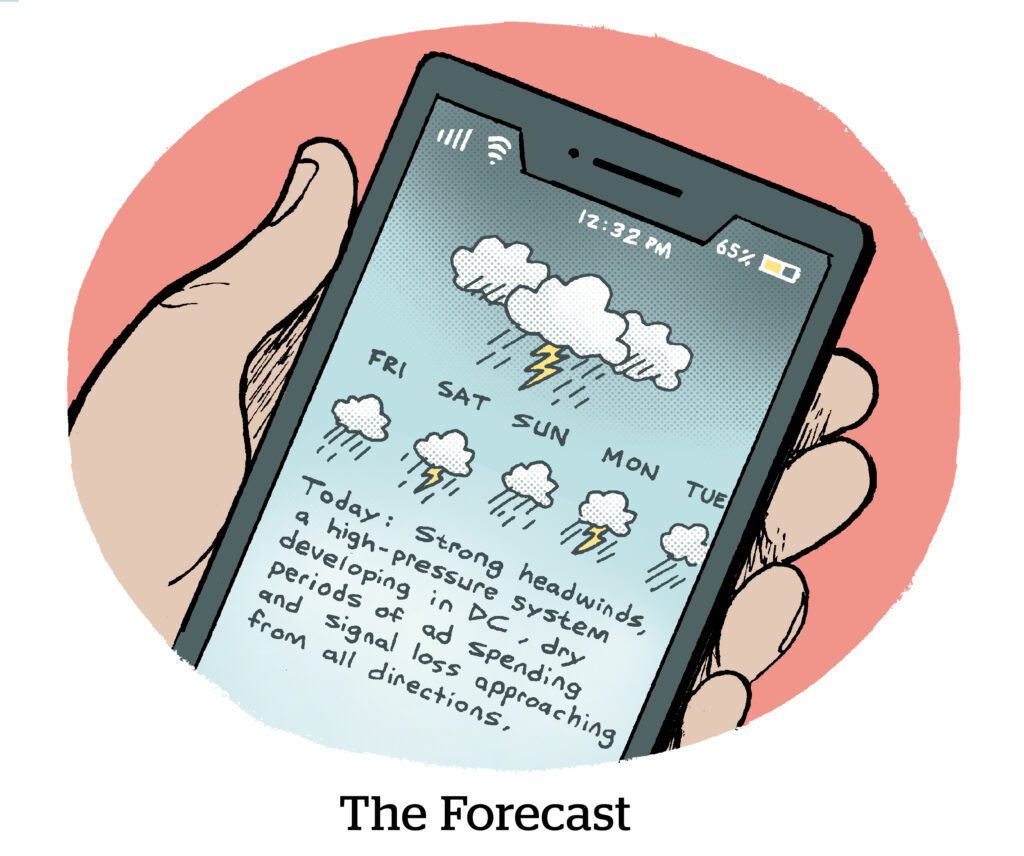
With a feared recession yet to materialize, GroupM is feeling somewhat optimistic.
In its midyear forecast, released on Monday, the holding company predicts that global advertising is on track to grow 5.9% in 2023, in line with its projection from December.
Still, that number represents negative growth when accounting for inflation. While 2022 started out strong and slumped in the second half of the year, the inverse is happening in 2023.

Ad revenues in the first half were coming out of a trough because “inflation was a bit stickier and interest rates continued to rise for longer than we had thought,” said Kate Scott-Dawkins, global president of business intelligence at GroupM.
“We expect more of a recovery story in the second half of the year,” she said.
GroupM projects that global ad revenue will reach $874.5 billion in 2023, excluding political ad spend, and that US ad revenue will grow by 5.1% this year to $325.3 billion and by 5% in 2024.
RMNs on the rise
Digital ad revenue as a portion of overall ad spending is also set to grow. It’ll be up by 8.4% this year and make up 74.4% of total ad revenue by 2028.
The dominance of digital and the maturity of the sector means that digital ad revenue will no longer grow at double-digit rates. GroupM predicts digital ad revenue growth to continue slowing down over the next five years.
But there are certain standout channels within digital that will keep on growing at a breakneck pace.
For instance, retail media, including delivery services such as Instacart, DoorDash, UberEats and Amazon, will grow 9.9% to $125.7 billion in 2023, making up 15.4% of total ad revenue by 2028. In a telling sign of its powerhouse status, retail media revenue is expected to surpass overall TV revenue by 2028.
So seductive is retail media’s call that many companies are pulling money from trade budgets.
“There is this push within CPG, the biggest endemic category for retail media, to bring [trade and marketing] closer together, to have visibility over the entire spend with these retailers,” Scott-Dawkins said.
This inevitable shift of trade budgets to online media could get a little awkward, however, because the fight for budget creates competition between a brand’s trade marketing team and its digital marketing team.
Growing like a weed
But while retail media is expanding rapidly, it’s only the third-fastest-growing category within digital.
According to GroupM, digital out-of-home (DOOH) and CTV take first and second place on the podium in terms of growth rate (although it should be said that ad spend across both categories is still tiny compared to retail media).
DOOH will grow 26.1% to $13.3 billion in 2023, capturing 37.2% of all OOH revenue. By 2028, DOOH revenue will represent 43% of OOH revenue.
And out-of-home as a whole recovered a year earlier than projected in GroupM’s December forecast. GroupM pegs global OOH to grow 12.7% in 2023 and keep growing through 2028.
CTV ad revenue, meanwhile, is set to increase by 13.2% to $25.9 billion in 2023 – and there’s still runway for growth.
In the US, subscription video on demand (SVOD) has grown more popular over the years. Still, only 21.6% of consumer video spending went to SVOD in 2022. So streaming providers have plenty of room to grow their subscriber bases.
“The overwhelming trend for where people are spending their time is toward streaming, especially among younger generations,” Scott-Dawkins said.
You down with UGC
Another behavioral shift driven by younger users is more consumption of user-generated content (UGC) on channels including YouTube, Meta, TikTok, Snap, Pinterest, LinkedIn and Twitter.
“We have seen growth in time spent,” Scott-Dawkins said. “Obviously, ad dollars are following.”
In 2016, UGC represented a scant 9.8% of ad spend, versus 60.2% for professionally produced content. By 2022, UGC seized a 25.6% share of ad dollars, compared to 34.7% for professional content.
But content creation is changing.
GroupM predicts generative AI will inform a minimum of half of all ad revenue, including both media optimization and ad creative, by the end of 2023 and more than two-thirds of advertising by 2028. “AI touches everything,” Scott-Dawkins said. “It’s so pervasive.”
But despite the benefits, such as helping marketers automate repetitive tasks and enhancing decision-making, AI comes with pitfalls as well.
A deluge of AI-generated content, for example, could engulf UGC platforms and the open web until they become so “cluttered with content that you don’t know whether it was created by AI or not, whether it’s true or not,” Scott-Dawkins said.
Brands might hold back their spending on UGC channels due to concern over brand safety issues, she said.
GroupM also sounds a cautionary note on how IP rules and regulations surrounding generative AI are in flux.
For instance, the EU AI Act proposes that companies employing generative AI must disclose any copyrighted assets they tap to train the algorithm. But the US Copyright Office has stated that images produced by generative AI models such as DALL-E 2 and Midjourney can’t be copyrighted.
Gathering clouds
AI will continue to grow despite these hurdles.
But there is no joy in Mudville for other channels. Predictably, linear TV will experience a revenue decline of 1.2% this year.
Still, the overall ad revenue forecast is bright.
Brands continue to spend on advertising despite factors such as macroeconomic pressures, data privacy and antitrust regulation hovering over Big Tech, the ongoing Writers Guild of America strike and surrounding generative AI, according to Scott-Dawkins.