The gaming channel is having a bit of an identity crisis.
On one hand, gaming ad platforms are delivering the targeting and measurement capabilities advertisers expect from other digital channels. That way, gaming can position itself as part of agencies’ omnichannel strategies, rather than being treated as its own scary bucket of stereotypical “gamers.”
But, on the other hand, game platforms are adamant that they need to embrace what sets the gaming channel apart from other forms of media to bring the best value to advertisers.
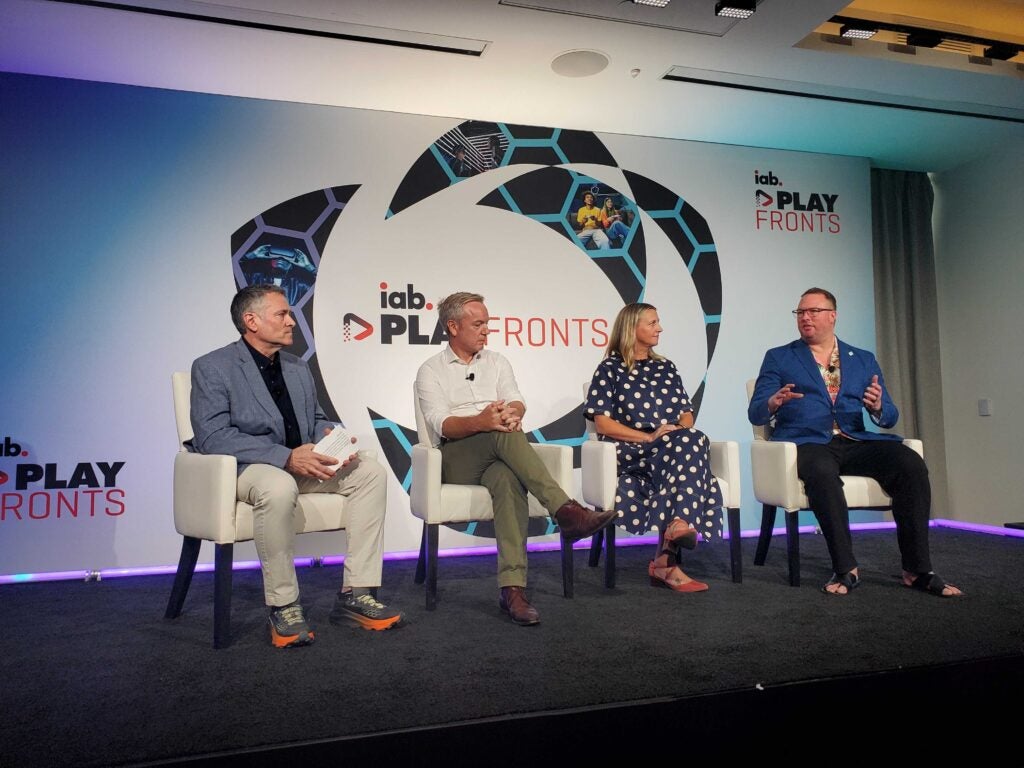
IAB CEO David Cohen spoke to this tension during his opening remarks at the fifth-annual IAB PlayFronts event on Thursday.
Emerging media channels like creator marketing, podcasts and gaming “represent a broader change in how people experience media, and therefore how the industry needs to think about that opportunity,” Cohen said. “We need to resist the temptation to take the models of yesterday and simply put them into the environments of tomorrow.”
While PlayFronts highlighted plenty of ad innovations and inventory unique to gaming, much of the new tech showed off at the event aimed to do exactly what Cohen warned against.

As it turns out, adapting other channels’ tried-and-true strategies might be exactly what gaming platforms need to do to get advertisers comfortable spending more in the channel. Leaning into gaming’s differentiators will have to come later, after bigger budgets arrive.
Proving the case
In many ways, gaming is still trying to prove its audience reach and its ability to produce outcomes to skeptical buyers.
The IAB has helped legitimize gaming as an advertising channel by updating its gaming measurement guidelines and rolling out standardized ad units that are easier to buy at scale and measure against other channels.
The organization is now working on a Gaming Buyer Map. IAB’s SVP of product development Cintia Gabilan described it as “a practical planning framework” that breaks down which of the channel’s creative types and measurement features are suited for upper- and lower-funnel objectives.
Still, despite years of efforts to make it easier to activate campaigns, gaming is still locked in the “Why won’t advertisers spend more?” cycle that plagues every emerging media channel except for CTV.
Today, gaming attracts just 2.4% of media spend despite the fact that 67% of Americans play video games every week, said Shahar Sorek, CEO of gaming creator platform Overwolf, citing recent research by his company. “This is the single biggest mismatch between attention and investment in media today,” he added.
Advertisers who participated in the Overwolf study said buying gaming inventory is too complicated, and they feel it’s too hard to prove results.
To address those concerns, Overwolf announced at PlayFronts its new In-Game Audience Map, a media planning tool that helps buyers find their target audiences across more than 5,000 game titles. It’s based on Overwolf’s first-party data platform, Gamer Grid – which works more or less like any other audience ID graph marketers would use to target ads in other media channels.
Giving marketers a way to target IAB standard ad units across a wide array of games can get gaming more deeply embedded in ad agencies’ media plans, Nathan Lindberg, VP of Global Brand Partnerships at Overwolf, told AdExchanger in a chat after his company’s PlayFronts presentation.
Lindberg added that Overwolf has plenty of gaming-specific inventory and solutions that it can demo to wow advertisers. But, he said, “sexy gets you innovation budgets,” which tend to be just a small share of an agency’s overall spend.
Instead, Overwolf wants to get larger shares of programmatic and direct budgets, Lindberg said, which requires getting in front of agency strategy teams. Hence rolling out a new media planning tool that mimics what they’re used to in other channels.
But Overwolf is also pitching potential partners on the unique attribution capabilities it can provide as a desktop-based app for gaming creators and their communities.
Because its app lives on a user’s computer as an executable file, Lindberg said, Overwolf can tell what hardware and peripherals they have connected to that device. Which, he said, comes in handy when measuring campaigns for companies selling headsets, controllers and graphics cards.
The publisher playbook
There were even more examples of gaming platforms taking cues from other media channels at PlayFronts.
Zynga, the Take Two-owned mobile app publisher, announced the launch of its own third-party publisher network, Zynga Ads+. It’s a similar play to how other large digital publishers like People Inc. have extended their ad platforms to off-network sites.
And, in a nod to the media quality concerns that follow digital publishers’ third-party ad networks, Zynga Ads+ has its own quality controls: It’s only letting apps with an App Store rating of 4.5 or higher into its network, and it’s promising brand-safe and high-attention inventory as scored by its measurement partner, DoubleVerify.
Meanwhile, gaming news site IGN is following many of its fellow digital pubs in using AI and its own audience intelligence platform, called IMAGINE, to revamp its display advertising experience. But it did so with a twist tailored to its gaming audience.
In partnership with AI agent platform Firsthand, IGN created interactive display ad units for a campaign for graphics processor brand AMD that gave readers different prompts tailored to the content they’re reading. Say a person reads a review of Capcom’s new game “Onimusha: Way of the Sword,” then moves to an article about building your own gaming PC. The display ad would prompt the reader to learn whether they need to upgrade to a new AMD graphics card to play Onimusha.
Video verisimilitude
But gaming’s attempt to balance between being just another media channel while hyping its differentiators really came to the forefront whenever video strategy was discussed at PlayFronts.
When dealing with advertisers, it can be hard to decide whether to play the gaming card or say, “I’m just a video network like any other, and you can buy me through DV360 or The Trade Desk,” said Jean-Baptiste Godinot, SVP of Gameloft for brands, the advertising arm of the French game publisher.
Roblox likewise touted its integrations with DV360 and other programmatic platforms. It’s all part of making its video inventory easier for advertisers to buy using their preferred methods, said Mike Schoelch, head of agency partnerships at Roblox.
However, the many ways advertisers can buy gaming inventory might be causing gaming’s share of spend to be undercounted, said Andy Martinson, senior marketing manager at H&R Block. “Is a Twitch campaign gaming, or is that programmatic?” he wondered. “Is a creator campaign gaming, or is that social? Is an integration in a game the only thing that counts as gaming?”
While Martinson acknowledged that gaming spend can be pulled from different budgets, he also encouraged buyers to treat gaming as its own channel and experiment with its unique creative options, from deep in-game integrations to more typical rewarded video. And, he added, the inventory is cheap – so “you can enter this space and play with it without spending tens of millions of dollars.”
Speaking of rewarded video, that format – which has always been associated with mobile games – has until recently been treated by many on the buy side as a joke, said Frank Puma, managing director of investment and activation at WPP Media. But, he said, now that premium platforms like Roblox are embracing it and proving it can drive results, he’s seen buyers change their tune.
For example, Roblox’s Schoelch pointed to a recent rewarded video campaign the Walmart subsidiary Sam’s Club ran on the platform. For engaging with the video units, Roblox players were rewarded with virtual Sam’s Club membership cards. The campaign produced 5 million engaged impressions, with a million users claiming virtual cards. The results translated to in-store purchases, too, with an 18% lift in sales per cardholder and a 6% lift in conversions, according to consumer research platform Cint.
Given results like these, Puma said, it’s become easier to get brands onboard with rewarded video as just another video format – but one that brings to bear gaming’s unique value exchange, in which both the consumer and the brand get something out of the experience.