Agentic Frenemies
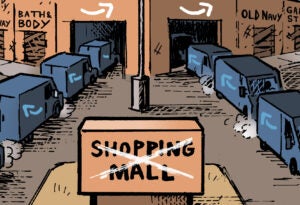
Agentic commerce: Is it real? That’s the trillion-dollar question.
And the biggest retailers are convinced the answer is “yes.”
Walmart reported Q4 earnings yesterday and disclosed that the average order value for people using its AI shopper assistant Sparky is roughly 35% higher than for those who don’t. Amazon, meanwhile, claims its agentic assistant Rufus generated $12 billion in incremental sales during its first season – a figure that, as Jason Del Rey points out in The Aisle, Amazon hasn’t substantiated or detailed.

Be that as it may, agentic commerce is also spawning new partnerships and integrations, most of which are enemy-of-my-enemy-type alliances.
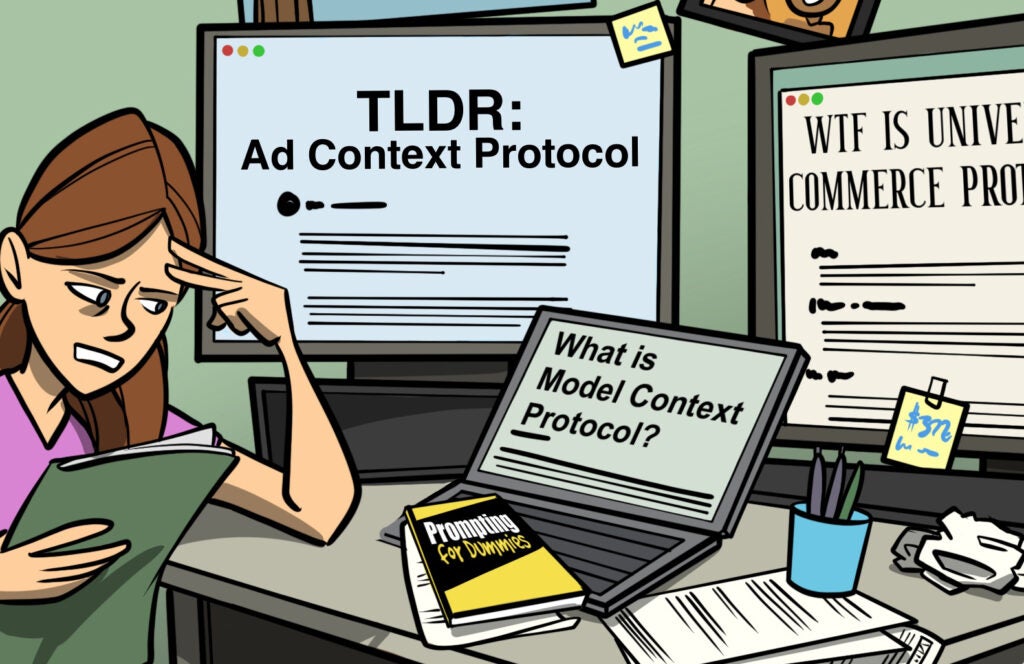
Last month, Google and Shopify debuted an AI framework called the Universal Commerce Protocol, which they hope will become a de facto standard for purchases via agentic tech. Walmart and Target are on board, among other retailers. The UCP came a couple of months after OpenAI introduced the Agentic Commerce Protocol, with early backers PayPal and Stripe.
These protocols are competing with each other – but all of them are really aimed at countering Amazon, which is probably the only player that could do it alone.
Then again, maybe not. The Aisle also reports that Amazon and OpenAI have held talks about incorporating OpenAI’s models into Amazon’s shopping recommendations.
In Pursuit Of Ad-free-ness
According to its critics, ads in AI chatbots are disruptive, erode trust and can even feel manipulative.
That, purportedly, is why Perplexity is officially pulling the plug on ads, for now at least.
Introducing ads into the experience makes users start “just doubting everything,” a Perplexity executive told the Financial Times, “which is why we don’t see it as a fruitful thing to focus on right now.”
This rationale might be more believable if Perplexity hadn’t been one of the first chatbots to launch ads back in late 2024, and then struggled to satisfy business and client needs. Perplexity’s now-former ad chief Taz Patel left the company after less than a year, and his performance received lukewarm feedback from brand clients.
In October, Perplexity announced that it would no longer take on new advertisers. And, earlier this week, execs confirmed the move is already underway, telling FT that Perplexity has been winding down its ad operations since late last year with “no plans to pursue advertising further.”
So maybe Perplexity really did have a change of heart – or maybe, after Anthropic’s Super Bowl ad, it saw an opportunity to steer the conversation from performance to principles.
I’m Lovin’ App!
If you can’t join ’em, beat ’em?
After an unsuccessful (and somewhat performative) attempt to buy TikTok’s US business, AppLovin is instead hinting at plans to develop its own social media platform, Bloomberg reports.
No official announcement has been made, but the company is currently hiring for a software engineer in its Singapore office who will “architect the digital backbone of our next-generation social platform.”
The idea is not without merit. Thanks to recent privacy policy updates, technical glitches and perceived censorship concerns, TikTok is newly vulnerable in a way it hasn’t been since it got banned. Yet a strong alternative to TikTok’s scrollable short-form video feed has yet to emerge – only offshoots of existing platforms, like Instagram Reels and YouTube Shorts.
Unlike Google and Meta, however, which had to build their respective ad platforms over time, AppLovin’s already got one. Which would be great for advertisers, but potentially tricky for winning over users.
After all, these days a lot of new social platforms market themselves by what they don’t have – as in, no ads, no algorithms, no AI. So how will AppLovin position itself against the big players if it can’t make those same claims?
But Wait! There’s More!
Ring’s founder knows everyone hated his company’s Super Bowl ad. [NYT]
The IAB Tech Lab releases new standards for delivering ads during live streaming events. [TV Tech]
Google launched a no-coding-required version of its Meridian MMM tool. [Adweek]
In an escalation of the brinksmanship between the US and EU over content moderation and free speech, the US State Department plans to launch an online portal where people outside the US can see content banned by their governments, including alleged hate speech and terrorist propaganda. [Reuters]
Meta CEO Mark Zuckerberg testified in a high-profile social media addiction trial on Wednesday to defend his platform from accusations that it exploits kids and teens for profit. [CNN]
In other Meta news, the company began its $65 million election-season blitz and launched four super PACs to support state politicians who oppose AI regulation. [NYT]
Oh, and Meta is also shutting down its standalone Messenger website. [TechCrunch]
In addition to teeming with AI slop, Pinterest has implemented moderation tools that can’t always tell the difference between humans and bots. [404 Media]
Why LLMs struggle with long-form content. [blog]
The concerns over age verification technology. [Rest of World]
You’re Hired!
Jon Nash and Danny Moggs join custom algorithm company 59A as part of its North American expansion. [release]
Bra and intimate apparel brand Bare Necessities names Salima Popatia as president. [release]
Here’s today’s AdExchanger.com news round-up… Want it by email? Sign up here.