
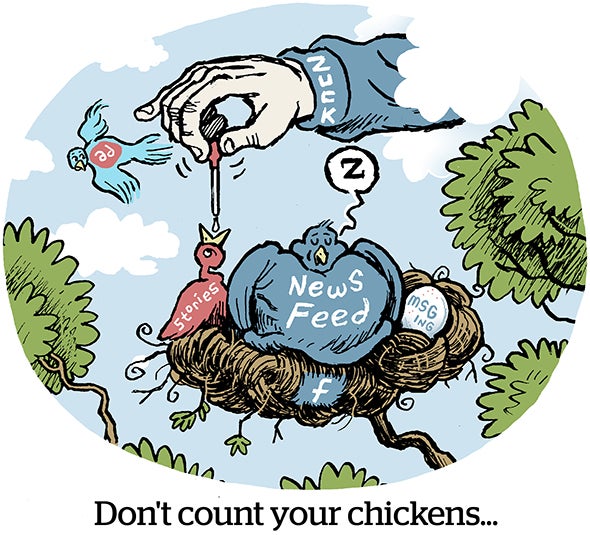
Comic: Room For More?
A weekly comic strip from AdExchanger.com that highlights the digital advertising ecosystem…

A weekly comic strip from AdExchanger.com that highlights the digital advertising ecosystem…

Here’s today’s AdExchanger.com news round-up… Want it by email? Sign up here. No Compromise For Google Google’s reported offer to US regulators as a bid to avoid an antitrust suit was to spin off part of its ad business. But that news apparently landed with a thud. The Department of Justice is poised to move […]

Google may have a solution to the antitrust regulatory pressure it’s facing from governments around the world: a proactive spinoff. Alphabet, Google’s parent company, is exploring splitting Google’s digital ad business into a separate entity under the Alphabet umbrella. The question is whether Google’s proposed solution will pass muster with regulators, and if it does, who stands to win – and who stands to lose?
Here’s today’s AdExchanger.com news round-up… Want it by email? Sign up here. Get The Net Netflix isn’t just vetting third-party vendors for its pre-launch ad business (though it is vetting vendors, to be clear). The streaming leader is on the hunt for an executive to lead its incubating advertising business, The Wall Street Journal reports. […]

The impending Google customer force-shift from Universal Analytics (UA) to Google Analytics 4 (GA4) represents a major change to how advertising ROI will be measured via Google’s services going forward. But publishers that spoke to AdExchanger about their migration plans aren’t feeling the same pressure as with, say, preparation for third-party cookie deprecation, Google’s other major upheaval scheduled for next year.

The overturn of Roe v. Wade, the ongoing war in Ukraine, a stock market collapse – it’s all the news that’s fit to print, but how are publishers going to monetize it if brands are skittish about serious topics? Plus: The dangers of data collection in a post-Roe world.

Brands and tech vendors can do a lot more to make good on their public promises to support diverse and Black-owned media, says Rhonesha Byng, the CEO and founder of Her Agenda, a digital media platform for millennial women, and co-creator of the Black Owned Media Equity and Sustainability Institute.

Google recently began testing Topics API, the latest part of its Chrome Privacy Sandbox. It’s a significant improvement over FLoC, but it leaks audience information from trustworthy sites and enriches large platforms at the expense of niche or independent sites – especially sites that invest time and skill to cover categories in detail, writes Don Marti, VP of ecosystem innovation at CafeMedia.

What happens when your main monetization partner starts flagging your content as spam? Freecycle turned to header bidding to reduce its reliance on Google AdSense, but the company’s one-person engineering team had trouble managing the header-bidding system and the constant stream of Prebid updates on top of web development duties. So, after a 70% drop in ad revenue, Freecycle handed its digital ad business over to PubWise’s managed service.

Keyword blocklists are blunt instruments, and yet they persist in programmatic media buying. It’s time to kick blocklists to the curb and start curating keywords by campaign, says contextual pioneer John Snyder, who sold his company, Grapeshot, to Oracle in 2018.

Why wouldn’t DSPs want to secure the best possible access to OTT inventory through programmatic while accessing the impression commitments and set pricing provided by direct deals? If DSPs want to compete with more traditional advertising platforms, they will need to do just that, writes Doug Huntington, CEO of FatTail.

Here’s today’s AdExchanger.com news round-up… Want it by email? Sign up here. Paid Upfront NBCUniversal says this year’s upfronts was its highest-grossing since Comcast acquired the programmer in 2013. Unsurprisingly, streaming media helped break the record. Of NBCU’s $7 billion in ad commitments, per a release, $1 billion is earmarked for its AVOD service Peacock […]

Google’s decision to delay third-party cookie deprecation until 2023 came the day before Salon CRO Justin Wohl’s wedding. Salon had converted its ad business to an open-web programmatic model a few years earlier, so the brief reprieve from signal loss came as a huge relief and another reason to pop some champagne. Since then, Wohl has been laying the groundwork for effective post-cookie monetization on the open web.

Here’s today’s AdExchanger.com news round-up… Want it by email? Sign up here. The Personalization Delusion The ability to dynamically scale creative and A/B test dozens – even hundreds – of ad campaign permutations, all potentially targeting specific audience types, has led marketers away from making a single piece of creative that stands alone and appeals to as […]

Ad agencies are understaffed and their clients – small businesses in particular – often don’t have the time or the technical background to sift through reams of campaign data. And so, increasingly, they’re turning to automation to cut down on the more tedious and time-consuming aspects of account management. Tag, an independent agency based in Iowa, uses a suite of automated reporting tools, including from Basis Technologies, to communicate cross-platform campaign metrics to its clients.

Foundry, formerly known as IDG Communications, wants to shed its old identity and build a new reputation not as a digital publisher but as a provider of data and marketing tech, according to Foundry President Kumaran Ramanathan. Ramanathan spoke to AdExchanger about why Foundry walked away from open-web programmatic, how it’s fusing its first-party data with a marketing and data tech stack and its M&A ambitions.

Here’s today’s AdExchanger.com news round-up… Want it by email? Sign up here. Get Connected The coveted prizes in programmatic right now are exclusive CTV contracts. In Cannes, the crème de la crème for handshakers and lunch-takers is Netflix. Google is meeting with Netflix there, Ad Age reports, and is an obvious choice as Netflix purportedly […]

Instead of a funnel that slows traffic, we need to create a ubiquitous, always-accessible “sales superhighway” that provides countless on-ramps. This change of perspective will impact both how we define our potential audiences and the speed with which we have meaningful interactions with them, writes Lance Porigow, EVP of growth at The Shipyard.

The IAB, in collaboration with the IAB Tech Lab and the Media Rating Council (MRC), released its first update to in-game ad measurement standards since 2009. The new standards reexamine the metrics for counting a valid in-game ad impression and add criteria for measuring ad placements in 3D and virtual environments. They also define in-game measurement terms in alignment with cross-channel measurement efforts.

The market is not being kind to digital media companies. The nearly 40% drop in BuzzFeed’s stock price on Monday and the decline of its valuation from $1.5 billion when it went public in December to roughly $300 million now is no doubt causing other digital-native publishers to rethink their IPO plans. But any doom and gloom about the long-term viability of digital publishers in public markets is likely overblown.

Connected TV may be the media industry’s shiniest new toy, but it’s not squeaky clean – it’s rife with ad fraud, and high CPMs only make the channel a better target for con artists. Several industry execs discussed why the industry’s best shot is to increase transparency as much as possible across the bid stream at IAB Tech Lab’s Transcend summit.

Here’s today’s AdExchanger.com news round-up… Want it by email? Sign up here. Baby Steps Babylist began as a registry to combine a gift registry and services (like helping new parents by arranging dog walks) with an affiliate revenue model. Although the approach worked well, 85% of Babylist’s sales went to a single retail partner, CEO […]

As clients look for alternatives to third-party cookies, ad agency Dentsu can steer them to its in-house Contextual Intelligence tool, which launched today. Although contextual targeting is often considered inferior to demographic or behavioral targeting, it can drive performance. Jewelry retailer Pandora piloted the tool during the 2022 Valentine’s Day season. Ads placed using the solution represented 2% of campaign spend, but drove 36% of revenue, a 24x return on investment.

Cookie deprecation is hanging over the media and advertising industry like a storm cloud. New identity solutions built on first-party data are clearly one solution, but publishers and advertisers differ on whether they’re building their own proprietary solution or a shared shelter that will scale – and explained why at AdMonsters’ Ops conference in New York City.

Here’s today’s AdExchanger.com news round-up… Want it by email? Sign up here. Brick By Brick-And-Mortar The march of the retail media networks cannot be stopped. Dollar General on Tuesday announced a rebrand of its advertising business, now DGMN (for Dollar General Media Network), to extend its data to ad-buying across the web. According to the […]

Here’s today’s AdExchanger.com news round-up… Want it by email? Sign up here. Whoop Deduped Open Bidding, Google’s alternative to header bidding that maintains its high take rate, has been in the hot seat since last year, after a state-led antitrust suit revealed the lengths to which Google went to stymie header-bidding adoption. The Trade Desk cranked […]

You’ve probably heard (dozens of times) by now that first-party data will be the key to post-third-party-cookie ad targeting. But what exactly is first-party data? How does it differ from second-party, third-party and zero-party data? And what makes first-party data more suited to a privacy-centric ad experience?

In order to gain access to performance advertising budgets (and prove out the power of publisher first-party data), Vox Media is relaunching Group Nine’s G9 Direct performance marketing solution under the new name VM Connect. The relaunch is also a milestone in Vox Media’s integration of Group Nine’s digital properties and tech stack following its […]

The programmatic market continues to boom as marketers shift more of their budgets to digital channels. But despite the incredible scale of this ecosystem, the market is still maturing – and true price discovery and price setting at a level of granularity that reflects true marketplace dynamics can help fill some of those gaps, writes Andrew Casale, president and CEO of Index Exchange.

At Programmatic I/O in Las Vegas, CafeMedia’s Paul Bannister, Tinuiti’s Nirish Parsad and Insider’s Jana Meron weighed in on the ad industry’s worsening signal-loss problem due to the deprecation of device identifiers and third-party cookies.

Apple’s WebKit crackdown appears to extend well beyond The Trade Desk, putting hundreds of ad tech, data and identity vendors on a mysterious, dynamically updated block list.

Zoom has 99% unaided brand awareness, which sounds great on paper. But there’s a catch: Most people still think it’s just a video-call app.

Agencies are differentiating their tech stacks by building custom agentic AI tools for their clients. And they’re rethinking owning those AI tools – particularly since licensing them creates new revenue streams.


Agencies and marketers discussed the future of AI governance at AdExchanger’s Programmatic IO NYC this week. The main takeaway? Expect insurers to play an increasingly important role in managing AI compliance.

The Trade Desk is unable to serve ads to the Safari browser for Apple device owners that have downloaded iOS 27. Apple has been investigating the issue since last week.

The open web is done, stick a fork in it. Banner blindness is near universal, search traffic has run dry and publishers are struggling for oxygen. But what if that’s … not true?