
Here’s today’s AdExchanger.com news round-up… Want it by email? Sign up here.
Did The Oracle Get It Wrong?
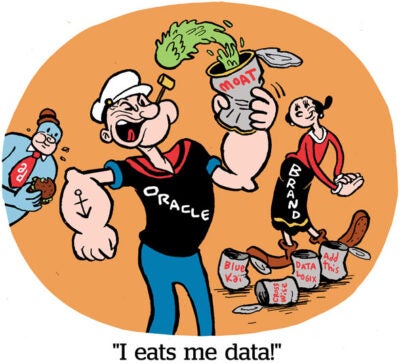
Is it time to call it on Oracle Advertising?
The group had painful layoffs this summer and has fallen behind rivals, Insider reports.
Oracle spent $4 billion to package BlueKai, Datalogix, Moat and more into what’s now Oracle Advertising (formerly Oracle Marketing Cloud, which became Oracle Data Cloud before taking the current form).
The rival ad suites by Salesforce, Adobe and Braze offered steep discounts that Oracle simply would not match, sources tell Insider.
The Salesforce Marketing and Commerce Cloud made $3.9 billion last year. Oracle Advertising reportedly brought in $2 billion.
On the other hand, the ad group is not a critical component for Oracle.
Oracle’s share value doubled between when it acquired Moat in 2017 and November last year, before the market crash. Salesforce shares tripled during that span.
But after Facebook and … uhh … Europe kicked out third-party audience sellers, key pieces of the Oracle Advertising business went defunct. (AddThis, we hardly knew ye.)
Moat, the former leader in verification, now trails DoubleVerify and Integral Ad Science. Both rivals IPO’d last year, and with market caps right now of $4.4 billion and $1.4 billion, respectively, both are heavy hitters in programmatic.

Go With The Stream
Nielsen’s July TV viewership report confirmed that streaming has surpassed linear television in terms of its share of TV attention time, Ad Age reports. The share of attention for streaming was a 34.8% plurality. That’s up 3% since June and 22.6% from the previous year. Finally, a fact that American TV watchers knew to be true has been stamped as true by TV’s official stamper of things as true.
Netflix may be struggling in the marketplace, but it’s dominant in the share of eyeballs, according to Nielsen. The streaming leader has an 8% share of all consumption (not just streaming). YouTube and YouTube TV combined boast 7.3% of viewing, while Hulu (3.6%), Prime (3%), Disney+ (1.8%) and HBO (1%) are the only others with a point or more to their name.
The rest of the entire streaming and AVOD market takes up 10.2%, according to Nielsen numbers.
Although, holding just 10.2% of the market isn’t necessarily terrible news for the long tail of streaming and CTV. There aren’t nearly as many players competing as within the long tail of the internet. And the value of the data and advertising means even a sliver of toehold has real value.
The DPA Dings The TCF, Round Two
Back in February, the Belgian Data Protection Authority (DPA) slapped the IAB with a 250,000-Euro-per-day fine for GDPR violations related to the IAB’s Transparency and Consent Framework (TCF).
The TCF allows publishers to convey consent data for advertising purposes in real-time bid requests on the open web. But the GDPR requires companies to have a valid legal basis for processing user-level personal data. The TCF allows too many players in the open web to process personal data without legal standing, according to the DPA.
The DPA also charges the IAB with not educating consumers on how their data is processed or the data security measures.
The IAB is appealing the decision and looking at ways to bring the TCF into GDPR compliance. But the IAB’s attempt to uphold the open web’s status quo is likely to fall short of the DPA’s demands, according to Digital Context Next’s Chris Pedigo.
So what are the implications if the IAB doesn’t win its appeal? Programmatic companies will likely have to deploy safeguards to mask user data and limit access to partners. And premium publishers, who tend to have more trust from users when it comes to their data, could stand to benefit.
But Wait, There’s More!
Spotify extends podcast tools to Megaphone podcast publishers. [Adweek]
PubMatic partnership with Havas Media Group makes it a preferred SSP. [release]
Google workers press company to stop collecting abortion data. [WSJ] Relatedly, a Mozilla review of pregnancy and period trackers sheds light on data privacy concerns. [Digiday]
Google: More content by people, for people in Search. [blog]
Big Tech has a message for Schumer. We come bearing gifts. [Bloomberg]
You’re Hired!
Extreme Reach expands its digital team with two UK hires. [release]








