Why Don’t Marketers Demand Better?; Attack of the Job-Killing Robots
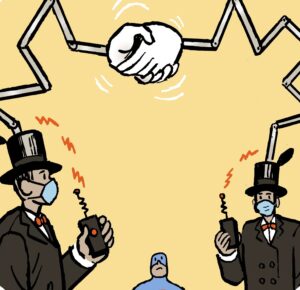
Wouldn’t it be great to enact standards rather than talk about them?; Amazon wants to go fully automated; and revenue doesn’t seem to drop like search traffic does.
Deli meat company Land O’Frost has been leaning into a new MMM approach to figure out which opportunities it’s been overlooking – or even inhibiting.
CTV has become a powerful full-funnel channel, attracting advertisers of all sizes – and the momentum isn’t slowing.
CTV ad spend is projected to rise another 16% this year to $26.6 billion, according to the IAB. But with rapid growth comes complexity. Advertisers now face a maze of platforms, apps and channels, each with different buying models, audience access and inconsistent measurement. For SMBs without large teams or budgets, this fragmentation is especially challenging to navigate.
It has long been understood that brand is advertising’s most powerful driver of growth. Yet, in a marketplace worth more than one trillion dollars, less than 10% of digital campaigns track brand outcomes.
The AI advertising agents will need their own trade group eventually. For now though, a bunch of companies are forming the Ad Context Protocol, or AdCP.
In today’s economic climate, every marketing dollar is under scrutiny. CMOs aren’t just required to build brands and grow demand; they’re expected to prove that their budgets drive measurable business value. And no one is more invested in that proof than the CFO.
The desire for a data-driven reinvention of OOH inspired OUTFRONT to create agentic AI tools for executing and measuring OOH campaigns and comparing OOH to other channels.
On Tuesday, game engine Unity, which has a growing advertising business, announced the appointment of Chris Feo as its new SVP of programmatic.
Apple TV is losing its plus; Agentic AI is ruining the ad tech equilibrium; and Google insists that search is still solid.
New Yorkers are bombarded by ads at every turn. But targeted ads? For your industry? While you’re on your way to an event for that industry? The surreality of that experience can still pack a punch.
Advertisers are still having a lot of the same brand-safety problems today as he did years ago – and it’s pretty damned frustrating.
Alvaro Bedoya shared his qualms with digital advertising’s more controversial targeting tactics and how kids use gen AI and social media.
The number and scope of U.S. laws that require advertisers to disclose the use of AI are limited. But there are some restrictions and guidelines that advertisers must follow to ensure their compliance.
Bringing media buying in-house is “chaotic and disruptive” – but totally worth it, according to Glenniss Richards, Bayer’s senior director of digital media.
Mike Hauptman, co-founder of AdLib, discusses the company’s evolution and how AI is changing the future of both AdLib and ad tech as a whole.
Principal-based buying isn’t inherently bad. When incentives are aligned, clients get more precision and speed than traditional agency models often allow. The issue isn’t the mechanism; it’s the incentives.
Marketing has long struggled to prove itself as a growth engine. What if agentic AI isn’t the threat many fear but the breakthrough marketing always needed?
YouTube backpedals on banning COVID and political misinfo; Tylenol pushes back against Trump’s claims that it causes autism; and Disney doubles down on linear TV and raises Disney+ prices after its Kimmel boycott threat.
Trevor Carr, newly appointed Head of CSA, North America at Havas, discusses data and tech consulting and AI trends.
Advertising using AI-doctored images could spark legal issues if the images are misleading. Plus: the commerce reckoning.
Clear Channel will provide advertisers weekly, mid-flight reports on outcomes driven by its inventory in order to bring OOH measurement closer to the speed of digital.
Last year, Shipt went hunting for a DSP, eyeing new programmatic reach and hyper-local targeting down to the ZIP code.
Best Buy Ads, the consumer electronics chain’s retail media arm, on Tuesday announced a slate of new partnerships and new ad tech features that push it further into ad tech and data services.
From a $637 million PE acquisition of healthcare of a DSP to acquisitions of freshly minted startups, there’s been a flurry of ad tech deals this month. And they have one thing in common: AI.
For too long, marketers have been stuck in a false dilemma: Do you want reach, or do you want relevance? Mass exposure, or accurate targeting?
Concrete findings on how effective QR codes are at driving ad interactions are now available, and some industry best practices are emerging.
Morgan Stanley downgrades The Trade Desk; Warner Bros. Discovery and Nielsen announce a new deal; and brands aren’t sold on virtual influencers.
Incubeta announced its acquisition of RocketSource, a consultancy that helps advertisers understand what drives customer behavior using data science and predictive analytics.
GAM’s dinner with ad agencies sparked speculation that Google is preparing to spin off its bundled SSP and ad server as a remedy to its ad tech monopoly. But Google says it’s just part of the trend of SSPs going direct to buyers.
Google’s search antitrust trial ends with a whimper; the pitfalls of agency-owned SSPs; Perplexity axes its ads business; and brands are still building big-ticket metaverse experiences.