
Rewards App Faces Data Broker Accusations; Apple Loves Advertising, Apparently
Reward Apps faces data broker allegations; Apple bolsters its advertising business; Comments are all the rage in social media marketing.

Reward Apps faces data broker allegations; Apple bolsters its advertising business; Comments are all the rage in social media marketing.
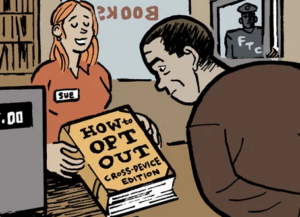
Surprise! Platforms ignore users opting out of ad tracking; the marketing machine claims credit for Geese’s popularity; and Meta’s MAGA-friendly moderation makes an unforced error.

Measurement and performance are expected to dominate convos at upfronts; Tubi doubles down on AI; and Meta takes down ads encouraging anti-Meta lawsuits.

When Apple launched AppTrackingTransparency (ATT) in 2021, access to deterministic identifiers fell sharply as roughly 80% of users opted out of tracking. User-level feedback loops became sparse and biased, and iOS performance marketing shifted into a different measurement environment under SKAdNetwork (SKAN). Apple’s AdAttributionKit (AAK) later delayed postbacks, compressed conversion values and set privacy thresholds that made signal availability dependent on campaign structure and scale.

Pepsi cut ads, raised prices, and now must reverse both; YouTube is bringing interactivity to TV content; Instagram kills “link in bio,” sidelining publishers.

A new marketing intelligence platform helps brands like nutpods address fragmentation by unifying data and inventory across the digital ecosystem.

The effect wasn’t just limited to news content. The Reuters.com/lifestyle vertical also had some of its brand-suitable pages blocked.
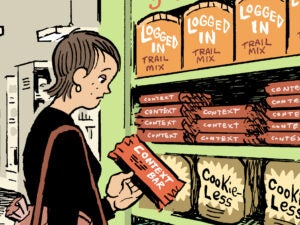
I’m keenly interested by emerging grocery aisle trends, snacks especially. So, I was quick to grab an interview with Andrew Thomas, head of marketing for the meat snack brand Archer, who was being offered to speak to a case study with GumGum regarding CTV pause ads.

Sonia Chung, Boathouse’s new CSO, wants to help the agency (and the industry at large) take full advantage of its data.

Swivel and Olyzon’s new partnership brings buy-side and sell-side agents together as early examples of an agentic marketplace.

Machines can now flag anomalies, surface trends and spin insights in seconds. Yet, even with its speed, AI still can’t decode the “why” behind the “what.”

If you want to protect your margins, your data and your long-term strategy, here are five questions worth asking before you sign anything.
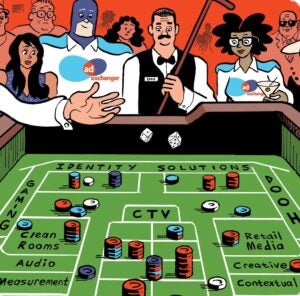
The retail media revolution of data-driven, digital marketing monetization is coming to the sports industry.

Meet Clamor, a new social listening product that pulls cultural insights from online conversations in real time. Clamor helped Manscaped freshen up its marketing, including for this year’s Super Bowl.

The age-old question for streaming TV advertisers is, how to target the viewers they want while reaching the scale their businesses need. The quick-serve restaurant operator CKE, which owns Carl’s Jr. and Hardee’s, sought an answer in a case study with Attain and Amazon Ads.

One web page now needs as much memory to run as an entire operating system did 30 years ago; not even advertisers understand the industry’s acronyms; and prediction markets want to sponsor individual journalists.

If a buyer wants real control, “domain rationalization” alone will never be enough. Buyers need “bid rationalization,” shaping the supply at the bid-request level so they see fewer, better, more outcome-relevant opportunities.

Marketers debate whether to build or buy their tools; Meta is shutting down the VR version of Horizon Worlds; and influencer marketing strives for authenticity.

Ad agency holding companies are among the most adaptable businesses out there. In recent years holdcos like Publicis, WPP and Omnicom-IPG have stretched our notions of what an agency business even is exactly.

Many organizations are encountering a paradox: Performance appears strong, while durable growth remains elusive. How should performance be evaluated when the strongest signals no longer align cleanly with growth?
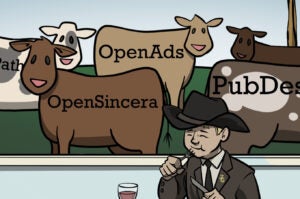
Publicis recommends some clients ditch The Trade Desk; ChatGPT reconsiders its “unlimited” enterprise subscription; and how NYC’s Washington Square Park became an influencer hub.

MyFitnessPal has just announced the launch of a data-driven advertising business that draws on its wealth of user-provided meal planning, fitness and nutrition data.

Complexity hasn’t made the CTV supply chain difficult to trust. This is a transparency problem and, more specifically, an ads.txt problem.

Viant reported its Q4 and full-year 2025 earnings on Wednesday evening and investors appeared pleased.

The deal is an example of OOH platforms building sales infrastructure that interoperates with agency workflows. It’s also an example of DSPs going direct to publishers.

Realtor.com is working with AI marketing startup BrandComms.AI to generate ad creative more quickly and across a wider array of channels.

For MolsonCoors, creative effectiveness is about more than just generating buzz. Ad creative needs to boost sales and improve brand health.

Crossplay is NYT’s first two-player game, and marks the first time that users will see ads within the game experience itself.

Nativo’s founder, Justin “JC” Choi, checks in post-acquisition to share how his tech is helping power Life360’s new advertising business.

The NHL develops new revenue streams; malware makes its way into the programmatic ecosystem; and Target plans to open 30 new locations this year, along with revamping existing ones.

Apple has a new block list for data brokers and ad tech vendors that do cross-site user tracking – which could expand to include a much broader slate of ad tech and martech vendors across the entire ecosystem. Plus: a few thoughts on Advertising Week New York.

Against the backdrop of Advertising Week New York this week, the programmatic ecosystem has been buzzing madly like the inhabitants of an overturned beehive after the release of Apple’s iOS 27.
Given how much agentic AI pervades nearly every conversation these days, it’s easy to overlook how nascent the technology still is, particularly when it comes to buying ads on connected TV.


OAAA COO Patrick Dolan explains how the organization is changing to guide the out-of-home channel through programmatic’s agentic era.

PubX has acquired media-quality startup Compliant and raised a $5 million Series A as it expands its agentic ad-buying platform into the US.

Warner Bros. Discovery has a new white paper analyzing the data and methodologies of five top video measurement providers: VideoAmp, iSpot, Comscore, Innovid and Samba.