

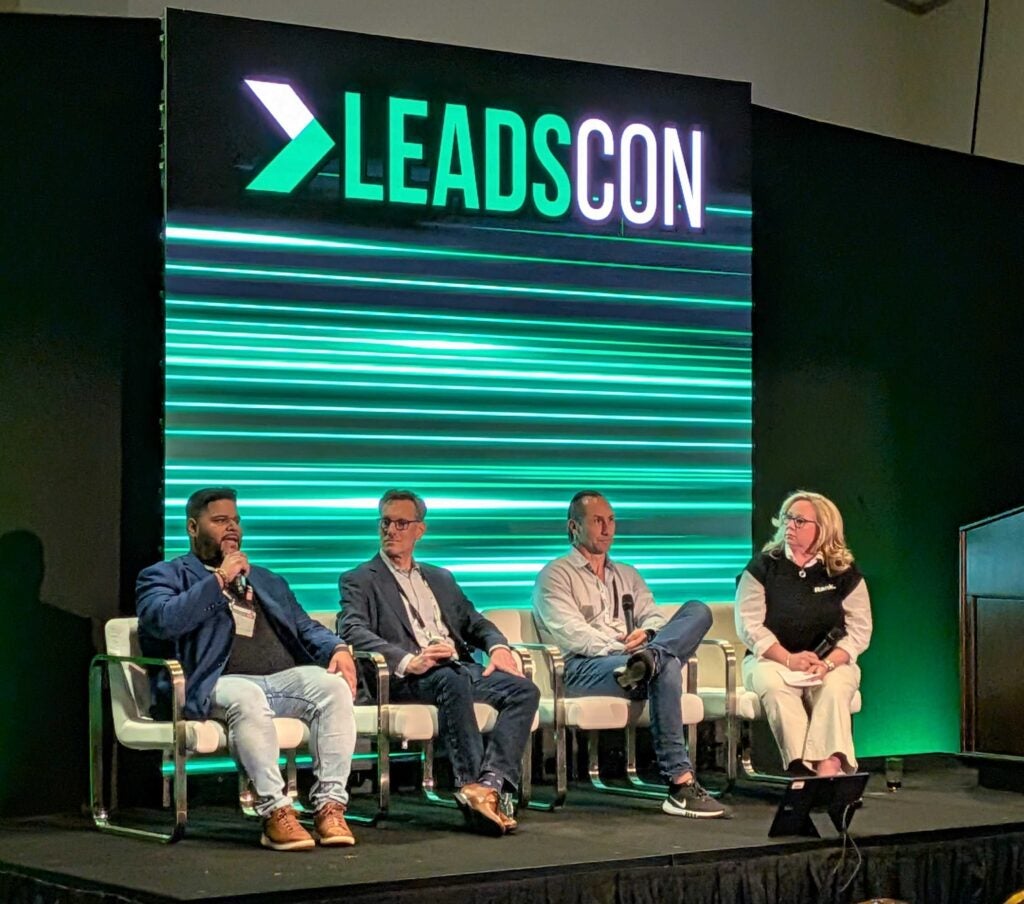
I didn’t expect to walk into a lead generation and customer acquisition-focused event and come out thinking about ad ops.
But that’s exactly what happened when I traveled to Las Vegas for Leadscon last week.
Lead gen and programmatic tend to live in different corners of the ecosystem. Lead gen is obsessed with calls and conversions, while programmatic is focused on impressions and yield. But sitting through sessions on customer lifetime value and creator-led video performance, it became clear to me that lead gen and programmatic folks are trying to solve the same problem, just from different angles.

Both are wrestling with the hard truth that they’ve spent years optimizing for the wrong signals.
For ad ops teams, that usually means cheap CPMs, cost per acquisition and volume. But those metrics rarely answer the question that finance and leadership actually care about, which is whether you’re targeting people with the potential for high lifetime value.
My main takeaway from Leadscon is that nothing will save you, including better measurement, if you insist on optimizing for volume over value.
That’s as good a lesson for ad ops as for anyone.
Rethinking performance with an eye on LTV
But what does “good” targeting look like?
Take online insurance marketplace eHealth, which built its lead-gen operating model to drive calls, route them to any available agent, close an enrollment and move on. Sounds efficient on paper, but eHealth was losing close to $100 million annually.
That changed, however, said eHealth CRO Michelle Barbeau, when the company stopped treating each conversion as the finish line.
Instead of optimizing for one-off transactions, eHealth began connecting interactions over time. eHealth assigned a customer a primary advisor who stayed with them, policies were tied to a single profile and success metrics expanded beyond initial enrollment to include renewals, add-ons and retention.
“Enrollment isn’t the goal. Lifetime value is,” Barbeau explained. “If you’re not measuring what happens after that first transaction, you’re missing the majority of the story.”
These shifts had a clear impact. The business moved from deep losses to roughly $95 million in adjusted EBITDA.
For ad ops, the key insight is that not all conversions are equal.
Optimizing toward the lowest CPA typically attracts lower-quality users. Optimizing toward campaigns and channels that bring in customers who stay, spend and return is a far better and more sustainable approach.
Gregg Johnson, CEO of voice solution company Invoca, put it more bluntly: “If you can’t connect calls and clicks to long-term value, you’re just optimizing for volume.”
Driving higher-value users through better advertising inputs
Which is a very true statement, but also begs the question of “how.” It’s one thing to know what good targeting looks like and a different thing to actually do it.
One possible way to get consumers to stick around is to use video and creator-led campaigns as performance drivers – which is something advertisers are very familiar with. But these channels work best when they align with user intent.
Creators need to reach their audiences at specific moments when they’re buying a home, for example, managing debt or making financial decisions – because that’s when users are already primed to act. Good timing changes how people perceive ads and how quickly they’re likely to move through the funnel.
“Creators don’t just drive awareness; they drive decisions as well,” said Don Batsford, Google’s head of industry. “When the message matches the moment, performance follows.”
For ad ops, this reframes how audience targeting should be evaluated. It’s not just about cost efficiency or scale; it’s about whether a channel consistently delivers users with stronger intent and higher downstream value.
Batsford pointed to YouTube, which uses what it calls the ABCD framework (Attention, Branding, Connection, Direction) to structure and evaluate video creative.
Each part of the framework touches on something tangible that can be tested, trafficked and measured. Attention determines whether an impression turns into actual engagement. Branding ensures a message is recognizable and consistent across platforms and devices. The messaging itself establishes relevance by aligning with a specific moment or need. And the call to action provides a clear, trackable path for a user to take the next step.
This structured way of thinking is one way to turn creative from a guessing game into a repeatable, data‑driven process.
“We think about creative as something you can systematically improve,” said Greg Powel, CEO of Money Group, a digital media company that focuses on personal finance. “If you’re not testing and learning from it, you’re leaving performance on the table.”
And that ties directly back to the first session.
From fragmented touch points to owned relationships
To bring it all together, regardless of who you are – whether you’re a lead gen professional or an ad ops expert – your focus should be on value and evolving your targeting strategy to prioritize signals that indicate intent and relevance, not just clicks.
But there are operational gaps that need to be dealt with first.
At eHealth, that meant maintaining a consistent experience over time and creating a relationship between customers and advisors. For video advertisers, meanwhile, there’s the challenge of reaching users across multiple channels, such as mobile, desktop and connected TV, each with different constraints.
The risk is losing context between touch points.
For ad ops, this plays out in how campaigns are executed and what happens after acquisition. Creative must be built for the environment it runs in or performance degrades. But, more importantly, campaigns need to extend beyond the initial conversion. Creators are already moving in this direction, building email lists, communities and direct audience relationships outside of any single platform.
The implication for advertisers is clear: If your campaign ends at the first click, you’re not capturing the full value of that user.







