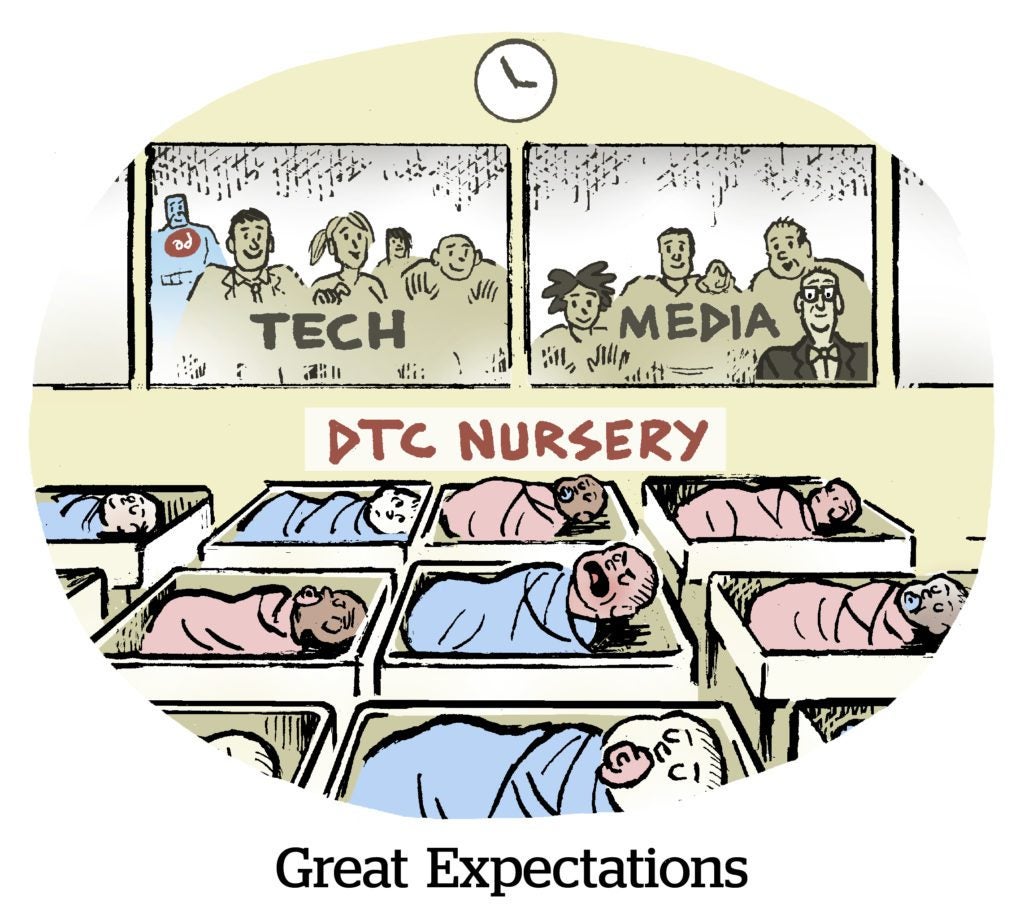
The IAB’s 2026 Connected Commerce Summit in New York City felt to me like the retail media industry’s first sit-down explanation to a child who is now a “big kid” and must act accordingly.
Not the birds-and-bees-type conversation by any means (we’ll save that for the consolidation phase in the future). But an important reality check.
And I’m not the only one to think so.
Collin Colburn, IAB VP of Commerce and Retail Media, who gave the keynote opener, compared this moment in time for the industry to the second and third days of potty training a child. Perhaps you’ve had reason for encouragement and think success is near at hand. Well, your next realization will be that you’ve barely begun a process that requires stick-to-itiveness.

This surfaced my own pet theory about potty training: that parents’ experiences in potty training, like the recollections of felt physical pain, are filed away and can never be precisely recalled. Make of that what you will.
I can’t help but agree with Colburn’s overarching point, which he emphasized to me in a conversation during the show, that runaway optimism and unrealistic expectations are real dangers for the commerce media industry.
Here is a selection of quotes from Colburn’s keynote:
“The uncomfortable truth [the IAB’s new commerce media report] starts from: The market cannot sustain hundreds of undifferentiated commerce media networks.”
“In-store media has to move beyond experimentation. Pilots don’t earn brand dollars. Reliability does.”
“2025 was about committing to our journey. This year is about not turning back when the going gets tough.”
“Over the next 24 to 36 months, every network that doesn’t make a deliberate strategic choice will have one made for them – by advertisers, by consolidation or by quiet irrelevance.”
And he’s right. The entire ecosystem of third-party commerce ad tech and hundreds of retailers has piled expectations behind the category for advertising and marketing data revenue. But the actual spend in the category has accrued mostly to Amazon, then Walmart, and slowing to a trickle after that.
Hard truths
There are a number of things that retailers and commerce ad tech companies need to hear.
For one thing, the IAB Building a More Competitive Commerce Media Ecosystem report, published this week, broached a hidden truth most commerce networks prefer not to talk about.
“Growth in the future hinges on access to national and brand media budgets, not by trade or shopper reallocation alone.”
Grocers and retailers of all sorts, not to mention hotels, airlines, ticket companies, restaurant and delivery services, et al., had marketing revenue lines before they officially packaged together a contemporary CMN. So nobody actually started from zero when launching a media network. Plus, they already have contracts that require products carried in stores to commit a certain percent of sales back to the retailer’s marketing program.
In other words, what often felt like a spectacular first year or two for a new commerce network would slow to a tough plateau.
The success of retail media programs, which require great investment in new people, vendors and/or technology by the retailer (or hotel, credit card, gas station pump, etc.), depends on finding new forms of growth.
Also, as Colburn notes, retailers shouldn’t chase what looks like every opportunity.
Some brick-and-mortar chains or other types of merchants think they’re going to be a media company or a technology company.
“People can say they’re becoming media companies,” he told me. “They’re never going to be media companies.”
Nor should retailers necessarily invest in developing their own tech. A few might sell software that competes with pure-play tech companies, as Instacart and Amazon currently do, Colburn noted. Some want to reach vast scale as fast as possible, he said, or merge their ad businesses with a merchandising group.
Being a retailer is already difficult enough. Consider the immense investments that now-trillion-dollar companies have made in unsuccessful bids to become merchants themselves. It was a huge priority for Meta, which, as of last September, conceded on in-platform checkout to website checkout – the whole original point was to own the checkout – after failing to find traction despite years of toil and expense.
Between 2017 and 2019, Google consolidated its retail programs, such as Google Express, into Google Shopping, with a seeming commitment to take on warehousing, delivery and aspects of fulfillment like customer service and returns.
Which is to say, Google fleetingly tried to become a real merchant. But the tech company pulled back on the whole endeavor as if it had touched a hot stove.
“TikTok is probably the best example of someone who’s actually taken on commerce as a nonretailer,” Colburn told me. But TikTok Shop has persevered through many setbacks and is itself “still kind of niche.”
By the same token, even very well-known retailer chains should not imagine that they can become a media company or a technology company.
Don’t hate, consolidate
The word of the year in retail media is “consolidation.”
2024 and 2025 were the years of standardization. But the energy and urgency behind the standardization push has lost momentum.
Rather, the IAB is more focused on “differentiation,” a term that came up throughout my conversation with Colburn, his keynote and the new commerce report.
Setting commerce media standards “is not a winning proposition this early in this market’s maturity,” Colburn told me.
There are specific places where the IAB can create retail media standards, he said, such as how CMNs report conversions or incremental sales. There are hundreds of retailers or vendors, and they don’t all use the same lookback windows or measurement methodologies. The IAB isn’t mandating certain forms of measurement, but can at least standardize the terms and levels of transparency presented to advertisers.
“We can walk and chew gum at the same time,” Colburn said, by solving for some basic standards while not creating standard formats and inventory types.
“There’s just too much sameness that exists” already across retailers and CMNs, he said.
And if retailers don’t lean into their differentiated value props, they will be consolidated away.
Although, what would consolidation even look like? There are hundreds of commerce or retailer networks, and always more. It’s a punchline at this point. Yet, we’ve only scraped the surface of whole categories like education, personal apps, automotive and sports.
Do they just join Criteo? Do they get together and form a joint venture?
Probably not, Colburn comforted me.
For one thing, some retailers will just spit the whole retail media adventure back out like its spoiled milk. Which, recall, is how Google responded to its brief foray into becoming a retailer.
Outside of the US, for instance, some retailers have already folded on their media businesses. And some of the top grocers and retailers in the UK have recently let go of senior leaders who’d been tasked with growing nascent ad businesses and failed to meet revenue goals, Colburn said.
Other forms of consolidation, he said, could include mergers, acquisitions or strategic partnerships where, perhaps, a finance or credit card company partners with a retailer or number of retailers by consolidating to one platform.
Mostly, without widespread change in the category, commerce networks will simply wither on the vine.
As the IAB’s report this week cautions up front:
“The goal of this work is not to preserve every network or promote a single operating model.”