

In the rush to scale globally, US brands are often content with “accidental attention.” But attention isn’t a lottery; it’s a strategy that requires a deep familiarity with context in real time.
Let’s say a big brand or agency in the US or UK is launching campaigns across dozens of global markets. Exciting on paper. But in reality, what works in one place often falls flat in another, lost in translation or out of sync with local culture. That’s when the guessing game begins, tweaking and hoping something sticks.
When brands go global, context is everything. You can’t navigate unfamiliar markets blindly. We have teams in over 40 countries and see this reality play out on a daily basis. Success requires cultural intel to separate high reach from meaningful engagement.
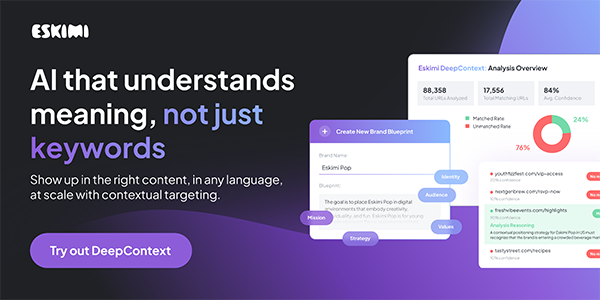
Contextual targeting does exactly that: It uses AI to place ads in content and environments that naturally match a brand’s message rather than relying on ineffective keywords alone.

Nobody is waiting for your ad to appear
Imagine a reader in Jakarta immersed in a travel article. They’re in a fundamentally different cognitive state than a user passively scrolling a homepage. While both might register as “attentive” by standard metrics, only one is truly receptive.
Eskimi’s internal research shows that contextual placements deliver a 74% increase in attention per mille (APM) on average, compared to standard display ads.
This isn’t just a placement statistic; it’s the difference between interrupting someone and reaching them. Your audience in Indonesia noticed your car ad because it appeared at the right time and in the right context, when they were engaged and open to the message.
Brand-safety gaps are costing you trust
Many brands believe their whitelists protect them. They don’t. This is especially true for brands operating in multiple languages and across shifting cultural nuances.
Direct translation often misses tone, context or sensitive local issues. What reads as neutral in one market can carry negative or even offensive connotations in another, making standard whitelists unreliable at scale. Because display advertising runs at scale, impressions often end up in low-quality or negative-sentiment environments, and unintended mismatches occur.
Far too often, for example, baby product ads appear next to miscarriage articles, ads for investment services run next to bankruptcy news and fast-food ads are on diabetes-related pages. Some big brands, including Verizon and Walmart, have even had to deal with unfortunate situations where their ads appeared next to extremist content.
These impressions generate “attention,” but attention triggered by irrelevant or harmful content doesn’t just underperform; it actively damages brand image.
Our data shows that AI-powered contextual solutions help brands achieve at least a 95% brand-safety score, significantly outperforming standard targeting options, which hover around 80%. That 15% gap is the brand-damage zone.
In emerging markets, trust is the only currency that matters. Consumers are often more skeptical of global brands and more reliant on word of mouth and local perception, meaning a single misplaced or tone-deaf ad can have an outsized impact on credibility and long-term brand equity. Why gamble with it?
Taking back control from ad tech giants
For too long, scaling globally meant surrendering to the algorithms of ad tech giants. Brands in the US accepted programmatic accidents as the cost of doing business abroad.
AI-driven contextual targeting allows for more intentional brand placements. By prioritizing relevant and brand-safe environments, this approach focuses on audience engagement and attention quality rather than raw metrics.
The industry already accepts this logic in premium publisher deals and curated marketplaces. AI-powered contextual targeting simply extends that logic to the open web, offering a transparent, high-control alternative for brands ready to move beyond the status quo.
In a nutshell
When expanding your business outside of the world’s biggest Western markets, it’s not enough to ensure that your car ad got noticed; it needs to be noticed in the right context, and preferably not next to news about a car crash.
The next phase of attention measurement won’t be about how long someone looks; it will be about whether the moment made sense – and AI contextual targeting ensures it does.
For more articles featuring Vytautas Paukštys, click here.