
Locality’s Tom Wolfe On Why Top-Down National TV Strategies Fail In Local Markets
Locality SVP Tom Wolfe explains why supply path optimization (SPO) must prioritize data fidelity, local TV fragmentation, and true value over fee-cutting.

Locality SVP Tom Wolfe explains why supply path optimization (SPO) must prioritize data fidelity, local TV fragmentation, and true value over fee-cutting.

Two-thirds of consumer attention lives on the open internet, but only one-fifth of ad spend follows it there. That gap is no accident. Walled gardens spent the past decade creating it.

AI is rapidly moving from promise to practice in streaming TV advertising, reshaping how campaigns are planned, executed and experienced. But as adoption accelerates, there remains no clear answer to what success actually looks like across all parts of the industry.

I’ve always loved sci-fi movies and the way they portray futuristic worlds shaped by advanced technological innovation. One of my favorite movies is the ’80s classic “The Terminator.” And the more I hear about “agentic AI” in ad tech, the more I think the film is a perfect analogy for what’s happening right now.

With an anticipated viewership of more than 1.5 billion people, the 2026 World Cup is expected to represent the most-watched live event in history. For advertisers, that creates an obvious opportunity to reach soccer fans around matches, highlights, team coverage and tournament content.

Most competitive intelligence is backward-looking. Earnings calls tell us what happened last quarter. Annual reports tell us where budgets went last year. Traditional competitive intelligence tools often focus on creative libraries, estimated spend or campaign archives.

Connected TV has entered a new phase.
For years, the channel was primarily a reach vehicle, a way to follow audiences as viewing shifted from linear TV to streaming. That migration has reached critical mass. Audiences are engaged across CTV, and advertiser dollars are following. According to eMarketer, US CTV ad spending is projected to reach $53.42 billion, reflecting continued double-digit growth as streaming outpaces linear TV.

In the rush to scale globally, US brands are often content with “accidental attention.” But attention isn’t a lottery; it’s a strategy that requires a deep familiarity with context in real time.

AI is only as good as the data that fuels it. In advertising, however, that foundation is often flawed.

In 2011, three media devices captured 87% of consumer attention. Today, that figure has dropped to 65%, according to McKinsey. The fragmentation isn’t slowing down; it’s accelerating. Streaming services, social media, podcasts and gaming now compete for eyeballs, making traditional media planning feel like navigating with an outdated map.

If you buy CTV advertising, you’ve likely encountered two approaches to securing premium inventory: programmatic guaranteed (PG) and buying direct, also referred to as direct IO (DIO).

Submit your comic caption idea by 5 p.m. ET on Mon., March 9, 2026 for the chance to win a free ticket to Programmatic AI in Las Vegas!

AI in advertising has gone from a buzzword to a full disruptor in what feels like just a few months. If CES was any indication, there is no sign of this slowing down.

Programmatic’s biggest promise was never automation for its own sake. It was accountability. But today, the industry is moving from reporting performance to steering performance.

Enjoy this weekly comic strip from AdExchanger.com that highlights the digital advertising ecosystem …

Programmatic media buying is expected to account for the majority of growth in the CTV market in 2026. This year alone, over 90% of CTV ad dollars were transacted through programmatic pipes. That data isn’t surprising. Programmatic has solved a real problem by helping brands reach TV viewers with targeted precision at much lower costs.

Bringing programmatic ads to AI chatbots marks a shift in the business model for AI search, while traditional publishers must find new ways to monetize.

Fizz, a new discussion and news feed app that targets college campuses, is helping marketers reach college students authentically.

Every conversation about addressability eventually lands on the same word: fragmentation. But the real symptom of that fragmentation isn’t just operational complexity; it’s also declining match rates. That single number explains why marketers are struggling to make their data work.
Most of what’s sold as “contextual” today still runs on the same keyword logic we used a decade ago. The industry didn’t reinvent contextual targeting; it simply replaced one keyword with a cluster.

Google recently settled a class-action lawsuit by agreeing to create an off-switch for data sharing in bid requests. Huge deal, right? So why isn’t anyone talking about it?

CTV has become a powerful full-funnel channel, attracting advertisers of all sizes – and the momentum isn’t slowing.
CTV ad spend is projected to rise another 16% this year to $26.6 billion, according to the IAB. But with rapid growth comes complexity. Advertisers now face a maze of platforms, apps and channels, each with different buying models, audience access and inconsistent measurement. For SMBs without large teams or budgets, this fragmentation is especially challenging to navigate.

On Tuesday, game engine Unity, which has a growing advertising business, announced the appointment of Chris Feo as its new SVP of programmatic.

As the newly appointed CMO of Genesis Motor America, it’s Amy Marentic’s job to raise awareness for the luxury auto brand, which is fighting for market share against more well-known incumbents in the US market. To do it, she’s analyzing the data and working on a growth strategy to reach a largely untapped demo: women. Plus: Marentic’s unique origin story, from astronaut hopeful to chief marketer.

Today’s developers face mounting challenges: heavier workloads, complex tech stacks and an increasingly fragmented advertising landscape demanding automation at scale. This complexity limits their ability to adopt new products and innovate.

As the advertising industry races forward, core technology providers – particularly ad servers, dynamic creative platforms and attribution or measurement companies – play an increasingly critical role in powering the infrastructure that enables targeted, data-driven and performance-optimized campaigns at scale. But one outdated pricing model is becoming an obstacle to innovation, efficiency and effectiveness: CPM-based pricing.
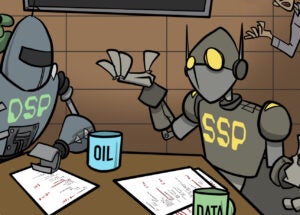
Enjoy this weekly comic from AdExchanger.com that highlights the digital advertising ecosystem …

With over $200 billion in programmatic spending on the table next year, maximizing yield is the name of the game for publishers in 2026. Capturing that opportunity demands maximum optionality across demand paths and signals. And with AI reshaping the landscape (referrals from ChatGPT to news publishers saw a 25x increase from the first half of 2024 to the first half of 2025, while traditional search traffic heads in the other direction) it is more important than ever for publishers to optimize their monetizable inventory.

TV audiences are rallying around CTV, and advertisers are following suit . But with this shift comes a persistent challenge: How can advertisers ensure brand safety, campaign efficiency and audience relevance in a fragmented, opaque streaming ecosystem?

Curated deals were once seen as a smart way to bring structure to programmatic chaos. Today, they’ve become table stakes.