

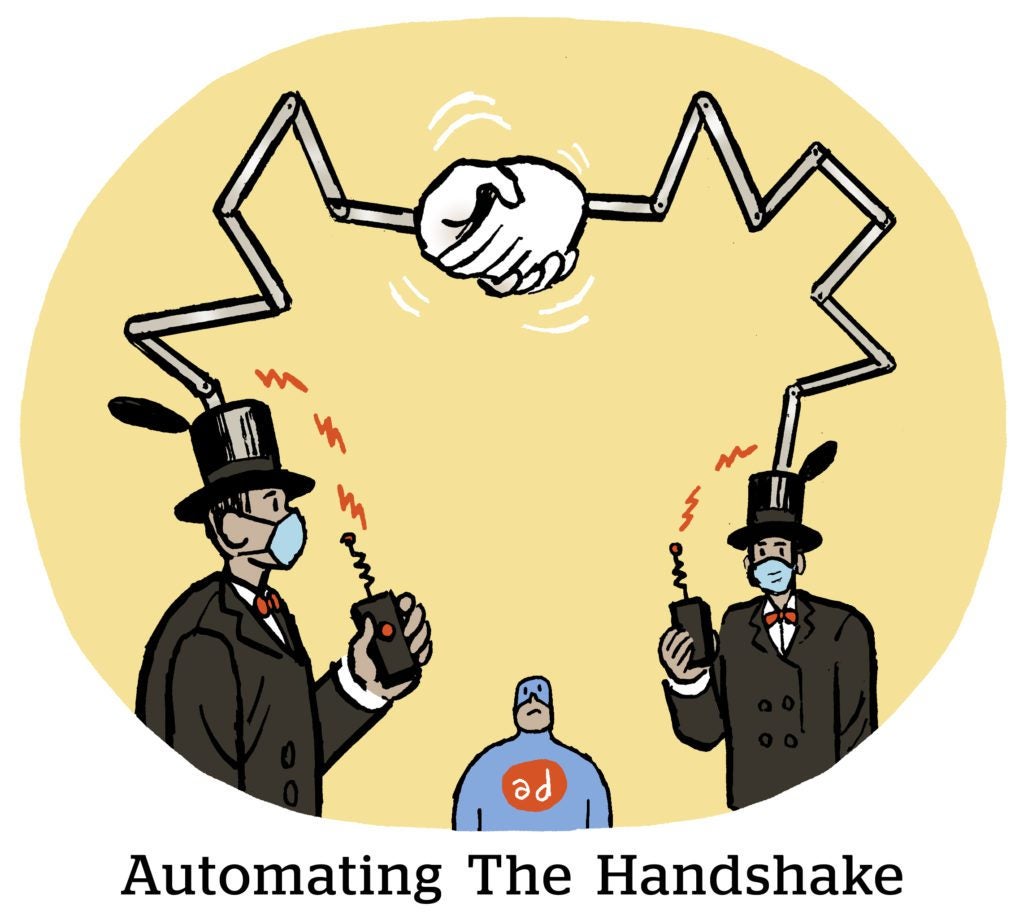
The AI advertising agents will need their own trade group eventually.
For now, though, a bunch of companies are forming the Ad Context Protocol, or AdCP. The consortium of ad tech and AI ad software vendors aims to establish standard protocols for agentic solutions across the advertising supply chain to negotiate, plan and execute media campaigns.
The co-founding members include Triton Digital, Yahoo!, PubMatic, Scope3, Optable and Swivel, each committing time, resources, plus a $10,000 annual budget to back the new organization. Other launch members have committed to test with less time and financial commitments, PubMatic CRO Kyle Dozeman told AdExchanger.
“What we’re seeing with the proliferation of AI across the advertising ecosystem is that agents need to be able to talk to each other, and they need to be able to interact,” said Scope3 Co-Founder and COO Anne Coghlan during a preview and Q&A regarding the new organization.

AI agents’ ability to take commands in natural language might seem miraculous, but, counter-intuitively, they don’t necessarily communicate very effectively to each other.
How it works
What does it mean for two or more agentic software solutions to “talk to each other”?
With the protocols that AdCP has in mind, an advertiser might be able to begin an agentic campaign with a prompt like, “I want to find women who are interested in rock climbing in the UK,” Coghlan told reporters. That request would go to publisher and platform agents (the agents of sales agents), which could respond with the types of inventory packages and audiences that fit the bill.
This model is a boost for publishers, which can now bring their unique data and direct sales capabilities to these automated systems, she said.
One holdup for programmatic is that brands don’t have a good way to keep ad spend in line with business growth, Joe Hirsch, co-founder and CEO of Swivel, a publisher ad server startup with an AI angle, said during the press demo.
For example, he said, a sneaker brand can go to the walled garden platforms and, essentially, just say they have $100,000 to spend and want to acquire new sneaker buyers at an $80 CPA limit.
Programmatic can’t do that. But an ad buyer using an agentic model might instead prompt its programmatic vendors to find and convert customers at that CPA, Hirsch said. Publishers that made sense to deliver sales and brand discovery at those price points would have their agentic solutions package the particular inventory and audiences.
From the publisher perspective, the potential agentic ad supply chain is a better alternative to the current open web monetization, said David Olesnevich, head of data and advertising products for The Weather Company, who is involved as a launch member (not a founding member).
“Anything that’s going to bring buyers and sellers together more closely is fundamentally just good for the industry, Olesnevich said. “And AdCP provides infrastructure to enable direct communication that can actually remove some unnecessary intermediary layers.”
Eventually, too, the agentic ad channel won’t even necessarily be programmatic. The advertiser’s and publisher’s agentic solutions planning a campaign betwixt themselves represents a “direct” campaign, Coghlan said. That campaign might include custom components that aren’t available programmatically, or offline inventory.
Could a publisher sales agent “convince” an advertiser agent to buy, say, an out-of-home campaign, linear TV or some other media package that the advertiser totally didn’t expect but the agents were persuaded of the value?
“Where we are right now, there is always a human in the loop,” Coghlan said. Large campaigns can’t be booked without a human’s approval, and for now the creative for a campaign must be approved as well.
Where we are right now
Agentic AI is definitely taking hold in data-driven advertising. But are agent-to-agent deals actually being negotiated, planned, bought and optimized with only a “human in the loop”?
“What’s happening already is aspects of an overall campaign are being tested and executed,” PubMatic’s Dozeman told AdExchanger. Campaign planning, audience analytics, media activation (i.e., buying) and troubleshooting are all different components of the campaign, for which agents are being tested. PubMatic has been testing troubleshooting in particular, he said. Others are more focused on other components. Eventually, he said, agents will be able to string together all those parts of the campaign.
He described the AdCP as a potential “Prebid-type layer” for agentic advertising, referring to its open-source status and trade org backing by industry names.
Within a year, Dozeman said he hopes the organization will have solid documentation and will be able to demonstrate tests of how the protocol has helped publishers in practice.
“Part of the excitement of all of this agentic stuff is that we can bring publishers a lot more into the execution,” he said.
Publishers may not be aware of how agentic advertising can benefit their ad business right now, he said, or even be aware of what’s happening under the hood of their programmatic supply chain using a protocol like the AdCP.
“So we’re looking forward to talking to our publishers about that and we’ll be making them aware of this growing pile of demand,” he said.









