AI In Advertising: What’s Real Beyond The Buzz
AI in advertising has gone from a buzzword to a full disruptor in what feels like just a few months. If CES was any indication, there is no sign of this slowing down.

AI in advertising has gone from a buzzword to a full disruptor in what feels like just a few months. If CES was any indication, there is no sign of this slowing down.

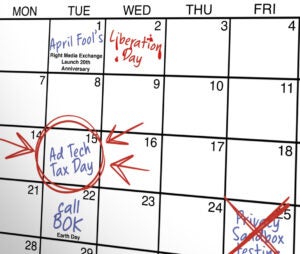
Chrome kept cookies and killed the Privacy Sandbox, but at least we got some great comics out of it.

Enjoy this weekly comic from AdExchanger.com that highlights the digital advertising ecosystem …

Publishers, brands and agencies today are navigating a new landscape. With rising consumer expectations and evolving regulations, delivering personalized campaigns requires a fresh approach.

Google’s aborted cookie crackdown ends with a quiet CMA sign-off and a sweeping phaseout of Privacy Sandbox technologies, from the Topics API to PAAPI.

Advertisers are still having a lot of the same brand-safety problems today as he did years ago – and it’s pretty damned frustrating.

The layoffs reflect a strategic decision on People Inc.’s part to free up money to invest in growth areas, according to CEO Neil Vogel’s memo to employees.
Clear Channel will provide advertisers weekly, mid-flight reports on outcomes driven by its inventory in order to bring OOH measurement closer to the speed of digital.

For too long, marketers have been stuck in a false dilemma: Do you want reach, or do you want relevance? Mass exposure, or accurate targeting?

When Google reversed its decision to deprecate third-party cookies, the first word in ID5 CEO Mathieu Roche’s mind was an expletive. But it doesn’t really matter what happens with cookies on Chrome anymore. “Most of the industry has moved past the notion that cookies were good enough to target and measure advertising on the web,” Roche says.

New social media content moderation policies will enable connections with audiences that reflect a broader range of perspectives, expand inventory, and provide opportunities for contextual alignment.

People Inc. – the former Dotdash Meredith – is fighting on multiple fronts to keep its business growing as Google Search declines precipitously as a source of referral traffic.

TV audiences are rallying around CTV, and advertisers are following suit . But with this shift comes a persistent challenge: How can advertisers ensure brand safety, campaign efficiency and audience relevance in a fragmented, opaque streaming ecosystem?

On Wednesday, AI-powered audio intelligence platform Sounder launched a new version of its brand suitability and contextual targeting tool for podcasts that can understand the nuances of Spanish-language audio content.

Today, David’s Bridal is as much an AI-powered tech company as it is a retailer of wedding apparel and accessories, according to Elina Vilk, president and chief business officer. The company recently unveiled a new digital transformation strategy centered on agentic AI and personalized experiences.

Alliant will integrate AnalyticsIQ’s audience modeling platform, which is based on user surveys and studies of health, wellness and cognitive psychology.

Even the CMA doesn’t seem to care about the Privacy Sandbox anymore. On Friday, it announced that it’s begun the process of “releasing” Google from its Sandbox commitments.

If there’s one safe prediction heading into Cannes this year, it’s that AI will be everywhere: in panels, on yachts and splashed across every DOOH ad within a 10-kilometer radius of the Croisette. But behind the noise, something real is happening. We are witnessing a strategic shift. AI is evolving from a shiny object into a performance engine that helps marketers uncover hidden audiences and iterate faster while delivering relevance at scale.

Life360, a popular family safety and tracking app, announced its first location-based ad targeting solution, called Place Ads, and a foot-traffic analytics product named Uplift that measures store visitation.
Despite all the cookie drama, companies haven’t completely abandoned the Chrome Privacy Sandbox, and BU marketing professor Garrett Johnson has the receipts to prove it.

Classify is entering a crowded space of AI-powered contextual curation offerings. But the company is already teasing some high-profile integrations thanks to its network of well-connected advisors.

Michael Komasinski, Criteo’s newly-minted CEO, shares his vision for the company – and swears that Criteo doesn’t regret its huge investment in testing the Chrome Privacy Sandbox.

The modern marketing landscape is being rewritten in near real time. While economic uncertainty may tempt brands to retreat into the comfort of walled gardens, the truth is more nuanced, especially regarding data and identity solutions.
Enjoy this weekly comic from AdExchanger.com that highlights the digital advertising ecosystem …

DDM reported 1% Q1 revenue growth, citing traffic downturns Google’s AI search results and soft advertising demand due to tariff-induced uncertainty.

Despite a 3% uptick in Q1 revenue to $451 million, Criteo’s stock fell by roughly 15% on Friday after news of a pullback by a major retail media client and tepid guidance.
Google isn’t a regulator. From an attorney’s point of view, its decrees don’t carry the force of law, and that’s what lawyers are concerned with: the law.

Google’s SSP and ad server businesses have been ruled monopolies. And Google Chrome isn’t going to change its third-party cookie opt-ins, further preserving third-party cookies. Go inside this momentous news.

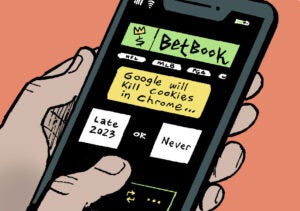
You know that choice mechanism that Google said it was planning to release for third-party cookies in Chrome? Well, it’s not happening.
Enjoy this weekly comic strip from AdExchanger.com that highlights the digital advertising ecosystem …

A lot of F-bombs got dropped on stage at the Coalition for Innovative Media Measurement’s (CIMM) summit in New York City earlier this week. And no, probably not the F-bomb you’re thinking of.

AI agents are moving fast, but MadConnect says ad tech’s slow, messy plumbing still needs an overhaul before agentic marketing can really work.
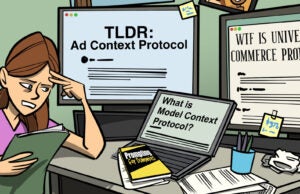
Your TL;DR on MCP, the open standard that lets AI models connect to tools, remember context and run workflows across platforms.

“We are focused on being where the world watches video,” said Tara Walpert Levy, YouTube’s VP, Americas at the Convergent TV conference in NYC on Thursday. “And to us that now is TV.”


Late last week, Netflix walked away from plans to acquire Warner Bros., clearing the way for Paramount Skydance to scoop up the whole company with its hostile takeover bid.

Sallie, the major issuer of US education loans, is getting into the retail media network business.

Meta will now measure social interactions like likes, shares and comments under a new “engage-through attribution” category, replacing click-through as the default.