Like A Chat Outta Hell
Sometimes, momentous change happens in the most banal ways.
So it was last week when OpenAI made an unheralded change to its “Shopping with ChatGPT Search” documentation, as AI Visibility Journal reports.
The documentation previously read: “Product results are selected independently by ChatGPT and are not ads, nor influenced by any OpenAI partnerships.” Now it reads: “Product results are not ads; how products and merchants are selected is described below.”
The cynical take is that OpenAI is now allowing room for marketing partnerships to influence ChatGPT’s product recommendations, even outside of official ads.
Other changes to the documentation are less important, though telling. ChatGPT formerly committed to showing products with “links to sites where you can learn more or purchase.” Now ChatGPT’s mandate is only to “show available ways to purchase.”
Marketers and merchants want to influence how their products and brands are presented to AI search users. There’s massive demand for such services (which are called AEO or GEO, as an evolution of SEO).
Plus, some platforms that are essential for AI training are monetizing their influence over the chatbots. Amazon recently launched “Conversational Briefs” – a silly underwear-adjacent name for a product that lets brands pay to affect relevant AI search outputs.
But AI platforms themselves are hesitant to break the dam and let brands pay to boost their profile directly. Which could look like, for instance, businesses picking and choosing which customer reviews get surfaced or considered by the model, or pay-to-play prompts or keywords.
Happy Ads-Giving
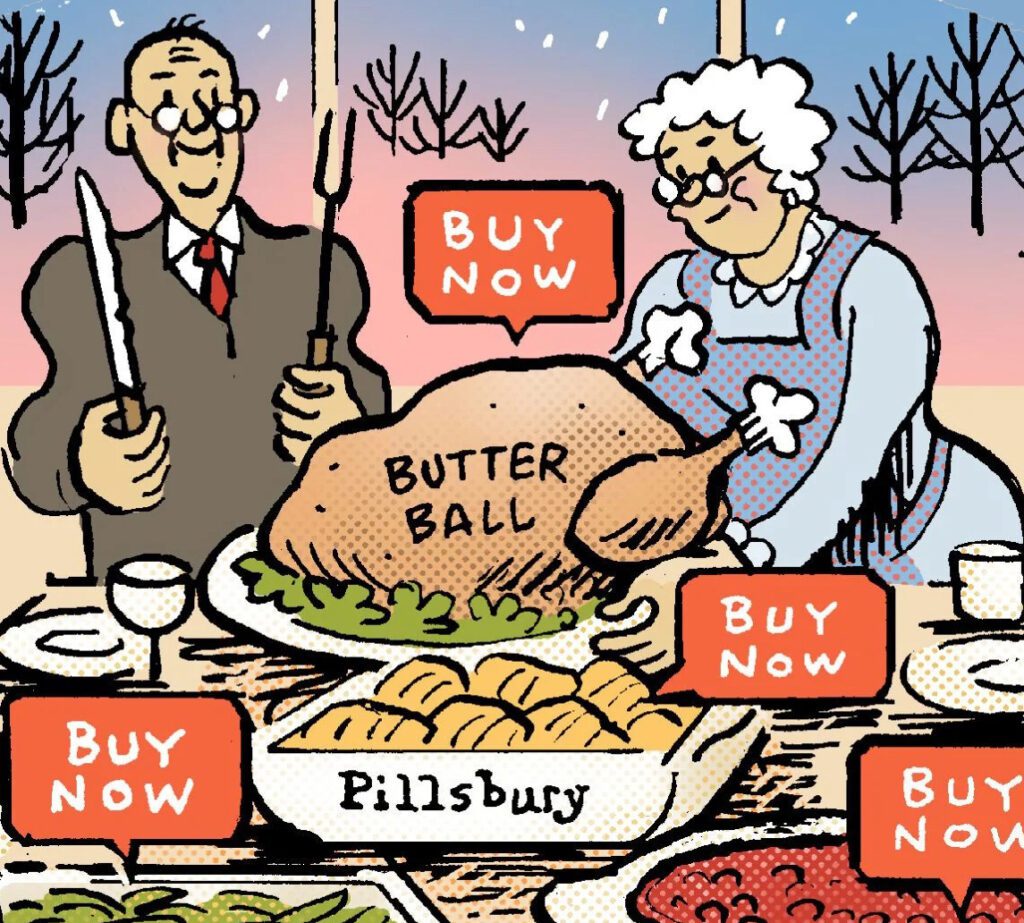
Holiday ads might be creeping into the schedule earlier than ever this year, but don’t get it twisted: For a lot of TV advertisers, broadcasters and streamers, Thanksgiving weekend is the main event.
On Thursday, NBCUniversal has the Macy’s Thanksgiving Day Parade, the National Dog Show and one of three Thanksgiving NFL games (CBS and Fox will broadcast the other two). Meanwhile, on Wednesday, Netflix has the first-ever Thanksgiving Eve NFL game, and Prime Video is airing its first Duke men’s college basketball game. Then, on Black Friday, Prime has a 15-hour marathon of live sports coverage lined up, including an NFL game, two Emirates NBA Cup games and a PGA golf event.
All that TV makes this weekend a crucial one for advertisers. Not only are many more people watching live during the Thanksgiving weekend (a record 34 million watched the Macy’s parade last year), but the National Retail Federation estimates that 182.7 million are planning to shop then, too.
Which means it’s one of the rare times when TV is both a massive brand awareness play and short-term performance driver.
It’s no wonder, then, that both NBC and Amazon are leaning heavily into interactive ad formats for their streaming broadcasts this year, as Variety reports. Amazon’s ads will feature on-screen prompts for interacting with Alexa or adding items straight to a customer’s Amazon cart, while Peacock will present shoppable pause ads that set up Instacart deliveries for users.
A Programmatic Plea
Ruh-roh: Loads of ad dollars are still getting lost in the programmatic abyss.
Only 43.1% of programmatic spend made it to “quality media” last quarter, according to the latest ANA Programmatic Transparency Benchmark report. The research says that, for every $1 million of programmatic ad spend, more than half is lost to transaction costs ($285,000) and media productivity ($284,000).
Ad tech taxes aren’t solely to blame for the wasted spend, though. The lack of effective measurement is also a significant source of programmatic inefficiency, according to the ANA. And poor measurement standards are a “particularly acute” problem in connected TV environments, where a whopping 24% of ad spend went to “non-measurable inventory.”
While the report doesn’t clearly define what makes inventory non-measurable, it’s no secret that CTV ad measurement is murky, to say the very least. Publishers, agencies and measurement and currency vendors can hardly agree on how to count reach, let alone how to quantify outcomes.
Sounds like those buy-side demands for more transparency are about to get even louder.
But Wait! There’s More!
Would you watch a 24/7 personalized AI TV channel about yourself? Because Google’s trying to patent that technology right now. [404 Media]
Don’t write off DSPs in the age of agentic advertising. [Adweek]
Microsoft search advertisers can now extend their campaigns into the Pinterest search platform. [Ad Age]
You’re Hired
After Jensen Huang’s unceremonious departure from NVIDIA amid affairs with an alleged Chinese spy and multiple subordinates, the company has appointed its new CEO: Jensen Huang. [TechCrunch]
Agentic advertising platform BrandComms.ai promotes Sheona Richard from chief client officer to CEO. [post]
CX platform Emplifi appoints Claire Wilson as chief marketing officer. [blog]
Here’s today’s AdExchanger.com news round-up… Want it by email? Sign up here.