
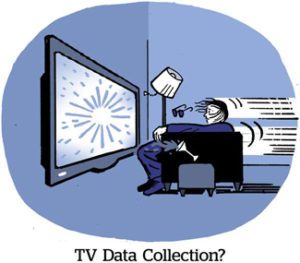
It’s Time For Another AdExchanger Comic Caption Contest!
🏆 We’re hosting our next comic caption contest. 🏆 Submit your caption idea by 5 p.m. ET on Tuesday, July 25, for the chance to win a free ticket to Programmatic I/O New York in October.

🏆 We’re hosting our next comic caption contest. 🏆 Submit your caption idea by 5 p.m. ET on Tuesday, July 25, for the chance to win a free ticket to Programmatic I/O New York in October.

Television does drive sales lift, although the impact usually isn’t immediate. Broadcasters have been trying to change that for a long time. Until recently, however, the reality of shoppable TV has lagged far behind the idea. Publishers are busy exploring interactive TV ad formats, from QR codes to clickable overlays – but are advertisers buying in?

Netflix’s biggest hope for its imminent ad tier is increasing revenue not from ads themselves, but by attracting new sign-ups with a cheaper subscription option. It chose Microsoft as its ad sales partner for flexibility in building out the tech, and it hopes new plans for password sharing enforcement will help keep up subscriber monetization, too.

The Acceptable Ads Committee, the group that establishes quality guidelines to whitelist ads on ad blockers, has a new president and he’s an old programmatic hand. Terry Taouss, a Cento vet and currently a principal at ad tech consultancy AdProfs, is taking on the role, replacing Marty Kratky-Katz, co-founder and CEO of Blockthrough.

DTC brands are struggling to get by without the Facebook ad engine. Legacy brands are flummoxed by ecommerce. One company that’s hoping to split the difference is RoC Skincare, which spun out of Johnson & Johnson and was acquired by the private equity firm Gryphon in 2018.
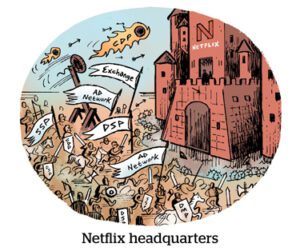
Just three months after Netflix surprised the world with the news that it plans to launch an ad-supported tier, the streaming leader has settled on its third-party vendor of choice: Microsoft. But why Microsoft? It wasn’t considered a serious programmatic contender until it acquired Xandr from AT&T (and that deal only closed last month). Still, something made Microsoft stand out from the crowd.

Unity will merge with ironSource in an all stock transaction that values the latter at $4.4 billion. The companies expect the merger to help deliver a $1 billion run rate by the end of 2024 and $300 million in annual EBITDA synergies the year after that.

If addressable ad IDs are the new keys to the kingdom, then you’ll find The Trade Desk at Epcot this summer. Which is to say, Disney and The Trade Desk announced an identity integration on Tuesday that will allow advertisers to activate against Disney’s first-party data programmatically via its clean room data product using Unified ID 2.0 (UID2) IDs.

Commerce and creator monetization are Pinterest’s two main priorities right now, said Jeremy King, the company’s SVP and head of engineering. King, who is also the former CTO of Walmart’s ecommerce business – he joined Pinterest in 2019 – said that the convergence of creator revenue potential with social media-based shopping and product discovery by consumers “will make Pinterest functional, versus purely inspirational.”

“We saw the rise and fall that can happen if you’re dependent on digital advertising,” said Bryan Porter, Simple Modern’s co-founder and chief ecommerce officer. “It worked really well for us … until it didn’t.” The experience of surfing an online ad wave and then crashing hard on the beach has shaped Simple Modern’s marketing strategy, which is fully in-housed

Verve Group, the ad tech subsidiary of German ad software holding company MGI, has struck again with the acquisition of mobile DSP Dataseat. Terms of the deal were note disclosed.
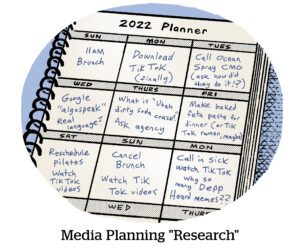
The parade of data-driven ad platform launches by companies that don’t traditionally monetize through advertising seemingly cannot be stopped. The latest example is Universal Music Group (UMG), a top music label which last week launched its data-driven ad-targeting platform called the UMusic Media Network.

Last year, Levi’s launched an in-house machine-learning bootcamp to help employees who don’t have a formal data science background learn about AI and develop new digital skills. More than 450 people applied for just 60 spots in the program. Roughly two-thirds of the first class were women, says Katia Walsh, head of AI at Levi’s.

Max Joseph, the filmmaker and producer of “Catfish,” an MTV reality show that exposes people who lie about themselves online, is helping Israel-based monetization platform Perion promote its cookieless targeting product, called SORT, with a satirical short film that highlights the perils of data collection on the internet and the great lengths one would have to go to in order to avoid it completely.
Two years ago, shortly after the start of the coronavirus pandemic, Nike doubled down on what it refers to as its Consumer Direct Acceleration. Nike wasn’t simply weathering a storm, but taking COVID-19’s worldwide shakeup of consumer buying habits as an opportunity to rethink its business “by expanding our digital advantage, reshaping the marketplace of the future and creating deeper, more direct consumer relationships,” CFO Matthew Friend told investors.
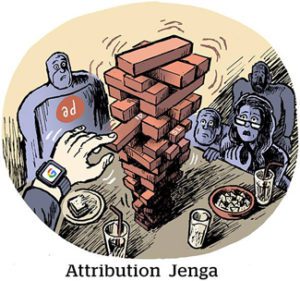
In nature, animals migrate. Elephants, birds, turtles – by some combination of memory, instinct and intuition, creatures in the wild know to make the same epic voyage every year. But how did they make the first great migration? If anyone figures that out, let Google know. It’s struggling to get marketers on board with a major analytics migration set for next year.

How should brands think about advertising in the metaverse? The question is a little hard to answer when there’s no consensus about what exactly the metaverse is or what it might become

The grocery chain Albertsons in-housed its advertising services and tech business in February, and is still making big changes to the group. “It’s really about owning the tech stack and the product vision,” said Evan Hovorka, head of retail media products.
Although advanced, addressable and convergent TV might sound like synonyms, they are distinct concepts. Think of advanced TV as the umbrella term for anything that is not traditional, over-the-air broadcast TV, with specific techniques including addressable and convergent TV, data-driven linear and OTT. To make the most of TV’s advancements (get it?), it’s important to understand the nuances.

T-Mobile is sharpening its programmatic sales pitch and releasing new ad platform features this week. One cosmetic adjustment: The ad revenue group’s name is changing from T-Mobile Marketing Solutions to T-Mobile Advertising. But T-Mobile has also launched App Insights, an app-based analytics platform that’s been in beta for the past year.
Sam’s Club, the membership-based retailer owned by Walmart, recently rebranded its advertising business as the Member Access Platform (MAP) as it charts its own course alongside other emerging retail media platforms. The notion of “member access” is what sets Sam’s Club apart from other retailers that are focused entirely on advertising as a way to monetize customers, said Lex Josephs, a VP at Sam’s Club and GM of the MAP business.

NBCUniversal shared the results of its cross-platform measurement currency tests with iSpot, which became the programmer’s first certified measurement partner in January. NBCU certified eight more partners in March – but anyone expecting a comparison of how those partners perform against each other is still waiting. NBCU’s currency pilot test with iSpot included 67 advertisers representing 158 brands and compared reach and frequency measurements against linear and over-the-top (OTT) buys.

Legalized sports gambling is flooding the market with betting apps, which are becoming powerhouse spenders as they seek to gain a foothold. Some betting apps put crazy-high premiums on new users that they hope to make up in lifetime customer (gambler) value, but they’re not all in a grow-now mode regardless of costs.

Back in 1997, when the oldest Gen Zers were born, Liz Smith joined a Silicon Valley startup called Yahoo! What started off as a group of misfits on the internet turned into a “Frankenstein’s monster” of sorts, said Smith, who left Yahoo! for film school and captures the effects of technological submersion on the next generation in her latest movie, I Am Gen Z.

Connected TV may be the media industry’s shiniest new toy, but it’s not squeaky clean – it’s rife with ad fraud, and high CPMs only make the channel a better target for con artists. Several industry execs discussed why the industry’s best shot is to increase transparency as much as possible across the bid stream at IAB Tech Lab’s Transcend summit.

Mike Schott joined Volta, which makes electric car charging stations, almost six years ago to build out the company’s nascent advertising business. That makes Volta early to the everything-is-an-ad platform trend. But even back in 2016, Schott, a longtime EV owner himself with a background in ad tech – he’s the former VP of sales for DSP Viant – had the sense that “an advertising business would be a strong differentiator.”

Cookie deprecation is hanging over the media and advertising industry like a storm cloud. New identity solutions built on first-party data are clearly one solution, but publishers and advertisers differ on whether they’re building their own proprietary solution or a shared shelter that will scale – and explained why at AdMonsters’ Ops conference in New York City.

Three web standards organizations tasked with the online ad industry overhaul, the W3C, the IAB Tech Lab and Prebid.org, called out for help this week during a series of presentations and a joint panel at the AdMonsters Ops conference in New York City.

The investment bank Needham estimates that Alphabet, Meta, Amazon and Disney combined will grab around $650 billion of ad dollars in 2023. By comparison, The Trade Desk earned just $1.2 billion in 2021, its first time clearing the billion-dollar mark in a single year, and even the strongest programmatic companies earn in the hundreds of millions, which is peanuts by walled garden standards. But “what that means is that a tiny 1% or 2% shift in budgets from the big platforms could double or even triple.”

TikTok’s content relies heavily on influencers and creators. As prime ad real estate for targeting younger “video native” audiences, TikTok is using its market positioning with brands to capitalize on both the creator marketplace and ecommerce through shoppable video trends, said Melissa Yang, TikTok’s head of ecosystem partnerships, speaking at AdExchanger’s Programmatic I/O conference earlier this week.