How Future Plans To Elevate Publisher-Provided Ad Tech
Future believes its new monetization offering can succeed where other publishers have struggled with selling ad tech and consulting to third-parties.
Contextual ad platform Seedtag acquires Beachfront, a supply-side platform that specializes in TV and video.
Being able to share information about a group of people without compromising any individual person’s privacy kinda sounds like a form of wizardry. But it’s not. It’s just math.
Here’s today’s AdExchanger.com news round-up… Want it by email? Sign up here. A Programmatic Standoff Agencies sing the praises of open marketplace bidding. But clients aren’t listening. Neither company stakeholders nor advertiser clients are fully convinced that bidding on the open marketplace is effective enough to justify all the expenses, Digiday reports. Transparency – rather, the […]
Imagine you’re deep into streaming game five of the NBA playoffs. After enduring the same car commercial countless times, frustration sets in: “Not that truck ad again. I’m not in the market for a car, but even if I were, I’d never buy this now because they practically ruined the game for me.”
The open web is getting smaller, with the squeeze happening in two directions: Curated deals are skimming the cream off the open web, and exposed made-for-advertising websites are shuttering.
While agencies push for more programmatic buying options, publishers want to maintain control in TV ad buying negotiations – and particularly over their “premium” content.
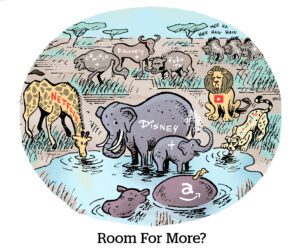
Enjoy this weekly comic strip from AdExchanger.com that highlights the digital advertising ecosystem …
Here’s today’s AdExchanger.com news round-up… Want it by email? Sign up here. Best Buy’s Best Bet Sales at Best Buy were down more than 6% from last year in Q2, as consumers cut back on discretionary purchases, especially electronics and home appliances. Best Buy’s shares jumped more than 10% on the news. Wait, what? Although sales […]
Inspire Brands, the fast-food franchise that owns popular chains such as Dunkin’, Sonic and Arby’s, is rewriting parts of its TV playbook to better manage reach and frequency in streaming media campaigns.
The advertising industry’s shift from last-click attribution to multi-touch attribution (MTA) initially promised a deeper understanding of marketing effectiveness. However, limitations like signal loss and the ineffectiveness of non-clickable media like TV have emerged.
Unfortunately, we seem stuck with our longtime measurement standards, like the trusty old CPM and ROAS. But for change to happen, it must come from within.
In today’s newsletter: Why Apple’s SKAdNetwork 4.0 is a bust; advertisers are irked by Google’s optimization-driven demand for different creative formats; The Trade Desk releases a baffling list of top 100 publishers.
Laptop fans can rest a little easier. A network of well-known MFA sites operated by Perion-owned Content IQ have been taken offline.
Late last year, Morning Brew hired Sara Badler, a longtime programmatic advertising executive, as CCO. But the publisher, which built its business on direct, isn’t planning to change its approach to monetization.
Breaking down how incrementality complements multitouch attribution and media mix modeling, and how advances in AI and ML have evolved incrementality measurement beyond A/B testing.
In today’s newsletter: Publishers fear they’ll be excluded from The Trade Desk’s “premium internet”; buyers weigh in on Netflix’s plans to offer an ad server; and PayPal launches an ad network and data brokerage.
As more ad spend shifts to CTV, there are new opportunities to make errors with campaign delivery. To help address the issue, Zeev Neumeier, founder of Inscape Data, is launching a new venture called GraySwan.
Signal loss is real, but don’t write an elegy for data management platforms just yet, says Andy Monfried, CEO and founder of Lotame, which turned 18 this year. Also in this episode: Lotame’s reinvention of itself as a data collaboration platform.
RAG is a recently developed process to ingest, chunk, embed, store, retrieve and feed first-party data into AI models. Here’s how to use these tools to inject first-party data into your next AI-enabled campaign.
In today’s newsletter: Ampla suspends loans to DTC brands, putting their ad budgets at risk; why Sony is investing in IP rather than a streaming platform; and Netflix will move on from Microsoft in favor of in-house ad tech by 2025.
Wishing you all a beautiful Memorial Day! This classic comic first ran in October 2011.
Well, that’s a wrap on Programmatic IO Las Vegas 2024! The AdExchanger editorial hopped on stage for a live recording of The Big Story to round up all the moments that made us go “a-ha” this week, including observations on commerce media, CTV and generative AI.
To some degree, the digitization of TV marketing is inevitable. But there’s a limit to how much TV ad buying should digitize, according to Needham’s Laura Martin.
Enjoy this weekly comic strip from AdExchanger.com that highlights the digital advertising ecosystem …
Here’s today’s AdExchanger.com news round-up… Want it by email? Sign up here. Walmart’s Writing On The Walls Targeting in aisle three? Beyond selling access to its online ad supply, Walmart is now offering advertisers a way to reach customers while they’re roving physical store aisles, The Economist reports. Theoretically, an advertiser has the best chance of […]
While Google’s Privacy Sandbox remains a subject of industry skepticism, brands are resetting their expectations around first-party data. Next up on the list of solutions agencies are trying is alternative identifiers, such as UID 2.0, ID5, Lotame’s Panorama ID and dozens of others.
If you’re a brand that wants to in-house its programmatic media buying, the best thing you can do is to make friends with the IT guys.
What if the new storefront is a person sitting on their couch and scrolling their phone?
Audience targeting and online information campaigns have had some gnarly byproducts. Advertisers need to own our contributions to political polarization before it can get better.