7 Ad Tech Veterans Who Have Founded Their Own AI Startups
As AI sweeps the tech landscape, new startups continue to emerge. Here are seven former ad tech execs’ thoughts on best AI practices and starting their own companies.
It has long been understood that brand is advertising’s most powerful driver of growth. Yet, in a marketplace worth more than one trillion dollars, less than 10% of digital campaigns track brand outcomes.
AdExchanger caught up Milani CMO Jeremy Lowenstein about how the beauty brand fits into mass-market retail, in contrast to DTC and social-based brands.
SSPs are looking pretty ripe for acquisition; agencies want real man-on-the-street content from actual human men; and AI slop is taking over the internet.
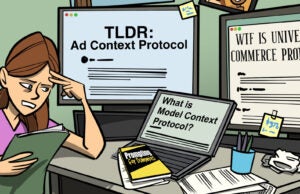
The AI advertising agents will need their own trade group eventually. For now though, a bunch of companies are forming the Ad Context Protocol, or AdCP.
In today’s economic climate, every marketing dollar is under scrutiny. CMOs aren’t just required to build brands and grow demand; they’re expected to prove that their budgets drive measurable business value. And no one is more invested in that proof than the CFO.
Anne Coghlan, co-founder and COO of Scope3, on why cutting carbon in ad tech isn’t just about saving the planet; it’s about eliminating inefficiency and financial waste at the same time. Plus: Using AI to automate and optimize digital media buying at the impression level.
The desire for a data-driven reinvention of OOH inspired OUTFRONT to create agentic AI tools for executing and measuring OOH campaigns and comparing OOH to other channels.
Publicis celebrates as its growth aligns with the IAB’s downgraded ad spend projection; Spotify and Netflix partner to chase YouTube’s video podcast biz; and how investor cash keeps health data safe from advertisers.
A peek inside PubDesk, The Trade Desk’s new dashboard that gives sellers detailed info on how buyers value their inventory.
On Tuesday, game engine Unity, which has a growing advertising business, announced the appointment of Chris Feo as its new SVP of programmatic.
For all of the ad tech industry’s sophistication, fragmentation remains its original sin.
The solution isn’t a mystery. Everyone agrees that greater interoperability is the answer. So what’s standing in the way?
Apple TV is losing its plus; Agentic AI is ruining the ad tech equilibrium; and Google insists that search is still solid.
New Yorkers are bombarded by ads at every turn. But targeted ads? For your industry? While you’re on your way to an event for that industry? The surreality of that experience can still pack a punch.
For as long as I’ve been in marketing measurement, people have been searching for the “easy button,” the one tool, model or platform that will finally tell them which marketing dollars truly drive growth. But, after 15 years and four attribution startups, I can tell you with confidence: The easy button doesn’t exist.
Advertisers are still having a lot of the same brand-safety problems today as he did years ago – and it’s pretty damned frustrating.
The fate of the open web will be decided on who controls the data that drives monetization and the AI that determines distribution. Google controls both, and proposed remedies to its ad tech monopoly do not address this imbalance.
American publishers are hamstrung by antitrust law; should marketers lean into ragebait?; and Pexplexity is hitting pause on its ads business.
With its PubDesk wrapper, The Trade Desk is putting roots into ad tech’s sell side. But publishers are wary.
TiVo has officially halted the sale and manufacture of its once-revolutionary DVR products. Which raises the question: What does TiVo even do anymore, anyway?
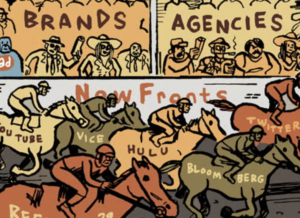
Enjoy this weekly comic from AdExchanger.com that highlights the digital advertising ecosystem …
The Viant-Tubi integration offers new data insights; advertisers can buy sponsored product ads on Gopuff, thanks to TTD; and publishers continue to face traffic woes.
The layoffs reflect a strategic decision on People Inc.’s part to free up money to invest in growth areas, according to CEO Neil Vogel’s memo to employees.
You just launched a new campaign across multiple channels, from search to social. Perhaps you’ve gone out on a limb – maybe even against the recommendation of your CEO or board – and included streaming TV in the mix.
Retail media has broken through some critical threshold, and is no longer the straightforward digitalization of shopper marketing budgets.
Ask advertisers, not Meta, how best to use Meta’s ad platform; holdcos and big brands are pressuring Big Tech to self-regulate; and how data-driven animal husbandry is impacting marketing.
Publishers must coalesce to gain a credible bargaining position and stop the bleeding caused by AI search. From there, we must put the processes in place to actually operate a licensing mechanism.
CleanTap claims that 100% of the invalid traffic it spoofed was accepted into live auctions run by programmatic platforms and was successfully bid on by advertisers.
Optable introduced AI agents this week, allowing clients to improve their workflows with the help of AI and integrate with multiple tech platforms.
Online advertising’s privacy problem isn’t just about bad actors; it’s about bad metrics, says Marc Guldimann, CEO and founder of attention startup Adelaide. “I think a lot of the invasive behaviors in the ad tech space can be traced back to a lack of a shared understanding of quality,” he says.