Here’s today’s AdExchanger.com news round-up… Want it by email? Sign up here.
Black Friday Indeed
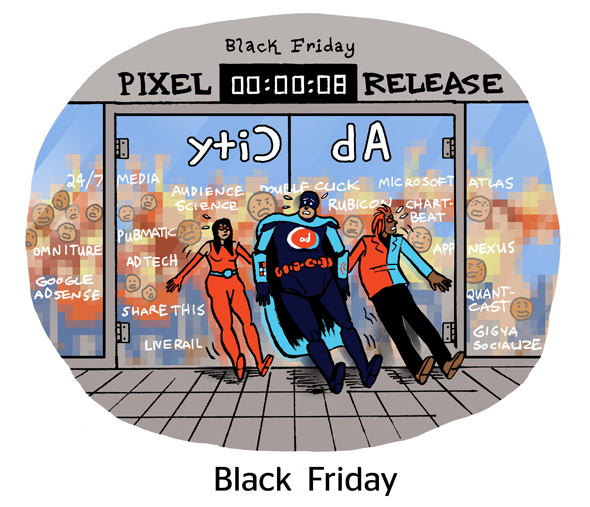
Black Friday is almost here. And while all advertisers are always nervous this time of year, ecommerce advertisers are really tweaking.
First, there’s the macro-gloom. Credit is tight, prices are inflated and retailers warn of a consumer spending downturn.
On top of that, some of the most exciting – even essential – online advertising and shopping platforms are not ready for primetime this year.

Facebook platform glitches have become holiday tradition, practically on par with Mariah Carey and the Macy’s Thanksgiving Day Parade. But this year, the mess is worse, and it seems increasingly unlikely that the Facebook platform flywheel will spin well.
Shopify, by the way, was also down for a spell last week, and its Audience integrations with the social platforms have been finicky – perhaps because Facebook, Instagram and TikTok, three main app partners, are going haywire.
Oh, right, and then there’s TikTok.
TikTok Shops, its in-app checkout and ecommerce ad product, is having issues syncing with Shopify and smoothly running campaigns. As with Facebook, TikTok account execs and platform engineers who know how to fix things are nearly impossible to reach – if they haven’t already been outright replaced by inadequate automation software.
The Unreachable News Reader
The PEW Research Center has released its annual social media news readership survey. Unsurprisingly, the number of people who regularly get their news from social media remained either flat or down. Not a shocker considering that the social platforms have made dramatic algorithmic changes to explicitly show less news in-feed. (Looking at you, Facebook and Instagram, but Twitter and Snapchat have also pulled back from the news.)
But there’s one notable exception.
Over the past three years, a growing number of users read (or watch) the news on … TikTok. The percent of users who regularly get their news from TikTok nearly doubled, from 22% to 43%.
Fact is, there are fewer and fewer places to go to get news if you’ve forsaken cable TV (which is for the best, honestly), especially as local newspapers disappear or are taken over by cynical private equity firms. After TikTok, the other social nets with relative news consumption growth are Nextdoor, Instagram and Twitch.
X’s Oh Nos
Twitter (the artist currently known as X) is under advertiser scrutiny after a report by Media Matters last week found ads for several major brands running alongside posts supportive of Adolf Hitler and Nazi ideology.
IBM pulled all of its Twitter ads on Thursday, followed shortly thereafter by Apple on Friday, Axios reports.
Making matters worse, owner Elon Musk himself is (once again) accused of spreading antisemitism on the platform.
The day before IBM pulled its ads, Musk responded approvingly to a post claiming Jewish people spread hatred of white people and financed liberal immigration laws. Musk’s tweet drew a rebuke from the White House.
Ad execs at X tell The New York Times they’ve received angry and confused responses from advertisers about placements on the app.
Meanwhile, CEO Linda Yaccarino, who has been leading a charm offensive to lure back advertisers, tweeted that “X has been extremely clear about our efforts to combat antisemitism.”
But what happens when brand safety issues stem from the owner rather than users?
But Wait, There’s More!
As the antitrust “trial of the century” against Google nears its end, have the scales tipped in the DoJ’s favor? [Digiday]
OpenAI CEO Sam Altman is fired by the company’s board after a vote of no confidence. [The Verge]
Here’s how much advertising costs on Netflix, Max, Disney and others right now as streaming ad prices fall. [Business Insider]
How prepared are performance marketers for third-party cookie deprecation? [Adweek]
One-third of the US newspapers that existed in 2005 will be gone by 2024. [Axios]