

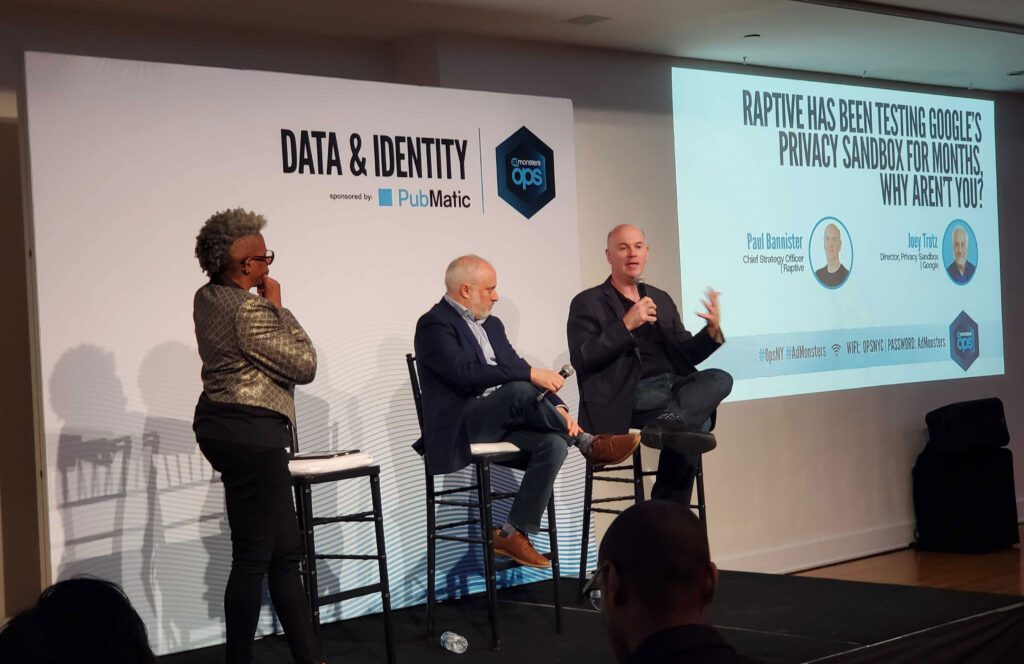
Publishers could be forgiven for dragging their heels on testing the cookie alternatives in the Chrome Privacy Sandbox. There’s been a delay or two on the phaseout of third-party cookies, after all.
But Google swears it’s serious about its 2024 deadline.
“One hundred percent, we are deprecating the third-party cookie in the second half of 2024 – full stop,” said Joey Trotz, director of Google’s Chrome Privacy Sandbox initiative, speaking at an AdMonsters event in New York City last week.
Google does appear serious. It recently announced that the Privacy Sandbox APIs – including the recently rebranded FLEDGE, now called the Protected Audience API – will be generally available starting in July.
That means publishers have roughly one year to get acclimated.

Don’t wait until Google deprecates
Publisher ad network Raptive (formerly CafeMedia) has been working with Google on testing the Privacy Sandbox since Google first announced its cookie deprecation plans in 2020.
Publishers have the opportunity now to raise any red flags to regulators, such as the UK’s Competition and Markets Authority, said Paul Bannister, Raptive’s chief strategy officer, who joined Trotz onstage at the event.
Digital advertising is being rebuilt, and mechanisms could be baked into the system that put some companies at an advantage – and others at a disadvantage. “Now’s the time you can actually start digging in and looking at it and say, ‘This thing is unfair. This doesn’t work,’” Bannister said.
Publishers that start testing the Privacy Sandbox APIs now will also be in a better position when third-party cookies are gone, Trotz said.
“I guarantee you’re not going to just drop in Topics on July 1, 2024, and have your revenue be what you want it to be without a cookie,” he said.
Two testing modes
There will be two major testing periods for the Privacy Sandbox before cookie deprecation begins in 2024.
The first will start in Q4 of this year when all ad tech companies will have the opportunity to ignore third-party cookies on 10% of their Chrome traffic. During this period, to facilitate A/B testing, impressions will be labeled as cookieless or not.
Then, in Q1 2024, Google will deprecate third-party cookies for 1% of all Chrome traffic globally before fully killing cookies in the second half of the year.
“That is the very beginning of deprecation,” Trotz said, “and that’s when the really hardcore testing starts.”
End-to-end testing
For targeting and attribution to work without third-party cookies, each step in the programmatic auction process has to be changed to accommodate a totally new way of buying ads, Bannister said.
End-to-end testing – from publisher to SSP to DSP and back – requires that all players in the supply chain are ready to transact using the Privacy Sandbox APIs.
Prebid has been particularly proactive in reorienting its systems to adhere to the Privacy Sandbox. For a publisher to start testing the sandbox in Prebid today, like Raptive has been, all it needs to do is update Prebid to the latest version and update its exchange endpoints.
Although some early tests by ad tech vendors have produced underwhelming results, Raptive isn’t discouraged.
“The biggest thing we’re happy about is that it’s winning auctions,” Bannister said. “The numbers are very small … but it’s beginning to be a real thing.”
The revenue that comes from these auctions is incremental, he added, so publishers can earn a little extra money while gathering testing data.
And the work continues. Raptive is still setting up other paths for testing as other SSPs and some DSPs reconfigure their systems.
Privacy Sandbox isn’t everything
Yet some supply-side and demand-side platforms are lagging behind, Bannister said.
But even if they weren’t, the sandbox isn’t a panacea that will cure everything ailing the ad industry.
It’s important to keep in mind, for example, that the Privacy Sandbox won’t help advertisers target iOS users who use the Chrome browser.
All browsers that operate on iOS devices are required to use Apple WebKit, which is the underlying tech for the Safari browser, Trotz said in response to a question from Scott Messer, a sell-side consultant and Leaf Group alum.
That blind spot demonstrates that, even though Google controls a huge chunk of the digital ad ecosystem, its cookie alternatives won’t address every area of signal loss. Publishers will have to take a “patchwork quilt” approach to cookie alternatives, Bannister said.
“The sandbox is probably the biggest single solution because Google is the biggest single buyer, and therefore that’s where a lot of money’s going to flow through,” he added.
But that doesn’t mean publishers shouldn’t also experiment with alternative IDs like The Trade Desk’s UID2 or contextual targeting and Seller Defined Audiences.
“Pick your battles,” Bannister said. “You can’t do 100 of them, but try and find out who the winners are going to be and get ahead of those.”







