

Even the experts at companies whose future depends on explaining the value exchange of personalized advertising to consumers struggle to make a convincing argument.
“It’s amazing that an industry that creates messaging to sell things to people has done such a poor job communicating this very basic value exchange,” said Ana Milicevic, principal and co-founder of digital consultancy Sparrow Advisers, speaking at LUMA’s Digital Media Summit earlier this week.
Part of the problem is that the ad industry’s MO has been to “overcomplicate” matters, said Lauren Wetzel, chief operating officer at InfoSum.
For evidence, just look at the overly crowded identity vendor landscape.

Investment bankers like LUMA Partners have made “a lot of money” out of all that complexity, Wetzel said.
“But let’s get back to the basics,” she said. “This is about having a transparent relationship with the customer where there is some sort of value exchange and they really understand what we’re doing with their data.”
Easier said than done, though – at least for the many hundreds of ad tech companies jockeying for position in the background … companies that only blip onto the average consumer’s radar when one of them gets caught up in a privacy scandal.
Because, although people do love free stuff – ask most consumers whether they want to pay for access to content or whether they prefer the free option and “it’s the free option all the time,” said 33Across CEO Eric Wheeler – they’re usually in the dark about what they’re giving away in exchange for their data.
It all depends on how you ask the question, said Brian Lesser, CEO and chairman of InfoSum.
Asking people if they want access to free content is a very different question than asking them if they want free access to content in exchange for sharing their data with possibly hundreds of companies they’ve most likely never heard of.
“Nobody cares about privacy in the US,” Lesser said (nobody, really, Brian??). “But I think there is a wave coming of consumers who might be willing to pay a little more to not have to share their data.”
One solution, oft suggested, is to give people more transparency into what’s done with their data. Middlemen, emerge ye from the shadows and tell us what you’ve done.
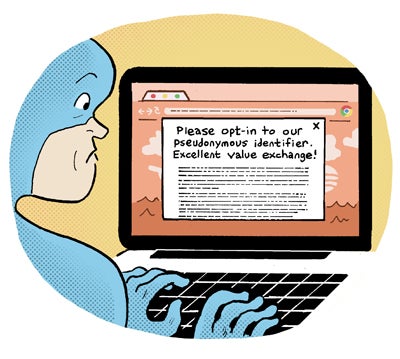
But there are only so many pop-ups asking for tracking permissions that any one mere mortal of flesh and bone should be asked to endure.
And so the debate continues, but something’s gotta give. Otherwise, regulators are going to step in.
“Europe shows us that [the solution] has to come from within rather than waiting for regulators to dictate what occurs. Otherwise you end up with a terrible user experience with people clicking ‘accept’ and not knowing what they’ve agreed to,” said Samantha Jacobson, chief strategy officer at The Trade Desk.
“Consumers wouldn’t know who 70% of the companies in this room are,” Jacobson said. (That’s being generous, Samantha.) “The onus is on us to make a more seamless experience, so we’re not looking to legislators to tell us how we can and can’t behave.”








