
How Ad Networks Ruin Everything; The Challenges Of Government Data Governance
Everything is (or becomes) an ad network. And then it gets ruined. Plus, there’s something the Trump administration has in common with the ad tech world.

Everything is (or becomes) an ad network. And then it gets ruined. Plus, there’s something the Trump administration has in common with the ad tech world.

Forecasters expected tariffs would impact advertising growth projections. But that was before we knew exactly how steep these tariffs would be – and now that we do, it doesn’t bode well.

What’s old is new. Time is a flat circle. Trends are cyclical. Choose your idiom, because this week’s episode grapples with two topics that are back in style (so to speak): bot traffic and the tantalizing dream of scaling programmatic in-game advertising.

Enjoy this weekly comic strip from AdExchanger.com that highlights the digital advertising ecosystem …

No, “ROMO” doesn’t have to do with the former Dallas Cowboys quarterback. Plus, X is dealing with the fallout of a massive data breach.

WPP has bought InfoSum, a data clean room and collaboration startup. Terms of the deal, announced on Thursday, were not disclosed.

After six months of pilot testing with The Trade Desk, Spotify launched its ad exchange on Wednesday and added new supply and demand partners to the mix.

As most generative AI search engines focus on general adoption and subscription licenses, Perplexity AI is zagging toward advertising and commerce applications.

Audience suppression may be the missing link between annoying a consumer and building a lasting relationship.

The Google PMax whisperer releases his latest annual report; publishers brace for more disruptions from Google search updates; and stolen content is the least of Wikipedia’s gen AI concerns.

While advertisers’ interest in gaming may be growing, their spending commitments seem stuck on pause, judging by Tuesday’s IAB PlayFronts event.

To say that David Jones, CEO and founder of The Brandtech Group, is bullish on generative AI would be an understatement. “Every single facet of marketing can be done better, faster and cheaper using technology and AI,” Jones says. “I’d rather have a fast, efficient machine than a slow, grumpy creative with a big ego.”

Does AI kill authenticity? Or is it just another evolution of content creation? And does it even matter? After all, consumers say they care about authenticity, but their actions don’t always match their words.

No punches pulled in another Senate hearing on Big Tech’s excesses; Nielsen’s lawsuits accusing competitors of IP infringement keep getting dismissed; and investors grow wary of Reddit’s closeness to Google.

Why is programmatic media buying so dang complicated? That question was an ever-present topic at the 2025 ANA Media Conference in Orlando, Florida this week.

Roblox is making major additions to its still-nascent ad offering, including new integrations to make its ad formats available through Google Ad Manager.

Comcast is trying to win over digital-native and social-savvy marketers for with its recently launched Universal Ads, a self-serve ad buying platform that makes it easier for SMBs to buy streaming TV inventory.
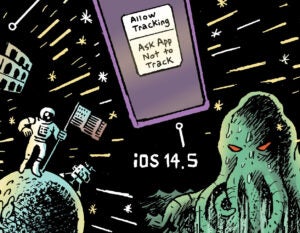
2025 will be the first year YouTube wins at ad revenue. Plus, d’ya hear that? It’s the sound of the mobile ad tech ecosystem saying, “We told you so.”

Industry experts agree that the bot activity analyzed in the latest Adalytics report is among the easiest type of invalid traffic to spot.

Privacy lawyers and ad tech folks often don’t speak the same language. But at least now they’ve got an acronym in common: MSCA.

The wave of CDP consolidation is riding strong. Plus, AppLovin CEO Adam Foroughi responded to reports that short sellers are targeting the company.

An Adalytics report released Friday details numerous instances of brands serving ads to known bots that appear on the IAB Tech Lab’s International Spiders and Bots list and TAG’s Data Center IP List.

Advanced and generative AI are transforming marketing from fragmented workflows into an engine of profitability and growth. Yet, despite AI’s promise, many in marketing remain trapped in outdated systems that fail to deliver.
The IAB Tech Lab is proposing that ad auctions move to a Trusted Server from the browser. Why its prototype attracted controversy. Plus, should data privacy be viewed as a badge of honor, or a baseline standard?

A unit of attention doesn’t serve as a useful indicator of interest or resonance among consumers. So what does? Well, consistency certainly helps.
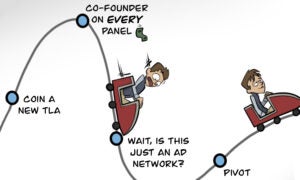
Enjoy this weekly comic strip from AdExchanger.com that highlights the digital advertising ecosystem …
Google is full-steam ahead with AI Overviews. Plus, don’t post AI-generated pictures in the style of Studio Ghibli.

That car dealership in your neighborhood? It’s probably got a branding problem. Most local car dealerships do.

ISpot’s new solution, called Outcomes at Scale, aims to make outcomes-based attribution easier, faster and more automated across linear and CTV video advertising.
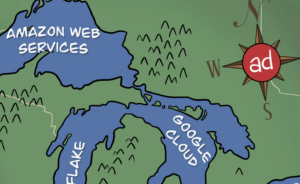
The biggest cloud tech companies, – namely AWS, Snowflake, Databricks and the Google Cloud Platform – are investing heavily in their own ad tech and marketing verticals. But, funnily enough, ad tech vendors themselves tend to avoid the big public clouds.