
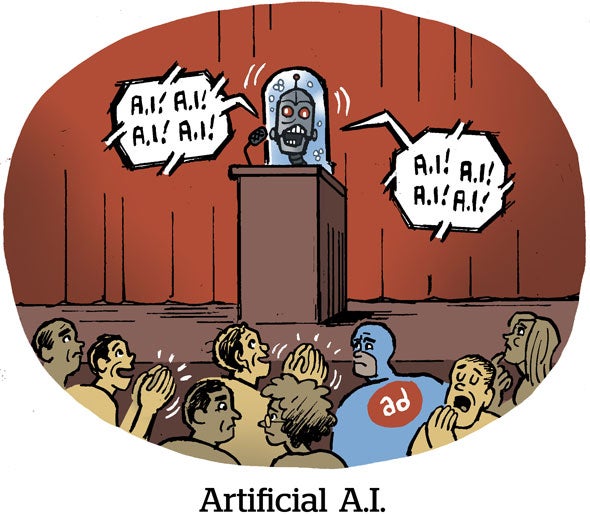
AI Overwhelms
Google is full-steam ahead with AI Overviews (AIOs), the generative responses that now show atop many search queries.
Like, to a crazy degree.
Well, this week, Google AIOs came to users in Europe inviting a wave of litigation.’

Crossing the Atlantic was “a bold move,” noted Thomas Höppner, a competition lawyer and partner at Berlin-based firm Hausfeld, in a LinkedIn post.
Only last week, the European Commission ruled against Alphabet, finding that Google Search should be considered a gatekeeper service when it displays something other than link-based site rankings in search results.
The commission cites sports results, financial info (like stock tickers), travel booking services, shopping and transport help. Those are all distinct service categories, per the EU Commission, and Google must provide a fair chance to third-party alternatives.
But Google isn’t offering third-party alternatives to AIOs.
Meanwhile, AI Overviews are also expected to diminish traffic to European publishers, although Google is deliberately avoiding AI-generated responses for news results.
That’s just in Europe, though. In America and elsewhere, Google is moving forward with a major rollout of AIOs for health-related queries.
As always, what could go wrong?
Princess No-Not-OK
A bit of free advice for all the social brand managers out there: Don’t be tempted to post AI-generated pictures in the style of Studio Ghibli animation.
For starters, you’re already late to the trend by this point. OpenAI announced the new image generator built into its ChatGPT-40 model on Tuesday, using a Ghibli-inspired image as evidence of the tool’s capabilities.
Ever since, Variety reports that users have flooded social media with AI-generated versions of iconic and even disturbing images – like the Saigon Execution – in the style of celebrated director Hayao Miyazaki.
(Why Ghibli, you might ask? Likely because Japan’s legal system is soft on AI-related copyright infringement. But that’s neither here nor there.)
Miyazaki himself is notoriously against the use of AI tools in animation. When presented with a demonstration of a computer-animated project in 2016, he said, “I strongly feel that this is an insult to life itself.”
But personal and/or moral objections aside, one would hope this gives pause to advertisers that are already worried about a lack of AI-generated content guardrails. After all, what’s protecting copyright holders who don’t have the same name recognition as Miyazaki?
Links For Me, Not For Thee
Since Elon Musk purchased X in 2022, the platform has taken a hard line against linking to external sites.
Musk has come just shy of outright admitting that X limits the visibility of posts that contain outbound links. But internet sleuths have demonstrated how X’s algorithm throttles any attempt to click through to a third-party site.
As a result, digital publishers have seen referral traffic from X crater.
But, apparently, Musk fiercely opposes any effort to limit linking to his own platform.
In response to Musk’s shady version of a Sieg Heil salute during President Trump’s inauguration in January, at least 100 Subreddits banned posts with links to X. Musk then pressured Reddit CEO Steve Huffman to end the X bans, The Verge reports. Musk’s pressure campaign also reportedly pushed Reddit to crack down on content identifying members of Musk’s Department of Government Efficiency.
Musk famously loosened content moderation on X after buying it and then decried government actors’ attempts to influence moderation decisions on social platforms. So maybe think of Musk getting involved in Reddit’s content moderation as just another bit of hypocrisy.
But Wait! There’s More
Meta is getting into a controversial new ad agency practice: principal-based trading. [Digiday]
A new Utah law makes app stores responsible for age verification. [TechCrunch]
Google makes a small but important policy change in targeting spam as a technique rather than a form of content. [Search Engine Roundtable]
Direct Digital Holding’s sell-side business, Colossus, reports a 92% YOY decline in Q4 revenue, with overall revenue decline of 78%. [release]
You’re Hired
Dan Hagen is the new global chief data and technology officer at Havas. Jamie Seltzer takes on Hagen’s former role as global chief data and tech officer at Havas Media Network. [release]







