
Elon Musk has taken a sledgehammer to Twitter’s established ad business since his $44 billion purchase of the platform went through last Thursday.
Musk’s promises to overhaul Twitter’s content moderation and user verification policies have caused brands and agencies to rethink their budgetary commitments to the platform. Plus, Musk’s seemingly disingenuous tone shift on advertising and his tweeting of fake news may make brands more inclined to pull budgets from a platform that was never seen as a must-buy anyway.
And his reported plan to cut 3,700 jobs – about half of Twitter’s headcount – is creating further uncertainty.
Agency holdco IPG advised a one-week hold on Twitter ad spending “until we have more clarity on Twitter’s plans for trust and safety, as well as the organizational capability to deliver on those commitments,” said a person familiar with IPG’s guidance. Havas also advised a pause pending clarification of the platform’s new direction.

Goodway Group is taking a “wait and see” approach.
“If a solid, thoughtful strategy is put out to advertisers, and that doesn’t conflict with your brand’s belief systems, then you can move forward,” said Amanda Martin, SVP of corporate development and strategic partnerships at Goodway Group. “But a quick tweet [from Musk] isn’t going to get spending paused or un-paused.”
GM, a competitor of Musk’s Tesla brand, was the first major advertiser to pause its Twitter spend. General Mills, Mondelez International, Pfizer and Audi, another Tesla competitor, have since followed suit.
Advertisers likely won’t be satisfied by anything short of assurances from Musk himself, said Matt Barash, SVP of Americas and global publishing at Index Exchange.
“For Twitter’s advertising business to survive, Musk is going to have to sit down with Fortune 500 CMOs and investment leads at holding companies to clearly define what his plan is, what his vision is, what ad product will look like and why they should invest money into a platform that is rife with controversy,” Barash said.
But it’s unclear at what scale those meetings are happening. Goodway Group has yet to take any meetings with the Twitter team, Martin said.
According to a tweet by Jason Calacanis, an investor and entrepreneur who has lobbied for the Twitter CEO position and who became one of Musk’s closest advisors in the leadership transition process, Musk and his team have been meeting with agencies and brands this week.
At least one agency holdco, Omnicom Media Group (OMG), confirmed that these meetings are taking place. “We are in close contact with Twitter as we assess the impact of new ownership and potential changes in their strategy,” OMG said in a statement. “It’s understandable that uncertainty of this kind raises concerns among advertisers, and we are providing guidance to clients so they can make informed decisions.”
And WPP and its clients, including Coca-Cola, Unilever and Google, held a video meeting with Musk in which he affirmed Twitter’s safety for brands, the Wall Street Journal reported.
But if brands and agencies expect to be meeting with familiar faces, they’re out of luck. Many of Twitter’s key executives on the ads side of its business have already been fired or departed from the company, including Chief Customer Officer Sarah Personette, Chief Marketing Officer Leslie Berland and VP of Americas JP Maheu, who led Twitter’s agency partnership and brand strategy teams.
Personette, Berland and Maheu were “the trusted faces of Twitter for advertisers,” tweeted Lou Paskalis, President and COO at MMA Global, a marketing trade association. Their departure is “a likely death knell for the platform’s viability as an ad-supported platform in the near term.”
Personette’s resignation from the company was especially jarring. On the day Musk’s acquisition went through, Personette tweeted that she “had a great discussion” with Musk and that “our continued commitment to brand safety for advertisers remains unchanged.” She assured advertisers that she was optimistic about Twitter’s future. But then she resigned from the company the next day. So much for feeling optimistic.
Personette is believed to be the driving force behind Musk’s letter assuring advertisers that Twitter will not become a “free-for-all hellscape” under his leadership, according to Axios’s Sara Fischer.
But, coming from Musk, who once tweeted, simply, “I hate advertising,” that letter seems to have landed with a thud. Actions speak louder than “a hastily written Notes app message,” said Ana Milicevic, principal at Sparrow Digital Holdings.
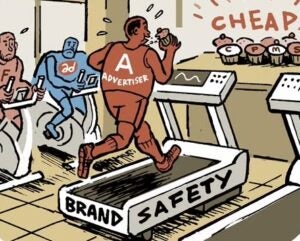
Brand safety in peril
That being said, Musk’s recent actions on the platform offer little encouragement for Twitter’s future approach to brand safety.
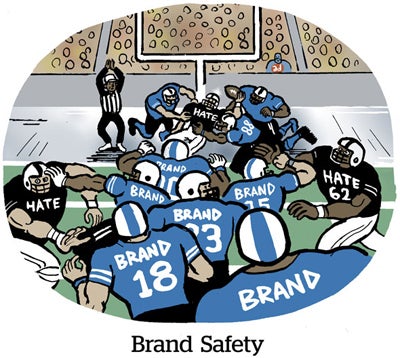
Twitter’s brand safety partners have been quiet so far on the changes brewing. IAS and DoubleVerify, which track ad adjacencies on Twitter for brands using the platform, declined to comment for this story.
If advertisers are worried that Musk’s stance as a “free speech absolutist” will result in fewer restrictions on misinformation and trolling, Musk himself has given them cause for concern.
Days after taking control of Twitter, Musk responded to a tweet by Hillary Clinton about the recent assault on House Speaker Nancy Pelosi’s husband by sharing a link to an article from a dubious news site that detailed unfounded conspiracy theories about the incident.
The site in question, the Santa Monica Observer, “fails to adhere to several basic journalistic standards,” according to NewsGuard, a media watchdog that offers brand safety guidelines for advertisers. NewsGuard assigned the site a 12.5 out of 100 trust score. By sharing the Observer’s content with his more than 110 million Twitter followers, Musk betrayed a lack of media literacy, which doesn’t bode well for his content moderation plans.
This ill-advised interaction coincided with the largest single-day dip in Twitter ad spending that MikMak, an ecommerce analytics platform, observed over the past month. Overall, MikMak saw a 30% decrease in Twitter ad traffic this month among brands using MikMak’s platform, including a 42% dip over the past week since Musk’s takeover, a sign that advertisers are pausing or rethinking spend on the platform.
Musk later deleted his tweet promoting the story. Then, when called out for his lapse in judgment, he resorted to trolling The New York Times.
The next day, Musk once again affirmed Twitter’s commitment to brand safety in response to a tweet from Global Alliance for Responsible Media (GARM) lead Robert Rakowitz.
But then, on Wednesday, Musk trolled advertisers by tweeting a poll that suggested advertisers must choose between “political ‘correctness’” or “freedom of speech.”
“Should Mr. Musk choose to remain a participant and provocateur on Twitter, it’s likely the platform is headed deeper into the world of toxicity and partisanship. If that happens, Twitter is doomed, from the perspective of advertising revenue,” wrote Rob Norman, a former senior executive at WPP, in an editorial for The New York Times.
So why bother?
Making matters worse for Twitter, its inventory is hardly considered a “must-buy” for advertisers, Milicevic said. Its 2021 revenue was “less than a twentieth of Meta’s and less than a fiftieth of Alphabet’s,” wrote Norman.
If marketers do pull their budgets from Twitter, programmatic channels could benefit because of the ease advertisers have in starting and stopping campaigns on those channels, Barash said.
“The easiest diversion would be to other social channels,” Milicevic said. “Transitioning to a banner campaign seems less likely.”
Basically, advertisers have plenty of better options at their disposal, particularly as they enter a crucial Q4 ahead of a likely economic recession next year.
“The interesting thing about Q4 is that there are always people willing to spend your money, should you need to move it,” Martin said. “CTV is probably going to be the hardest channel to move money into because there’s already a ton of demand and shorter supply. I would suggest brands try emerging channels that they weren’t going to put into their Q4 mix as a testing opportunity.”