
PODCAST: AdExchanger Talks
Zoom’s Next Act
Zoom CMO Kim Storin has one of the rarer jobs in marketing: She’s responsible for promoting and evolving a brand that’s also become a verb.

Zoom CMO Kim Storin has one of the rarer jobs in marketing: She’s responsible for promoting and evolving a brand that’s also become a verb.

InMobi acquires Apple ad startup MobileAction; the hallucination problem is real; and microdrama are being nonconsensually “nudified” with AI tools.

Magnite posted strong Q1 numbers and is confident that it will prevail in its battles with both Google and The Trade Desk.

Programmatic enemies make better friends in the AI era; social video projected to outgrow CTV this year; and apps are integrating into chatbots, but where are the users?

OpenAI announced a CAPI, along with the public launch of its self-serve ads manager, as the latest features of its rapidly evolving ads business.
Google is launching Meridian Studio, an enterprise version of its Meridian media mix modeling platform and an updated open-source version of its GeoX tool for measuring incrementality across geos.

Take your sunglasses off for this one. Fresh off the POSSIBLE conference in Miami, our reporters debrief on how the marketing industry addressed the subject du jour: AI. Plus: the topics that were conspicuously absent from the conference.

AdExchanger Senior Editors Alyssa Boyle and Anthony Vargas share their takeaways from three days chatting about agentic AI at POSSIBLE.
Amazon is optimistic about agentic commerce; the costs of AI may soon outweigh profits; and AMC Global Media thinks old shows deserve new ads.

Meta’s Q1 call sounded like an AI and hardware pitch, but under the hood it was still about one thing: investing in AI to squeeze more money out of its ads business.

We can’t simply trust AI to make up for bland creative with sheer volume. The real performance shift happens when we use AI to push creativity further.

Dappier’s new ad format allows advertisers to insert a custom brand agent into AI chat sessions on publisher sites.

Buyers want a single, coherent view of reach and performance across programmatic. But for publishers, the operational reality is quite messy. Trusted Media Brand is using AI to clean it up.
AI search is cautiously testing competitor-targeted ads; publishers’ prediction widgets risk backlash despite engagement gains; and Trump library donations from media companies face transparency questions.

Agentic commerce company Envive builds on-site agents for brands like footwear company Clove, painting a clearer picture of what their customers are looking for.
With RFPs in flux, diverse-owned media companies are finding ways to use their data to improve reach. Plus: Why we’re in retail media’s “potty-training” phase.

OpenAI has its own tracking pixel; Amazon sellers are boycotting the platform; and DirecTV hops on the CAPI bandwagon.

Kim Rosenblum, CMO of investment app Betterment, unpacks her “anti‑marketing” playbook, which involves telling customers not to engage and shifting away from chasing cheap CAC to prioritizing lifetime value.

Opal launched Gem, a new AI solution, to help large brands unify the layers of media and tech within their organizations.

Mula’s AI native content feed helps On3 keep its engagement and RPS consistent amid traffic drop-offs to publisher sites and the growing scarcity of online attention.

AI is only as good as the data that fuels it. In advertising, however, that foundation is often flawed.

ChatGPT’s ads manager leaves something to be desired; beware booking vacations via search ad; and YouTube is jacking up its premium prices again.

Measurement and performance are expected to dominate convos at upfronts; Tubi doubles down on AI; and Meta takes down ads encouraging anti-Meta lawsuits.
Every company wants an AI-powered product. So what do they all look like? From A/B testing and media optimization to agentic interfaces for customers, we give a rundown on AI’s most popular applications in ad tech.

We now have plenty of evidence that AI can be an incredibly useful tool. But proof is also piling up that it erodes our creativity.
Medvi caught in AI deepfake scandal; Delta SkyMiles members get 24-hour free NYT access. Source Golf launches a YouTube network.

The industry has spent years debating third-party cookies, but AI has settled the debate. First-party data isn’t just preferred; it’s structurally necessary. And the capital is already moving.

Sonia Chung, Boathouse’s new CSO, wants to help the agency (and the industry at large) take full advantage of its data.

Swivel and Olyzon’s new partnership brings buy-side and sell-side agents together as early examples of an agentic marketplace.

Machines can now flag anomalies, surface trends and spin insights in seconds. Yet, even with its speed, AI still can’t decode the “why” behind the “what.”
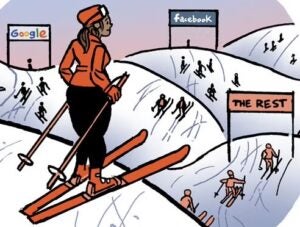
AppLovin is growing at a blistering pace, but Wall Street investors remain cautious about the business.
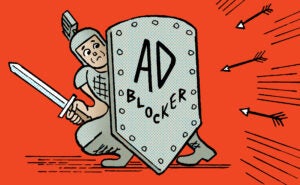
High-end ad blockers mimic some of the same behavior as bot traffic. So WiseGuyGaming repurposed the tools it was already using to identify bots to reveal its ad-blocking audience as well.
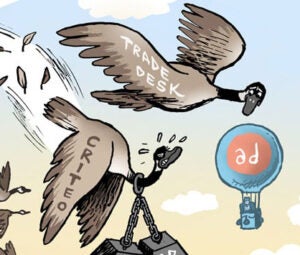
Criteo has weathered considerable storms in its day, including a painful moment in March 2020 when its market cap bottomed out below $500 million. Can it pull off yet another turnaround?

Disaffection and outright anger toward US sports institutions run deeper than logo-cluttered fields. Leagues and teams are sacrificing player safety and fan enjoyment for marketing dollars.

People Inc.’s referral traffic from Google search is down 70% over the past two years, and by 26% in Q3 alone. But its digital revenue is still growing, albeit slowly.
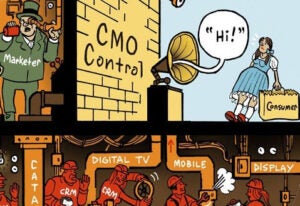
On Tuesday, Chord, a six-year-old commerce tech startup, acquired Zenlytic, an AI startup with an anthropomorphized data analyst agent named “Zoë,” for $5 million.