Just Show Me The Game
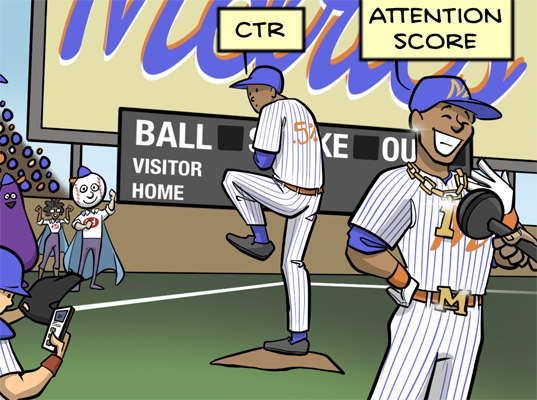
Netflix streamed its first-ever MLB game Wednesday night after securing the Opening Night broadcast rights last year.
And, as many critics noted, the inaugural game between the San Francisco Giants and New York Yankees felt like a Netflix showcase with a side of baseball.
An AdExchanger reporter who caught the broadcast received a pop-up notification at the start informing them that the platform shows ads during live programming, even though they paid for Netflix’s ad-free tier.

The ad experience included the typical streaming ad pods, as well as dynamically inserted ads behind home plate. But Netflix’s on-field self-promotion was much more in your face.
Netflix took over McCovey Cove, the part of the San Francisco Bay located just outside the right-field wall of the Giants’ Oracle Park. Comedian Bert Kreischer – who has a sitcom on the streaming platform – led a fleet of Netflix-branded kayaks, accompanied by giant floating Netflix logos.
In a distracting on-field interview, announcers chatted with Yankees infielder Jazz Chisholm Jr. for an entire half inning. Chisholm was wearing accessories inspired by the “One Piece” anime – which just so happens to have a live-action adaptation on Netflix!
Speaking of distractions, Netflix’s first-ever baseball broadcast missed the first-ever time a player challenged a strike call during an MLB game – the broadcast was busy interviewing the Giants’ manager in the dugout.
So Netflix missed baseball history because it was doing too much to meet its own history-making moment.
Data Centers Of Attention
The bad news for Big Tech companies is that a lot of consumers aren’t jazzed about AI – and the backlash has moved beyond AI-generated creative.
AI data centers are expensive to build and operate, they consume lots of electricity and many locals are less than enthused about having one nearby.
But opposition has now reached the point where it’s forcing some major tech companies – including Google, Microsoft and Meta – to rethink or delay some of their planned data center projects, The New York Times reports.
Last year, $156 billion worth of data center investments were blocked or stalled due to “coordinated local opposition,” according to NYT.
The slowdown in data center expansion could end up being a major setback for tech companies that have staked their growth on new AI infrastructure – and to advertisers eager to use AI tools.
But perhaps Big Tech will turn this experience into a teachable marketing moment by, say, heavily subsidizing electricity costs in states or locales that house their new data centers.
More likely, though, they’ll spend millions trying to advertise their way out of a problem they helped create.
Risky Business
Elon Musk’s attempt to turn the advertiser exodus from X into an antitrust conspiracy hit a legal dead end.
On Thursday, US District Judge Anne Boyle dismissed X Corp’s lawsuit accusing major brands and industry groups of working together to withhold ad spend from the platform, BBC reports. The case hinged on the claim that companies like Unilever, Mars and members of the World Federation of Advertisers acted against their own interest by pulling back spend on X, formerly known as Twitter.
The court found no evidence of coordination. Rather that brand marketers and advertising industry orgs came to separate, similar conclusions about advertising on the platform.
Advertisers and publishers had plenty of brand safety concerns when Musk first took the X throne. He actually told the whole cohort of marketers to “go eff themselves.” (Our expletive deleted.)
In the months following Musk’s acquisition, X scaled back on content moderation and reinstated previously banned accounts, which led to a rise in controversial content. For advertisers, that translated into reputational and monetization risks.
“The very nature of the alleged conspiracy does not state an antitrust claim, and the court therefore has no qualm dismissing with prejudice,” writes Judge Boyle.
But Wait! There’s More!
Marketers shift growing shares of search spending to GEO. [Digiday]
US lawmakers are pressing Tulsi Gabbard on whether using a VPN can strip Americans of constitutional protections against warrantless surveillance. [Wired]
OpenAI has shelved its erotic chatbot “indefinitely.” [The Verge]
CFOs believe AI is paying off. Researchers aren’t so sure yet. [Fortune]
The European Commission is looking into Snapchat and several porn sites over allegations that they fail to protect children and minors online. [Bloomberg]
MiQ acquires Adsmovil, a Latin American programmatic provider. [release]
You’re Hired!
Horizon Media Holdings names Bhavana Smith as its chief operating officer. [release]
Privacy compliance platform Boltive brings on Ellen Kamor as CRO and Christine Desrosiers as chief product officer. [release]
Local TV ad platform Locality appoints Kouros Esfahany as CTO. [release]
Here’s today’s AdExchanger.com news round-up… Want it by email? Sign up here.