
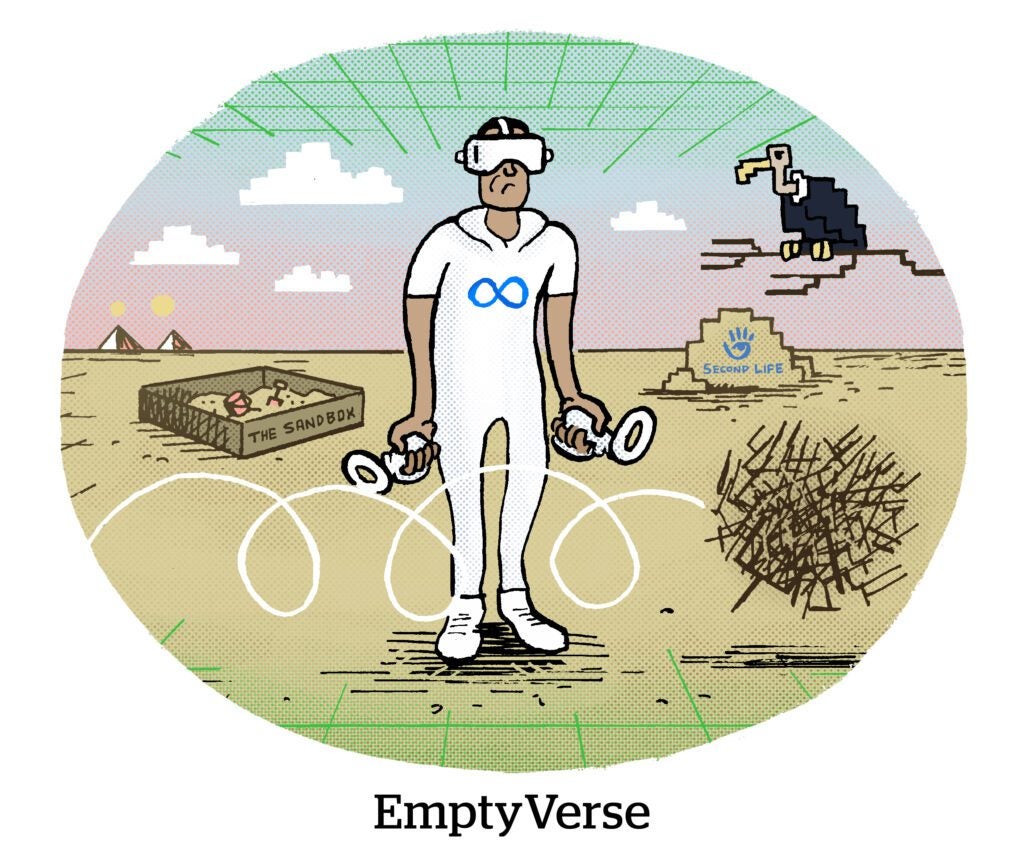
Meta’s Bad Bets
The metaverse is all but dead, and its demise is a cautionary tale for Big Tech’s AI ambitions.
In December, Mark Zuckerberg instructed Meta’s business divisions to cut expenditures by 10%, Fast Company reports. But Reality Labs – the group responsible for developing metaverse hardware and experiences that reportedly lost $73 billion in five years – cut spending by 30%. As a result, Meta laid off 1,000 employees from Reality Labs this week, according to Bloomberg.
It appears the metaverse – once projected by McKinsey to be a $5 trillion market by 2030 – is ending with a whimper.

Now, with AI stepping in as Big Tech’s new shiny object, it’s worth reflecting on the metaverse craze to understand “why such a delusional fervor took hold so that we can inoculate ourselves as the next one spreads,” writes Edward Ongweso Jr at Fast Company.
According to Ongweso, Meta’s search for new revenue lines beyond its insanely lucrative ad business has largely fallen flat. There was the finance and cryptocurrency period, not to mention gaming and hardware.
AI-powered easy buttons for marketers are Meta’s next attempt at reinventing what it’s always done best. But whether AI proves transformational or ends up as another of Zuckerberg’s failed pet projects remains to be seen.
Widening The Net
While Meta retreats from the non-toehold it never had in the nonexistent metaverse, Netflix is building up a head of steam as it expands into new channels.
Take live sports.
As the proverbial tentpole supporting pretty much the entire TV industry and an anchor for most streaming subscriptions, live sports is a major opportunity. But live sports broadcasts pose a unique technical challenge for Netflix, as The Wall Street Journal reports.
But, hey, live sports is also its entree to the $70 billion TV ad market, so Netflix is keen to work out the kinks.
And then there’s podcasting. After years of occasional toe-dips into the podcast market, Netflix is finally diving in, according to Bloomberg. It’s hoping podcasts will flourish the way reality TV and standup specials have on its platform.
Oh, and we can’t forget about the gaming market. Just a few weeks ago, Netflix came storming out of left field with the news that it – and not Electronic Arts – will produce the new FIFA video game title this year, the first since the organization’s acrimonious 2023 split with EA over licensing rights.
Guilt By AI-ssociation
The problem with labeling everything as “AI-powered” is that it lumps in tools and techniques platforms have used for years, giving AI critics an easy target for scrutiny.
Case in point: In advance of this week’s National Retail Federation Big Show, Google announced its new Universal Commerce Protocol (UCP) for powering AI shopping agents across Shopify, Etsy, Wayfair and Target.
Almost immediately, economist Lindsay Owens, who serves as the executive director for progressive advocacy group Groundwork Collaborative, seized on the announcement’s mention of “personalized upselling” to accuse Google of implementing surveillance pricing tactics.
“They’ll be working with some of the biggest names in retail to swap data and train their algorithm into a price gouging behemoth,” Owens wrote.
In a statement to TechCrunch, Google claims that Owens’ objections are fundamentally incorrect. Apparently, the inclusion of “personalized upselling” in Google’s AI road map refers to an agent being able to make personalized product recommendations, something that was already possible long before the AI hype train left the station.
Which is exactly the problem. Neither personalized upselling nor dynamic pricing are new, but their tangential connection to AI has more users paying more attention to these practices – and not always liking what they see.
But Wait! There’s More!
Mobile performance marketing platform Liftoff files for an IPO on the Nasdaq. [Investing.com]
Microsoft announces a new “community-first” AI initiative and claims it won’t increase the electricity bills of the neighborhoods around its data centers. [blog]
SuperAwesome acquires kid-focused podcast company Starglow Media. [Deadline]
Being against AI is becoming an effective brand marketing strategy. [Adweek]
So much for entrepreneur creators – even MrBeast claims he’s cash poor right now. [Fortune]
What Apple and Google’s Gemini deal means for both companies. [The Verge]
AI-generated imagery that depicts women in bed with celebrities is now being used to advertise and monetize adult content on Instagram. [404 Media]
Automated investment platform Betterment confirms hackers accessed users’ personal data, but de-indexes its announcement of the hack from search. [TechCrunch]
You’re Hired!
Jaclyn Nix joins Kevel as chief operating officer. [release]
Digital gifting startup Nift appoints Yahoo veteran John McNerney as general manager to lead its APAC expansion. [release]
Sally Shin moves to CNBC as EVP of growth and partnerships. [release]
Madhavi Tadikonda has been named senior director of network sales at E.W. Scripps. [TVNewsCheck]
Thanks for reading AdExchanger’s Daily News Roundup. Want it by email? Sign up here.








