
Replacing TV upfront presentations with client dinners originated with Paramount in 2023. Roku followed suit last year under the leadership of Jay Askinasi, who appreciated the approach when he was on the buy side. Askinasi left Roku to become Paramount Skydance’s chief revenue officer late last year, but Roku continued the tradition.
This year, Roku hosted several client dinners with all of the major holding companies as well as independent agencies in April, each with about 70 people per dinner.
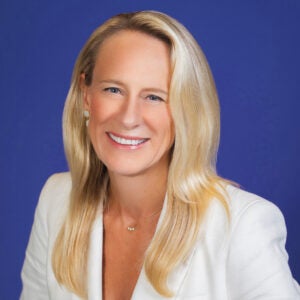
Allowing for a two-way dialogue with clients allows Roku to “address their business priorities [while] actually in the room,” which leads to deeper conversations with marketers about their needs, Lauren Benedict, Roku’s VP of global ad sales and partnerships, told AdExchanger.
Lately, Benedict said, those business priorities include programmatic options, custom brand integrations and, of course, ad performance.
AdExchanger asked Benedict to outline how Roku is working with buyers heading into upfront negotiations.
AdExchanger: What are Roku’s top priorities in working with buyers this upfront season?
Lauren Benedict: This year, our objective is establishing how we can help brands and agencies navigate the challenges that come with media fragmentation. We position ourselves as a full-funnel option for marketers that can drive the business outcomes they’re looking for.
That focus on full-funnel is also part of our rationale behind hosting intimate client dinners in place of a formal upfront event, in the sense that we’re trying to combine the objectives of both NewFront and upfront weeks.
Speaking of business outcomes, performance is a top focus for arguably the entire industry – how does Roku approach performance?
Performance can mean something different to every brand; to some, that can mean upper-funnel metrics like reach and brand awareness. When I was at Hulu, I remember brands really started to take notice of streaming as a worthwhile investment once they were able to transact and measure it on par with linear TV advertising. Now, we’re seeing something similar with digital technology helping streaming ads achieve and demonstrate lower-funnel metrics akin to search and social.
Which isn’t to say streaming is exactly like-for-like with those digital platforms where last-touch attribution models are common – streaming is still often happening via the big screen on the wall [where people don’t really click around the same way they do on a personal or handheld device]. But digital infrastructure, like self-serve platforms, make it possible for marketers to run streaming ads with a focus on conversions, such as through integrations with mobile measurement providers (MMPs), many of which have outcomes-based measurement baked into their solutions.
Integrations with retail media networks (RMNs) also make shoppable ads possible, which marketers can measure with more performance-oriented metrics, such as return on ad spend. That workflow isn’t mainstream yet, but that’s what we’re building toward.
Whether it’s integrations with RMNs, MMPs or demand-side platforms (DSPs), we’re trying to meet the market with how it wants to transact.
Sticking with that last three-letter acronym, where does programmatic fit into Roku’s upfront strategy?
Flexibility is a big part of what we’re hearing going into the upfronts in terms of how advertisers want to transact, which includes more programmatic buying options.
DSP integrations also allow us to help media buyers navigate audience fragmentation. Our relationship with Amazon DSP is a good example: Combining our household footprint with Amazon’s allows us to reach roughly 80% of addressable CTV households in the US.
When it comes to programmatic, the goal is helping brands plan and measure reach and frequency across platforms to improve campaign performance while minimizing ad waste.
How does Roku balance programmatic expansion with the custom integrations and direct relationships that buyers are also asking for?
Customized advertising and programmatic buying don’t have to be mutually exclusive. Curation is becoming a more popular example of how buyers are looking to personalize campaigns. For us, that means making it easier for marketers to pair Roku viewing data with their own data as well as data from other partners, such as RMNs. That way, marketers can create more custom audience segments to achieve their desired outcomes.
And brand sponsorships are often bespoke and bought directly, including custom creative on the Roku home screen or sponsorships surrounding live sports, which is a big driver of streaming growth and competition. Live inventory is still considered scarce, and marketers don’t want to miss out on the chance to be part of significant cultural moments that really resonate with viewers.
This interview has been edited and condensed.
For more articles featuring Lauren Benedict, click here.