


FedEx delivers more than 15 million packages per day in the US. It runs one the largest, most time-sensitive logistics networks on planet Earth.
Last year, it had a 95.3% on-time score for package delivery during the peak parcel season. Wow.
But what if you’re part of the 4.7% percent?
I’d argue a company whose slogan is “The World on Time” either needs to provide a perfect service or respond perfectly when things go wrong.
In my recent experience as an unfortunate member of the 4.7%, FedEx did neither.

You see, it doesn’t matter how many sweaters and cat beds and shampoo bottles and towels and comfy slippers and Christmas presents, vitamins, coffee filters and smartphone accessories you deliver right on time. If you’re not also able to do the same for medications in clearly marked insulated boxes labeled “Time Sensitive” and “Keep Refrigerated,” you’re not just risking one bad review; you’re undercutting the basic trust people place in your brand.
And a marketing slogan like “The World on Time” comes across a little hollow.
‘Your delivery date has changed’
The disconnect between promise and reality is especially jarring at a moment when so many companies, FedEx included, are pouring time and money into AI and other “next gen” fixes.
Clearly, I’m a bit salty, so let me back up. Here’s what happened.
I’m 42 years old, I recently got engaged and I’m doing IVF to freeze a few embryos because, like Mona Lisa Vito in “My Cousin Vinny,” I hear the biological clock ticking.
It’s been an education.
IVF demands extreme precision in the handling and timing of medication to mimic the body’s hormone cycle. Many IVF drugs, which cost thousands of dollars, need constant refrigeration or their proteins degrade fast, potentially ruining the cycle.
Earlier this month, I ordered a course of these meds on a Friday morning for priority overnight FedEx delivery the next day before noon. On Saturday morning before 10 am, when the FedEx store location in my neighborhood opens, I checked my tracking number to see whether it was time for me to swing by to pick up the package. But my delivery date had been automatically updated to Monday before noon.
“Your delivery date has changed. We appreciate your understanding while we work to deliver your package as soon as possible.”
I clicked in to see more detailed tracking information.
At 9:26 am, the tracking log showed a “delivery exception: Customer not available or business closed.” The message included a photo of the front door of the FedEx Office Print & Ship Center on First Avenue in New York City where the package was supposed to be delivered for pickup.
In other words, a FedEx driver had tried to drop off my package at a FedEx location a little over 30 minutes before it opened, marked this as a failed attempt and uploaded a photo of the locked front door.
The operating hours are printed right there on the door. You’d think FedEx, a logistics company, would have that information encoded in its system.
They don’t. And I spent the next four hours trying and failing to get someone to fix a very basic, very time-sensitive problem. I spent so long on hold that I had FedEx’s hold music in my head, earworm style, for days afterward.
The human cost of a miss
Look, I’m a fairly chill individual, but I did get hot under the collar about this one. And that’s without being particularly prone to mood swings, despite all the hormones getting pumped into me.
A lot of people going through IVF are raw and emotional. They deserve to be treated with some compassion. At minimum, their medication should be handled with care, especially if it’s refrigerated, time‑dependent and worth thousands of dollars.
I spoke to at least six different customer-service reps, including managers. At one point, a rep suggested I could go pick it up myself from a depot way downtown, which I wasn’t able to do because I had to leave town for a wedding. Sunday wasn’t an option, either – no deliveries that day – so Monday it was.
I was told by at least two reps that I’d be able to pick up the package from the original FedEx location when the store opened on Monday at 9 am. But when I went there at 9, the manager looked at me like I was a little crazy. The driver, she explained, never comes before 10 unless there’s a special arrangement, and no one had contacted her about anything.
By this point, the package, which should have been in my fridge by shortly after 12 noon on Saturday, had been unrefrigerated for 45 hours.
I finally got my hands on the box by midmorning on Monday, and all you had to do was glance at it to know that it was meant to be an urgent delivery. There was tape all around the exterior with “REFRIGERATE UPON ARRIVAL” in red block letters, “FedEx Saturday Delivery” stamped on the outside and an “SDR” sticker, which is a special tag FedEx uses on Express packages to flag them for weekend delivery.
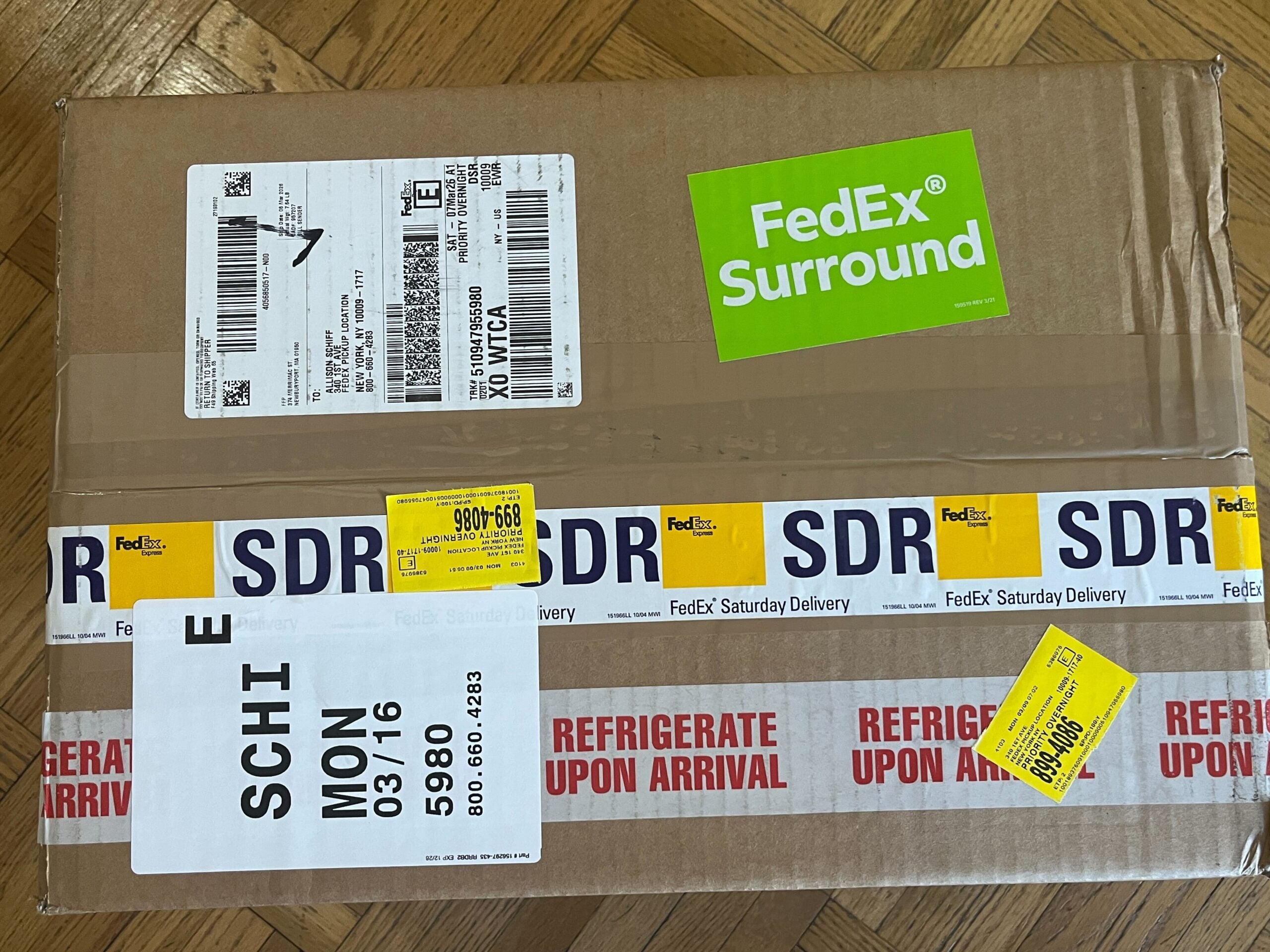
Most packages can afford to be a little late. This one couldn’t, and the box itself made that very clear.
When I opened it, the ice packs were no longer frozen, just slightly cool. I took my chances and used the meds anyway. There wasn’t really another choice. I won’t know for weeks whether they were still fully effective.
But that uncertainty is exactly the point; I shouldn’t have to wonder.
Customers have long memories
I don’t expect FedEx to guarantee that every truck and driver always runs like clockwork. Things fall through the cracks. But the real failure here wasn’t the missed delivery window. It was everything that happened – or didn’t happen – afterward.
When things go awry, businesses have to deal with the fallout correctly, because this is the stuff that customers remember. Some of those customers, like me, have traditional bully pulpits, and others will just take to social media. There are numerous Reddit threads complaining about nearly my exact scenario.
And people do act on those feelings. A PwC survey from 2018, which still feels fresh, found that roughly one in three consumers will walk away from a brand they love after just a single bad experience, and many never come back.
What can I say? Don’t offer overnight priority for medication if you can’t deliver – literally. 🤷♀️
I know one botched delivery doesn’t define a global company. But it does color how I see the kinds of investments FedEx is making.
Over the past few years, FedEx has been building an army of AI agents to work alongside its human workforce. The company wants these systems embedded in more than half of its core workflows by 2028, with software “manager” agents assigning work, “worker” agents carrying out tasks and “audit” agents logging and checking what everyone else does across things like routing, real-time shipment rerouting and marketing campaigns.
In other words, there’s no shortage of ambition and tech on the backend and maybe things will be great in 2028. But those investments don’t mean much, at least not to me, if the basics aren’t reliable, like knowing the opening hours of your own stores or making sure that clearly labeled boxes of medications get where they need to go and by when.
FedEx says it moves “The World on Time.” I’d settle for one refrigerated box of IVF meds.
For more articles featuring Allison Schiff, click here.







